Showing posts with label 2017. Show all posts

Monday, December 11, 2017

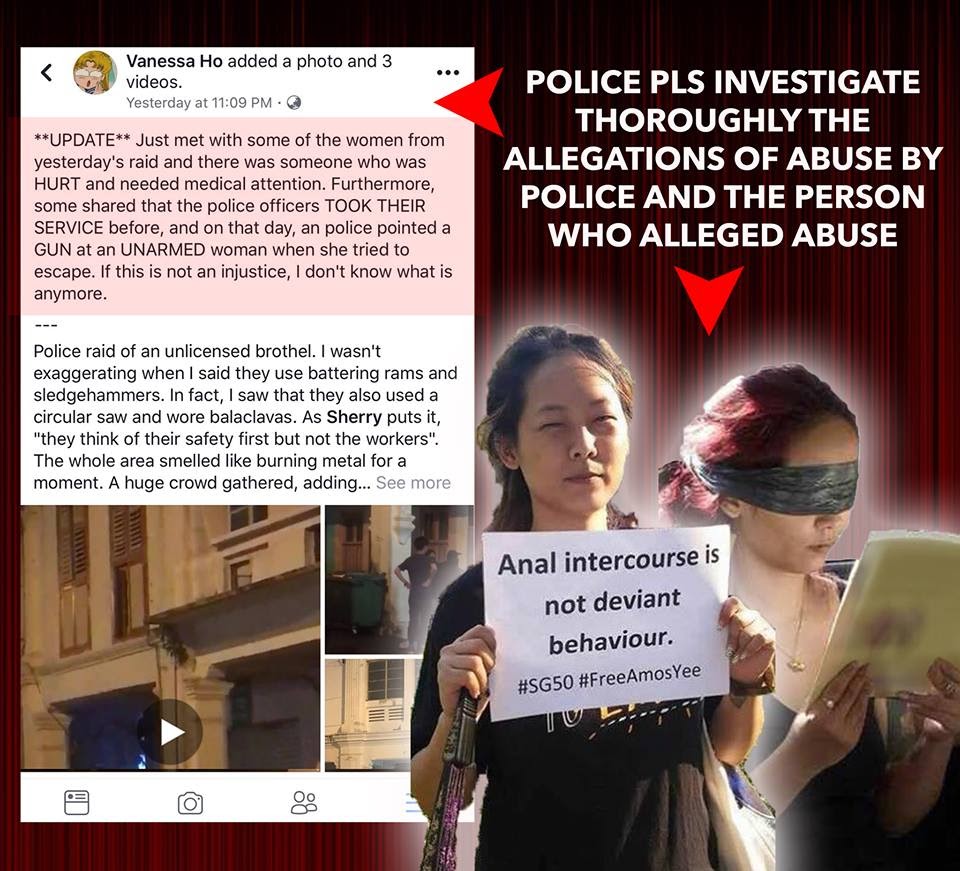
Why we have little to no confidence in SG's "Activists"


Tell me lah.. how to believe or support these Activists when they have a credibility/trust issue?

You can be passionate about your cause BUT that does not give you (or your cause) the license to bend the truth or manufacture half-truths or cast any baseless aspersions. Such actions neither aids you, nor help the cause you are championing.

In fact, in the eyes of the public, such lies will destroy any shred of credibility you or your cause may have - no matter how worthy the cause.


Source: FLOP FB Page
It is not called a "raid" for nothing. You think that these criminal elements are going to play nice when they are about to be arrested for their illegal activities? Grow some brain-cells can?


And further more, by casting such baseless accusations at the police, you are putting the interests of one group (ie: sex workers) over the interests of another group (ie: the police/general public).

Who are you to decide whose interests are more important? Are you saying the for the sake of your interests/cause, the ends justify the means?

The trust between the public and the police is paramount. It allows the police to carry out their work without any unnecessary duress or bias, and it enables the public to believe that the police are carrying out their duties without favor or fear, to the spirit as well as the letter of the law.

Look at what is happening in other countries where there is low trust/respect between the police and the public. Justice takes a back seat to all the political bickering and posturing. There are charges of corruption and abuse of power being thrown about. The police force becomes increasingly ineffective against crime and are regarded as lacking legitamacy in their actions. Crime levels go up. Is that what you want to see happening in S'pore? (See more here)

As such, any allegations of wrong-doing by the police must be properly reported to the appropriate authorities and be investigated.  And if any wrong-doing is found, either by the police or by the accuser, then the guilty parties must be punished according to the full-extend of the law.

And this is not just an isolated case of an Activist trying to stretch the truth in order to gain public sympathy.

Other NGOs/causes have been found to be taking a more than liberal interpretation of the facts when they post their "complaints" about the Govt or {Insert Govt agency name here}. (See here).

If you cannot advocate for your cause without dealing in the facts, then you are simply a waste of everyone's time. Don't pretend to be ignorant or claim innocent sharing on social media when you post such baseless accusations without any evidence.

Interestingly, she has already taken down her posts.

So what does that mean? The allegations made in her post are serious charges. And we believe if the police were found guilty of these charges, there would be serious consequences.

Was she lying? Does she stand by what she had posted? Or was it simply a vicious, unjustified and baseless attack on the police, made to advance her cause? If she truly believes what she posted, then she should be making a report to the police or CPIB. Where's her integrity?


And here is what K Shanmugam (Min. for Home Affairs and Law) had to say: 

Monday, November 27, 2017

Americans are starting the realize the truth about Amos


Americans are starting to realize what many of us Singaporeans already know about Amos  - that he is simply a attention-seeking brat.

Recently, Amos was interviewed by Jeff Holiday (a YouTuber) for more than 2 hours about Amos's views on pedophiles and child pornagraphy.

And here is a follow up video by Jeff, stating out what he thinks of Amos.

TLDR version? I think its summed up in this quote.

"Amos Yee is not worth the emotional trauma that you can get from having to listening to his absolutely stupid dog shit ideas. Don't let him get under your skin." - Jeff Holiday (21:33)

hahahahah.....


Meanwhile, back in Singapore, the Government is considering new penalties for sex crimes targeting women and kids online. (Read here).


Amos sets the world on fire again


ICYMI (or more likely couldn’t give a damn about him), Amos was given refugee status in Sept 2017 and has been released from detention (after 10 months +-) in America. (Read here).

Needless to say, he has been back to his usual antics - which is posting a video on a controversial topic and trying to milk some money off YouTube/social media/donations. 

So what’s new right?

What's new that is Amos is touching on a very sensitive topic, even for the US.

Amos has chosen to advocate for pedophiles, and even makes the outrages claim that child pornography should be permitted and that babies/children can consent to sex.

His views are so ridiculously bat-shit crazy and gives so much weird anecdotal evidence and assumptions that you can’t help but wonder at WTF is going on in his head.

To date, Amos has made about 3 YouTube videos on this topic but his 20th Nov one is probably the most controversial one.

I’m not going to post his video links here (simply because I do not want to drive traffic to him and hence make him a couple of cents) but you should be able to find it quite easily, together with tons of rebuttal videos.

Instead, here are some articles and rebuttal videos about what Amos has said.


In this video, Jeff Holiday calmly talks to, and rebuts Amos about his views, and from Amos's incoherent and often nonsensical responses here, we see exactly how bat-shit crazy he is.

Update: In a follow up video here (21 Nov 2017), Jeff analyses what Amos is, and it is telling. Why am I not surprised at his conclusions?

Priceless quote


"Amos Yee is not worth the emotional trauma that you can get from having to listening to his absolutely stupid dog shit ideas. Don't let him get under your skin." - Jeff Holiday (21:33)


When he was in Singapore, the views that he was espousing caused so much public outrage that a man actually lost control and went up to him in front of the Subordinate Courts (Vigilantism is wrong but this dude’s got some balls to do this in such a heavily policed location.) and slapped Amos right across the face. (Read here). In that context, I’m not sure if Amos fully understands the implications of the fact that he is now in America, the world’s most gun-crazy country.

Any how I wonder what Amos’s supporters and his donors think of him now.


Guess Amos is slowing finding out that absolute freedom of speech does not exist - even in America.


Tuesday, October 24, 2017

What President Trump Can Learn From Singapore Next Week


By Walter Lohman, Director, Asian Studies Center
20 Oct 2017
KEY TAKEAWAYS

(1) Singapore's Prime Minister Lee Hsien Loong will visit Washington next week. He is the fourth Southeast Asian leader to meet President Donald Trump.

(2) Key topics of discussion are likely to be economics, China, and North Korea.

(3) As President Trump prepares for his trip to Asia next month, he can learn a great deal from Prime Minister Lee.

Next week, when Singapore's Prime Minister Lee Hsien Loong visits Washington, he will become the fourth Southeast Asian leader to meet President Donald Trump. This early engagement, to be followed next month by Presidential attendance at the East Asia Summit in the Philippines and the Asia-Pacific Economic Conference in Vietnam, is a very encouraging indication of continued American commitment to the Western Pacific.

When President Trump came into office, there was quite a bit of anxiety about his commitment to American alliances in Northeast Asia. The 2016 Presidential campaign was an extraordinarily contentious one. As a presidential candidate, Trump made statements about America’s Asia policy that raised concerns in Japan and South Korea, and among American military, and foreign policy experts. Ultimately, however, as time is showing, it is difficult to overlook U.S. allies in Japan and South Korea. They occupy too central a role in America’s foreign policy and force posture in the Pacific. There were more than enough people, including the Japanese Prime Minister himself, to help President Trump understand that, if he truly did not before taking office.

Focusing on Southeast Asia requires more subtle strategic awareness. There are small constituencies that speak for it in the American electorate and a relative handful of Southeast Asian experts in Washington to go to bat for U.S. interests there. Yet, despite this – and very much to its credit—the Trump Administration appears to appreciate its importance. The official statements from Southeast Asian engagements coming out of the White House, including the one announcing Prime Minister Lee’s visit, are replete with references to strategic priorities. That said, the President himself would be well-advised to take on board some of the finer points Prime Minister Lee will make about the strategic picture in the region and the American role in it.

Singapore is a small country with a highly developed economy. Its lack of strategic depth, its economic success, and the fact that it is a multi-ethnic Chinese-majority country, surrounded by countries with Chinese minorities, means it is vulnerable. As a result, leaders of Singapore are very carefully attuned to geopolitical disturbances. They do their best to contribute to stability. Singapore hosts critical U.S. naval logistics capabilities – a role they stepped into in the 1990’s when the U.S. and the Philippines failed to agree on terms that would keep them at Subic Bay. It constructed a naval base, Changi, deliberately designed to berth a U.S. aircraft carrier. And it accommodates the rotation of American littoral combat ships and P-8 patrol aircraft through Singaporean facilities.

On the diplomatic side of things, Singapore offers wise council in the Association of Southeast Asian Nations (ASEAN) and they maintain a very constructive, determinedly independent relationship with China. Accordingly, although they are quiet about it, American audiences in particular will appreciate that Singapore maintains the most positive—albeit, like the U.S., unofficial—relationship with Taiwan that Southeast Asia has on offer. This is worth mentioning because it points to the value Singapore places on the autonomy of its foreign policy. There would be no easier calculation for it than to jettison Taiwan, downgrade or rescind reciprocal representation, and end military exercises it has conducted there since 1975. It could kill its free trade agreement with Taiwan. Every other country in Southeast Asia—as well as the U.S.—have apparently calculated that an FTA with Taiwan is not worth inconveniencing Beijing.

On the face of it, Singapore’s interests in China dwarf anything it can accomplish with Taiwan. But what Singaporean leaders know is that if Beijing can dictate its policy on Taiwan, it will assume it can dictate other aspects of its policy, on the South China Sea, on its relationship with Japan, on military cooperation with the U.S., and on its positions in ASEAN.

So as high as the stakes are in Singapore’s relationship with China, its long-term investment in strategic priorities that contribute to regional stability and principles essential to its survival—like freedom of the seas—are more important. From a Singaporean perspective, it is the Chinese who will have to make the mental adjustment that allows the relationship to work as it does—and they are perfectly prepared to help them do so.

So, what messages is Prime Minister Lee likely to bring to Washington?

First, economics. Singapore has a free trade agreement with the U.S.; it also runs a trade deficit with it. So while trade balance is an indicator too broad to be of much use in any regard, at least in the case of Singapore, it will not distract from a discussion of the larger strategic imperative of American economic engagement. Prime Minster Lee warned the U.S. that a pullout from the Transpacific Partnership (TPP) would be a setback for its strategic interests in the region. With this decision already made, he is not likely to revisit this criticism. One hopes, however, that the Prime Minister will talk to the President about the options the region has for moving forward without the U.S. There is the real prospect of a TPP-11, an agreement modified to exclude the U.S—temporarily the Singaporeans hope. There is the Regional Comprehensive Economic Partnership (RCEP). There is China’s one-belt, one-road infrastructure project. Regarding the latter, there are signs that the Administration is coming to understand the significance of this, but it cannot beat something with nothing. TPP may be dead as far as the U.S. is concerned. These other initiatives are Asia’s plan B. The U.S. desperately needs a plan itself, something more encompassing than renegotiation of trade agreements and imposition of trade remedies.

Second, China. Singapore is very much interested in the trajectory of US-China relations. This is because leaders there understand the challenge that China presents the region. It does not see China’s rise as a “threat” or as a clash between Western and Confucian civilizations. It certainly will not subscribe to the U.S. waging an “economic war” with China—as some of President Trump’s supporters have advocated. Singapore sees the rise of China as a reality that must be managed. Beijing has presented the U.S. with some difficult decisions, on the South China Sea, for instance. And Singapore is both publicly and privately supportive of pushing back in areas like these where it threatens to overturn the regional order. Poor management of the relationship on the part of the United States, however, would also represent a danger to regional stability, and to Singapore. For these reasons, Singapore has an interest in helping American officials understand China in all its complexity. Expect the Prime Minister to appeal to President Trump’s better angels on matters related to China.

Third, North Korea. In one of the Trump Administration’s earliest efforts to reach out to the Southeast, Secretary of State Rex Tillerson met with ASEAN’s foreign ministers in Washington. The very real threat from North Korea’s nuclear weapons program was high on the agenda. Singapore appreciates that and has said so publicly. They can be trusted to comply with UN Security Council (UNSC) Resolutions regarding North Korea’s nuclear weapons program and cooperating with U.S. intelligence agencies and the UNSC’s Panel of Experts to do so.

Singapore is squeezing its limited contact with North Korea, but it does maintain diplomatic relations with it, as do all other members of ASEAN and more than 150 other countries. North Korea is also part of the annual ASEAN Regional Forum. Singapore has no diplomatic mission in North Korea; North Korea has a bare-boned, two person embassy staff in Singapore. Singaporean companies conduct a miniscule amount of trade with North Korea estimated at 0.2% of North Korea’s total—the same share as Luxembourg, Taiwan and Sri Lanka—and declining. During Prime Minister Lee’s visit to Washington, if not in his meeting with Trump, then on Capitol Hill or in other Administration meetings, this contact and ASEAN’s relationship as a whole might be raised. One can expect the Prime Minister to be constructive and open to suggestion.

Singapore is a sovereign country. As such, it is, of course, occupied with protecting its own national interests. The analysis of its leaders and diplomats is honest and insightful. It is not entirely objective. It is colored, at least in part, by Singapore’s geostrategic fate and what Michael Leifer—the most prominent scholar of Southeast Asian international relations of his generation—once called a “foreign policy rooted in a culture of siege and insecurity.” Singapore’s prescriptions cannot be bought wholesale by American political leaders and officials. They come at foreign policy from a much different historical and material perspective. But Singapore does offer extremely valuable advice and an enlightened concept of its national interest that has consistently aligned it with the United States. As a result, for decades, it has long been among the most persistent advocates of for a robust U.S. presence in the Asia-Pacific. As President Trump prepares for his trip to Asia next month, he can learn a great deal from Prime Minister Lee about how best to establish and maintain this.


Notes: 

  • As director of The Heritage Foundation’s Asian Studies Center, Walter Lohman oversees the think tank’s oldest research center.

  • Prime Minister Lee Hsien Loong is currently in the United States on an official working visit to Washington D.C. and will be meeting President of United States (POTUS) Donald Trump in the White House on 23 Oct.

Article source: The Heritage Foundation


PM Lee Hsien Loong speaking at the Economic Club of Washington, D.C


PM Lee Hsien Loong speaking at the Economic Club of Washington, D.C. on 23 October 2017.


PM Lee Hsien Loong held a dialogue at the Economic Club of Washington, D.C. on 23 October 2017


PM Lee was on an Official Working Visit to Washington, D.C. from 21 to 26 October 2017.

Video source: Prime Minister's Office, Singapore YouTube Channel


Tuesday, October 10, 2017

[Defending the Lion City] Why We Serve - Our NS Stories


Episode 1: The early years of National Service 
"At that time, the question was, are you ready to stand up for the challenge or will you give up? And if you give up, where will the next generation be?" 
In Part 1 of the new video series "Why We Serve – Our NS Stories", Robert Yeo and other pioneer National Servicemen from the Singapore Armed Forces share their stories of perseverance, and commitment to the cause. 


Episode 2: Basic Military Training – The experience that binds
Basic Military Training is memorable for every Singaporean son. Through the tough training and strict discipline, thousands of recruits mature as they find out a little bit more about who they are, what they stand for, and why they do what they do. Watch Part 2 of "Why We Serve - Our NS Stories" to find out more about this shared experience from those who have gone through this rite of passage.


Episode 3: Soldier, Sailor, Airman - A Common Purpose
After Basic Military Training, Full-time National Servicemen (NSFs) proceed to take on different roles in the Army, Navy and Air Force. Together, they form the backbone of the Singapore Armed Forces, enhancing Singapore’s peace and security. Watch Part 3 of "Why We Serve - Our NS Stories" and see some of the ways in which they contribute to national defence.


Episode 4: Being a Citizen-Soldier
After two years of service, Full-time National Servicemen go on to serve as Operationally Ready National Servicemen (NSmen). They continue to keep themselves combat ready through regular training. Having to balance their families and careers with National Service (NS) responsibilities, strong support from their families, employers/employees and fellow servicemen becomes absolutely critical. Get to know some of our NSmen in Part 4 of "Why We Serve - Our NS Stories" and find out what it means for them to do what they do.


Episode 5: A Shared Commitment
In this final episode of “Why We Serve - Our NS Stories”, we spoke to different members of the community to understand their views on NS, and the reason behind their support for NS. This is their story. 


Thursday, October 5, 2017

A Singaporean mother’s letter to her daughter on her 21st birthday

Saint Andrew's Cathedral, an Anglican cathedral in Singapore: "... Habib Omar’s journey to Singapore was also an act of faith. He was deeply religious and believed that Allah’s Rahmah (love) and compassion was for all humanity. Today, one of his legacies, the Masjid Omar Kampong Melaka, stands as the oldest and first mosque in Singapore. Soon after Masjid Omar was built in 1824, Habib donated a plot of his land to the Anglican community, so that they too could built their place of worship there. Today, St Andrews Cathedral stands as a beautiful testimony to the fundamental belief that “if God is important to you, God is important to everyone else, too”. Never forget this simple truth. ..."


A Singaporean mother’s letter to her daughter on her 21st birthday
BY MARIAM ALJUNIED
PUBLISHED: 7:50 PM, OCTOBER 2, 2017, TODAY Online


This is a letter from chartered psychologist Mariam Aljunied to her daughter Sara when she turned 21 this year, in which Dr Mariam Aljunied spoke about their family history dating back to the year Singapore was founded in 1819 and what it means to be a Singaporean growing up today.

Dr Mariam Aljunied’s great-great-great-grandfather, Syed Omar Ali Aljunied, built Singapore’s first mosque - Masjid Omar Kampong Melaka - in 1820 and also donated the land on which St Andrew’s Cathedral now stands to Sir Stamford Raffles.

Dear Sara,

You’ve been a blessing and a gift to both me and your dad. Your late Habib (granddad) once reminded me that the two things we must bequeath to our children are “roots to stay anchored, and wings to fly”. I’ve never forgotten this message. So in this significant year, your 21st, I want to share with you some things that I hope you too will never forget. These are messages that I’ve learnt in my lifetime: messages from the past, present and future; and messages that are forever.

MESSAGES FROM THE PAST

Sara, you’re a sixth generation of Aljunied in Singapore. In 1819, the same year that Raffles arrived in Singapore, your ancestor Sheikh Omar Aljunied came to Singapore from Tarim in Yemen, via Palembang.

He was a merchant, a trader and a philanthropist. His contribution as one of the founders of modern Singapore and his legacies to the nation are well documented in the National Archives and Museum. There are two things in particular about Habib Omar’s legacies that we should never forget:

Habib Omar came to Singapore with his wife, Sharifah Alwiyah Alkaff.

They had five sons and two daughters. All of his children were born in Singapore. Clearly, Habib Omar was not looking for ‘hotel Singapore’; he was finding a place to make a home for his children and his children’s children.

He was neither a refugee nor a runaway; he did not come to Singapore because of despair or desperation. He chose to come here to pursue a shared dream: the collective belief that this place was special, and could become even more special in the future.

For the next 200 years, when things were good, this dream was the driving force that spurred Habib Omar and other pioneers like him to reach for new successes. When things were bad, it was this belief that propelled them to persevere and fight-on.

Never forget that you and I are inheritors of this inspiration that they shared.

Habib Omar’s journey to Singapore was also an act of faith. He was deeply religious and believed that Allah’s Rahmah (love) and compassion was for all humanity.

Today, one of his legacies, the Masjid Omar Kampong Melaka, stands as the oldest and first mosque in Singapore.

Soon after Masjid Omar was built in 1824, Habib donated a plot of his land to the Anglican community, so that they too could built their place of worship there.

Today, St Andrews Cathedral stands as a beautiful testimony to the fundamental belief that “if God is important to you, God is important to everyone else, too”. Never forget this simple truth.

MESSAGES FOR THE PRESENT AND FUTURE

While we recognise and acknowledge where we came from, we must never forget where our roots are currently planted.

You and I have a historical link to Tarim and the Middle East, but emotionally, our connections are here. It is the people that we interact with daily - our families, friends, neighbours and community - that become ‘our people’; they are our Tribe.

It is with this Tribe that we share our everyday concerns and hopes for the future. An invisible thread joins our collective consciousness.

Our Tribal Tapestry is special; its colours expand as we embrace anyone and everyone who shares the same collective dream. This is how it has been for the past 200 years.

Never forget that we need to always strengthen this invisible thread. The stronger it is, the thicker and richer the Tapestry we can create for our Tribe.

I remember well the first time I brought you to the National Day Parade. You were 5 years old, and we got tickets for our neighbour Eline and her mum, too. You and Eline had been best friends since you first met each other during the playgroup session at the Sims Drive void-deck centre.

You became inseparable, and we enrolled you in the same preschool. You and Eline thoroughly enjoyed Singapore’s birthday celebration, and were dancing and singing loudly throughout the parade. That day, you asked me a curious question: “Mama, Singapore was born today, right? Who is Singapore’s mum and dad?”

Let me attempt to answer that question again.

Singapore does not have a mum or dad.

Singapore is unique, because we are simply born out of an idea. When we became independent in 1965, there was no invasion, mutiny or civil war. 
Our birth was driven by the ferocity of an idea. The idea that different people can live side-by-side and pursue their dreams together, without any one group being given special privileges over another, and at the same time, with everyone being given equal opportunity. 
52 years ago, enough people believed in this collective dream to make it come alive. 52 years on, we are still pursuing this idea. Never forget that it is our shared responsibility and collective actions that can make this ideal become a reality for all of us. It is always work in progress.

MESSAGE FOR FOREVER

At 21 years old, you are on the cusp of many exciting adventures in your life. Many of the pathways the future holds are ones which you have yet to even dream about. In navigating your future, I want to share one tip that I learned from someone much older than me.

A few months ago, while I was taking a group of students with physical impairment to learn dragon-boat racing at Bedok Reservoir, I met Mrs Lim, an 85 year old lady.

She was one of a group of seniors in wheelchairs at the same session. As we were taught to paddle, Mrs Lim began singing. Her enthusiasm and exuberance were so infectious that soon we all joined her and became a ‘singing dragon-boat’.

Later, I quietly asked Mrs Lim, what was her secret? How did she maintain such vibrant vigour and positive energy?

Mrs Lim smiled and whispered, “The secret is… to always do the things that makes you feel most alive”. Over the years, Mrs Lim had taken on the jobs of a baker, a kitchen hand and a sales assistant. Regardless of the role she held, she took any opportunity to sing, because for her, singing was what made her feel most alive.

Happy 21st birthday Sara. Never forget to do the things that make you feel most alive.


ABOUT THE AUTHOR:
Dr Mariam Aljunied is a chartered psychologist with more than 20 years experience working with schools, children with special needs and their families. She has a daughter, Sara, who turned 21 this year, for whom this letter is dedicated to. This piece first appeared in The Birthday Book 2017, a collection of 52 essays that examines challenges and opportunities for Singapore with the theme “What Should We Never Forget?”

Article Source: TODAY Online


[Defending the Lion City] Why Starlight matters


This is a Quora post by Timothy Soh in response to the question "Why can't Singapore suspend/end exercise starlight?" 


Source: Quora post by Timothy Soh


Thursday, September 14, 2017

Chee Soon Juan tries to spin yet another lie


Sigh.. why is Chee Soon Juan agitating again for a By-Election?

There is nothing dubious or nefarious about why the Govt is not calling for a By-Election to fill the GRC seat vacated by Madam Halimah Yacob.

Madam Halimah Yacob resigned her position as MP for the Marsiling-Yew Tee Group Representative Constituency (GRC) to stand as a candidate for the Singapore Presidential Elections.

The main operative word(s) here being : "Group Representative Constituency (GRC)"

Section 24(2A) of the Parliamentary Elections Act clearly states that no writ of election can be issued unless ALL THE MPs in a GRC have vacated their seats in Parliament.


Source: Singapore Online Statues - Parliamentary Elections Act (Chapter 218), Section 24(2A)


Madam Halimah Yacob's resignation does not mean that all of the four seats of Marsiling-Yew Tee GRC are now empty. This is because the GRC still has three other MPs - Mr Lawrence Wong, Mr Alex Yam and Mr Ong Teng Koon.

And remember, the PAP Govt has never shied away from calling for a By-Election when it is required by the law, even if it meant that it may lose that seat to the opposition.

In 1981, PAP MP Devan Nair resigned to appointed as the President of Singapore. His resignation trigger the Anson By-Elections in which the PAP lost the single-seat constituency to then WP's J.B. Jeyaretnam. (Source)

In 2013, when PAP MP and Parliament Speaker Michael Palmer resigned due to personal indiscretions, the resulting By-Election resulted in PAP losing the single-seat constituency of Punggol East to the WP's Lee Li Lian.

The only GRC By-Election ever to have been held was in 1992 for Marine Parade GRC.

In this case, the GRC By-Election was trigger when ALL FOUR MPs (including then PM Goh Chok Tong) of the Marine Parade GRC had resigned from their seats. (Source)

Chee Soon Juan is simply lying when he says that "the Govt is refusing to call for a By-Election".

The facts here is simply, that our laws governing the GRC, does not require a By-Election to be held.

All things considered, Chee is simply just being Chee.

Character is indeed, permanent.


See more of the dubious shit things that Chee Soon Juan and SDP doesn't want voters to know.


Wednesday, September 13, 2017

Singapore Air Force supports hurricane relief in Texas

The RSAF's CH-47 Chinook helicopters


We are proud that Singapore is able to do whatever it can to support the hurricane relief efforts.

Our care and prayers goes out to all who have been affected by the hurricane.


Singapore Air Force supports hurricane relief in Texas
By Sgt. Michael Giles | 100th Mobile Public Affairs Detachment | September 06, 2017 
(Reposted)

CAMP MABRY, Texas—Thirty-four members of the Republic of Singapore Air Force in CH-47 Chinook helicopters coordinated with the Texas National Guard's 372nd Combat Sustainment Support Battalion to resupply Joint Task Force Harvey personnel with food and water.

The airmen with Singapore's Peace Prairie Detachment supported hurricane relief efforts by delivering supplies to Brenham, Texas, on Aug. 30 in support of Joint Task Force Harvey.

The contribution toward Harvey relief efforts reflects an ongoing partnership between Singapore and Texas, according to an Aug. 30 Singapore Ministry of Defence statement.

Prime Minister Lee Hsien Loong said, "This was a small gesture to express our appreciation and gratitude to the U.S., and in particular the State of Texas, which have been good hosts for our Peace Prairie Detachment."

Texas has hosted Singapore's Peace Prairie Detachment at the Grand Prairie Army Aviation Support Facility in Dallas since the detachment's inauguration in May, 1996. In that time, they received training at the Joint Readiness Training Center and in Exercise Red Flag, and trained alongside Texas Guard members in large-scale emergency response exercises. They put this training to use as they coordinated with the Texas Guard in response to Hurricanes Katrina in 2005, fire and flood operations in Texas in 2000, and Hurricane Floyd in 1999.

The Singaporean detachment has been fulfilling a crucial role in helping resupply food and water to service members on the ground, said Lt. Col. John Crawson, commander of the Texas Army National Guard's 36th Sustainment Brigade.

"We have Soldiers down in the joint operations area that are relying on our resupply," Crawson said. "They're relying on our MREs and bottled water. And when they begin to get very low on supplies, it's very crucial that I get them there."

Crawson said that sling load operations are necessary when flooding prevents effective ground travel. The Singaporean detachment is an ideal partner in these situations, because they frequently rehearse these capabilities with Texas Guard members during their annual training.

"We are extremely grateful for their support and we will continue to ask them to help us out," Crawson said.

Tuesday, September 12, 2017

Singapore's Lessons on Affirmative Action


A student from Elias Park Primary School dressed in a traditional Malay outfit during the school's racial harmony day celebration. TODAY FILE PHOTO


Singapore's Lessons on Affirmative Action
Balancing Meritocracy and Diversity
By Mathew Mathews, Foreign Affairs, 5 Sept 2017

In early August, the New York Times reported that the U.S. Department of Justice (DOJ) would be looking into lawsuits filed by Asian Americans against Harvard University, alleging anti-Asian racial discrimination in the school’s admissions policies. The move has set off fervent discussion in the United States over the future of affirmative action, or the practice, in place since the 1960s, of positive discrimination in favor of historically marginalized groups.

Yet the United States is not the only country trying to negotiate the delicate balance between upholding meritocracy and ensuring that racial minorities do not feel a sense of alienation. Singapore, a multiracial city-state that has assiduously avoided affirmative action policies, last year passed constitutional changes that pave the way for its first presidential election (on September 23) in which all candidates will come from the minority Malay ethnic group. The Singaporean government views any help it provides to ensure minority representation as a safeguard against instability. It is wary of implementing policies that affect a broad category of minorities, which may ultimately relegate them to be viewed as tokens.

THE AMERICAN WAY

In the United States, the DOJ’s move has reignited long-running debates about affirmative action. Such policies have long been opposed by conservative white Americans, and many fear that President Donald Trump’s administration is simply looking for any avenue it can find to bolster white privilege. Yet not all those who oppose affirmative action are white—some Asian Americans, often more recent immigrants, have also called for a purely meritocratic system of college admissions, since they need to obtain much higher test scores than students of other races to be admitted to highly selective colleges. Asian Americans, moreover, have often been presented by critics of affirmative action as so-called model minorities for having allegedly overcome discrimination through an emphasis on education and hard work.

American opponents of affirmative action argue that the United States is no longer the segregated country it was in the mid-1960s, when such policies began. Today the U.S. elite is much more diverse, and a black man, Barack Obama, served two terms as president. Allowing affirmative action to continue, they argue, simply perpetuates the existence of an underclass whose members require exemptions from normal standards and who are not fully accepted in prominent positions because they are viewed as tokens. Critics of affirmative action also see it as tantamount to reverse racism. Race-conscious policies, they claim, are biased against whites and high-achieving minorities. And in fact, one of the most under-represented groups on prestigious U.S. campuses is white, working-class Christians from conservative states.

Defenders of affirmative action generally counter that such measures should continue as long as racism and bigotry remain present in society—a charge that is hard to deny considering recent events in Charlottesville. It is unfair, they say, to expect minorities such as African Americans, who have faced a history of oppression (including slavery, segregation, and police brutality), to be measured according to the same metrics as other students. Some argue further that test scores alone are an incomplete measure of academic potential—they may reflect nothing more than hours of preparation with the help of tutors. And many fear that tampering with affirmative action can hurt minority representation. After California banned affirmative action in 1998, combined African American and Hispanic enrollment at the University of California, Berkeley, plunged from 22 percent to 13 percent of the school’s total.

The U.S. Supreme Court, in its 2016 ruling in Fisher v. University of Texas, defended the use of carefully thought-out affirmative action policies in pursuit of the broader goals of higher education, such as ensuring opportunities for minorities and giving students the benefit of learning in a racially and ethnically diverse environment. The latter consideration weighed heavily on the court’s decision in Grutter v. Bollinger (2003), in which a five-to-four majority affirmed the University of Michigan law school’s consideration of race as one among many factors in admissions. As Justice Sandra Day O’Connor noted in her opinion (quoting from a district court decision), a diverse campus promotes “cross-racial understanding,” helps to “break down racial stereotypes,” and enables students “to better understand persons of different races.” A 2016 review of empirical literature by the economists Peter Arcidiacono and Michael Lovenheim, however, found that the effects of affirmative action are inconclusive.

SINGAPORE'S MERITOCRACY

Affirmative action continues to inspire discomfort among many Americans. For instance, a 2016 Gallup poll found that 65 percent of Americans disapproved of the Court’s ruling in Fisher. Ultimately, affirmative action goes against the ideals of a meritocratic society, which holds that talent and not background should determine attainment. The need to balance this ideal with the quest for diversity in a multiracial society continues to present a difficult problem. Singapore—where about three-quarters of the population is ethnically Chinese, with Malays, Indians, and other minorities making up the remainder—provides an interesting comparison with the United States. Singapore is opposed to affirmative action for admissions into its competitive colleges, but has mechanisms in place to safeguard minority representation in the highest office of the land.

Singapore’s intensely meritocratic vision has long differentiated it from its northern neighbor, Malaysia, from which it separated in 1965. Whereas Malaysia has adopted policies to provide preferential treatment—ranging from university admissions to jobs in the civil service—for members of its ethnic Malay majority, the founders of modern Singapore were deeply committed to the principles of multiracialism. They sought to create a system in which all citizens are treated equally regardless of racial background, and opportunities are given to those who deserve them.

Meritocracy is a fundamental principle of governance in Singapore, but this does not equate to a race-blind approach to policymaking. In addition to allowing the talented to succeed, the Singaporean government accepts that it is responsible for the maintenance of a diverse society and designs policy to maintain peaceful coexistence between the country’s racial groups. Harmonious relationships, the government believes, can only be forged if each community is willing to cede some of its rights and tolerate those of the others. No community, moreover, should be marginalized.

As part of this responsibility, Singapore has sought to ensure representation of all races in different sectors of society. In higher education, which has long been associated with better job opportunities in the city-state,

the government has had some success in increasing the proportion of minority groups who are able to be admitted to the university. (In Singapore, university admissions are highly competitive and primarily based on performance in examinations.) In 1980, among the cohort of Malays who had entered the first grade together, only 0.5 percent had been admitted to a publicly funded university. By 2005, that number had risen to 5.4 percent, and in 2015 reached 7.7 percent. By comparison, for Singapore Chinese the cohort participation rate in 2005 was 30 percent; for Indians, 11 percent.

This increase among Malays was the result not of affirmative action but of official efforts to build Malay students’ capabilities starting in early childhood. In 1982, the government established ethnic self-help groups for Malays (known as MENDAKI) to look into resolving student underperformance. The agency has developed numerous strategies to improve educational attainment, including subsidizing tutoring services, establishing mentorship programs, and educating Malay parents on the value of academic achievement. The steady growth in Malay graduation rates suggests the partial success of these efforts. And Malay students in the universities are accepted as equals by their Chinese counterparts, who know they have qualified with similar scores on the national examinations.

Despite such progress, however, Malays still lag behind Chinese and Indians in terms of education. Partly as a result, 41 percent of Malays age 18–25 support preferential treatment for minorities, according to a nationally representative survey conducted by the Institute of Policy Studies (IPS) in 2013, whereas only 24 percent of Chinese supported such policies. But the government has not shifted its position. Instead, it periodically highlights the achievements of the Malay community, while pointing out that these have been the result of talent and hard work rather than official preferences.

BALANCING ACT

Although the Singaporean government has hesitated to use affirmative action to improve minority representation at universities, it does not shy away from policies that may appear to buck its official ideology of meritocracy.

One such policy is the Group Representation Constituency (GRC) scheme, implemented in 1988, in which parties field a team of candidates to represent a constituency in parliament, at least one of whom must be an ethnic minority. One of the main purposes of the policy is to ensure that Singapore’s minorities are always represented in parliament in proportion to their share of the population.

In 2016, Singapore made the latest addition to its suite of race-based policies by updating the law governing election to the country’s presidency. (In Singapore’s  parliamentary system, the prime minister is the head of government while the president plays a largely custodial role that includes safeguarding the nation's financial reserves and approving appointments to key government posts, such as the attorney general.) Under the new modifications, the office of president must from time to time be held by members of each of Singapore’s constituent races. If one of the races has not been represented after five election cycles, parliament can call for a restricted election, open only to candidates from the excluded group. The coming presidential election on September 23, for instance, will feature only Malay candidates.

The proximate cause of this change was the absence of any Malay president since the death of President Yusof Ishak in 1970. This led government leaders to become concerned that the issue could be politicized, thereby threatening Singapore’s carefully managed ethnic harmony. Yet the restricted election solution has been challenged. In the public hearings on the subject, many questioned whether the restriction of presidential candidates by race would shift Singapore away from its race-neutral aspirations. Others, such as Gillian Koh (a colleague of the author at IPS), asked whether such restrictions might result in a president who was seen as an ethnic token who would lack the legitimacy to check the government. Singapore’s leadership, however, has maintained that the use of a restricted election does not amount to affirmative action since it does not reduce the qualifications required for an individual to serve as president. All candidates, regardless of race, must have held very senior positions in the public or private sector in order to run for the office. This high bar will not be lowered, even if the group in question has few members who can clear it.

The main purpose of the restricted election will be to address potential biases among the population. Despite more than 50 years of official attempts to combat it, there is still some racism in Singapore. An IPS survey on race relations conducted last year in collaboration with the broadcaster Channel News Asia revealed that although Chinese respondents would unanimously accept a Singaporean Chinese as the country’s president, only 59 percent of them would accept a Malay and 68 percent of them an Indian. The survey does not take into account many other considerations that might determine voter preferences, but it suggests that biases could unfairly penalize otherwise stellar minority candidates from being elected. This is especially so in the presidential election, in which candidates are expected to be non-partisan. Without a political platform, racial biases are even more likely to play a role in voting.

Singapore’s approach to managing racial issues is certainly not perfect, and has its detractors both domestically and internationally who claim that the government’s foray into issues of race further entrenches the persistence of racial stereotypes. But the city-state’s example shows that by intervening in carefully designed ways, there is scope for a pluralistic country to fine-tune policies that ensure minority representation without compromising on the principle of meritocracy. At a time when the issue of race has emerged as one of the most threatening potential fault-lines in meritocratic societies, finding a balance between the two will likely become much more urgent.


Article source: Foreign Affairs


The Jakarta Post - Editorial: The mighty red dot


The special #RISING50 flypast executed in sync by F-16s of The Republic of Singapore Air Force and TNI Angkatan Udara. TNI-AU formed the number 5 while RSAF formed the number 0. (MCI Photo by Chwee) - Lee Hsien Loong's FB page.


The Jakarta Post - Editorial: The mighty red dot
Jakarta |Fri, September 8, 2017 | 07:53 am

How is it that Singapore, once mocked as a mere “red dot” state by then president BJ Habibie, became the largest foreign investor, and sent the largest number of tourists to a much more “gigantic” Indonesia in 2016? The moral of the story is: Size alone does not always matter.

In Thursday’s joint press conference with his guest President Joko “Jokowi” Widodo, Singaporean Prime Minister Lee Hsien Loong announced that his country invested US$9.2 billion in Indonesia last year. Indonesians, who have often blamed the city-state for harboring corruption suspects, may sneer that the investment value is just a “red dot” compared to the huge amount of money invested by corrupt Indonesians and unscrupulous conglomerates in Singapore.

For many Singaporeans, the “red dot” mockery later became a source of pride because, despite their extremely small size, they became much more prosperous and advanced in nearly all aspects of life compared to their neighboring “big brother.”

At the time he made his comment, Habibie was upset because, according to him, then prime minister Goh Chok Tong was very late in sending his congratulatory message on his appointment as Indonesia’s third president in May 1998.

In an interview with the Asian Wall Street Journal, Habibie, who had just replaced Soeharto following his abrupt decision to end his nearly 32-year dictatorship, pointed to a map, and said, “It’s OK with me, but there are 211 million people [in Indonesia]. All the green [area] is Indonesia. And that red dot is Singapore.”

Singapore denied Habibie’s allegation of belatedly congratulating Indonesia’s new president; but Singaporeans have since taken the phrase as their own, and it has become both a source of pride and an endless source of jokes to tease Indonesia and themselves.

President Jokowi arrived in Singapore on Wednesday and attended a bilateral summit to commemorate the 50th anniversary of relations between the two countries. Two years after Singapore’s separation from Malaysia to become an independent republic in 1965, Singapore and Indonesia agreed to end military tensions between them.

In the same year, the two countries, along with Thailand, the Philippines and Malaysia, established ASEAN. Soeharto is always remembered by Indonesia’s neighbors as a leader who created political security and stability in the region, letting them grow and progress together.

There have always been ups and downs in relations between Indonesia and Singapore, especially after the fall of Soeharto. From the very beginning, Singapore always stood firm against its larger neighbors, including Indonesia — sometimes unnecessarily — while Indonesia is often tempted to show off its muscles to its smaller neighbor, but to no avail.

PM Lee’s revelation about the investment is strong evidence that Singapore plays an important role in Indonesia’s economy, while Singapore also needs Indonesia’s market and resources. As a pragmatic leader, Jokowi knows very well how to conduct business with his counterpart, based on mutually beneficial relations. Neither Singapore nor Indonesia will ever tolerate bullying from their neighbor.

Indonesia and Singapore have learned a lot in the last 50 years.


See more photos here: 

Lee Hsien Loong's FB album - RISING50: Singapore-Indonesia Leaders’ Retreat 2017
Exactly 50 years ago, Singapore’s then-Foreign Minister S Rajaratnam signed a joint communique with his Indonesian counterpart, Adam Malik, establishing formal diplomatic relations between the two countries. 

Since then, our relationship has grown and prospered. While we are neighbours by geography, we are partners by choice. Last year’s retreat with Presiden Joko Widodo was in Semarang (http://bit.ly/2fU8uqw), so I was happy to reciprocate and welcome him here to celebrate our 50 years together. 

We discussed more areas that we can work on together, such as investments and skills training, digital technology, as well as tourism. You can watch my speech here: https://youtu.be/SrcRyMBaRGw

Hope that our close partnership will continue to strengthen and prosper. I look forward to Singapore and Indonesia rising together to greater heights over the next 50 years! – LHL #RISING50


Friday, September 8, 2017

The A-Z Guide to S'pore's Elected Presidency


A-Z Guide to S'pore's Elected Presidency
By FLOP FB Page


A IS FOR ADVISERS

The president's panel of wise men has expanded, and wields more power following changes to the elected presidency passed in Parliament last November.

The president must now consult the Council of Presidential Advisers (CPA) on all - as opposed to some - monetary matters relating to the reserves, and on key public service appointments.

If the president acts in accordance with the CPA's advice, his veto is final and the Government must abide by it. If he goes against its advice, the Government can bring the matter up to Parliament, which can override the president's decision with a two-thirds majority.

In the light of its heavier responsibilities, the CPA now has eight members, up from six.
After all, as Prime Minister Lee Hsien Loong noted: "The system does not solely rely on the judgment of a single person acting alone but, rather, on the president well advised by a team of wise and experienced men and women."

B IS FOR BILL

The road to a reserved election began in January last year, when PM Lee raised the need for a review of the political system during the first Parliament session since the 2015 General Election.

A Bill to amend the Constitution was passed last November with the backing of 77 MPs, after a Constitutional Commission set out its recommendations on the elected presidency, and after three days of intense debate in Parliament.

All six elected Workers' Party MPs voted against the changes, which include raising the eligibility criteria for presidential candidates, strengthening the Council of Presidential Advisers, and ensuring members of racial minority groups are elected from time to time through a hiatus-triggered reserved election.

The changes were the widest made to the elected presidency scheme in its 26-year history.

C IS FOR COMMUNITY COMMITTEE

Are you Malay enough to be Singapore's next president? That decision lies in the hands of the Community Committee, a new feature of the presidential election.
Its first task is to assess whether those hoping to stand in this month's polls are part of the Malay community.

These hopefuls will be informed of the result by Sept 12, after the five members of the Malay community sub-committee deliberate on their applications.

Presidential hopefuls must declare which of the three main communities they consider themselves a part of, and will be issued a certificate if the respective sub-committee agrees.
This process may require the person to provide further information and to be interviewed, among other things.

The Community Committee will be convened even during an open election, and candidates will still have to declare their ethnicity as this will help determine when a reserved election should be triggered.

D IS FOR DIVISIVE ELECTIONEERING

Campaign rules have been changed to discourage divisive electioneering.

The authorities, for one, will no longer designate election rally sites.

This is because rallies "by their nature and format, may be divisive and not congruent with the unifying role of the elected presidency", as Minister in the Prime Minister's Office Chan Chun Sing put it.

Candidates can pick their preferred sites, but must apply to the police for a rally permit.
Explaining the changes to campaign rules in Parliament, Mr Chan said: "Campaign methods for the presidential elections must not inflame emotions and must be in keeping with the decorum and dignity of the Office of the President."

E IS FOR ELECTED PRESIDENCY

This was almost a decade in the making.

The elected presidency was first mooted by founding prime minister Lee Kuan Yew in 1984, but took effect only seven years later, in 1991, after two White Papers were debated in Parliament from 1988 to 1990.

Before that, presidents were appointed by Parliament and served a largely ceremonial role, save for discretionary powers over select matters, such as the appointment of the prime minister.

The elected president, however, is vested with custodial powers over the country's reserves, among other things.

F IS FOR FARID KHAN

A school dropout who worked as a grasscutter at age 13 after his father died, Mr Farid Khan now has his eye on the presidency.

He is the chairman of Bourbon Offshore Asia Pacific, a regional marine services company with a reported shareholder equity of around US$300 million (S$407 million). He was the second aspiring candidate to submit the required forms.

It was a long slog up the ranks for Mr Farid, now 61, who spent years taking on a string of blue-collar jobs that ranged from lorry attendant to janitor.

He attributes his success now to Singapore's meritocratic system. For him, the presidency is a way to serve and give back to the nation.

G IS FOR GOALKEEPER

This was the role the late Mr Lee Kuan Yew saw the president playing: goalkepeer, the very last line of defence against a rogue government bent on squandering the country's reserves or installing cronies in key public positions.

"You need a wise person in that job to play the goalkeeper, and your council of advisers are fullbacks to prevent stupid people - your own players - from kicking into your own goal," said founding prime minister, Mr Lee, in an interview.

This comparison resurfaced over the past year as PM Lee told Parliament that the president is "neither the government nor is he the opposition".

"He is a custodian. He's a goalkeeper," he said, noting that while the Constitution gives the president power to block certain actions of the government, it does not give him the power to initiate policies.

H IS FOR HALIMAH YACOB

For months, she deflected questions by reporters on persistent talk that she would run for election, being one of the few publicly-known Malay candidates who would automatically qualify for the contest.

Madam Halimah Yacob, 63, finally put the flurry of speculation to rest when she announced at a National Day dinner that she would be leaving her party and political posts to stand.

She said then: "It is a heavy responsibility but I hope that with the support of Singaporeans, we can do more good together."

Last Wednesday, she became the last known hopeful to submit the necessary forms.
The former Speaker of Parliament and veteran People's Action Party (PAP) MP - who, as a schoolgirl, helped her mother hawk nasi padang to support the family - entered politics in 2001, after a decades-long career with the labour movement.

I IS FOR INDEPENDENT

The Constitution dictates that the president be non-partisan and apolitical - and the three aspiring candidates have taken pains to stress their independence.

Businessmen Farid Khan and Salleh Marican point out that they have no ties to political parties, while Madam Halimah Yacob - who has been out of politics for less than a month - says she has always put "people before party colours", and has the track record to prove that she does not always toe the government line.

An occasion she cited was when she abstained from voting on amendments to the Human Organ Transplant Act in Parliament in 2007 because she was concerned that this would lead to poor people being persuaded to "sell" their organs.

"I know people have that concern because of my past affiliation with the PAP," Madam Halimah said. "But I just want to say that the President has a duty first and foremost to Singapore and Singaporeans, and not to any party."

J IS FOR 'JUST DO AWAY WITH THE ELECTED PRESIDENCY'

Calls emerged during the discussion on changes to the elected presidency to abolish the entire system instead.

The Workers' Party was among these voices, reiterating a stance it has held since the 1980s.

One reason it gave was that the elected president could be an unnecessary alternative power centre.

It also worried that an elected president could potentially "cripple" a non-PAP government, noting that those who qualify to run come from an elite group, and many are "senior officials appointed under the PAP Government".

The WP wanted a return to the former system of appointed, ceremonial presidents, and said it was open to the idea of additional parliamentary mechanisms - such as requiring a super-majority vote - to safeguard the reserves instead.

A Constitutional Commission reviewing aspects of the elected presidency also raised the possibility of a return to an appointed president, and hiving off the president's custodial powers to a body of experts.

The Government rejected this, arguing that the holder of the second key needed a direct mandate from the people to have the moral authority to veto a government action.

K IS FOR KEY

Two "keys" guard Singapore's reserves and the integrity of its public service.

The Government holds the first key, but the president wields the second. He must agree before the Government can dip into past reserves or make key public service appointments.

The first president to turn the second key and unlock past reserves was the late Mr S R Nathan.

During the 2009 financial crisis, the Government sought and obtained his approval to withdraw $4.9 billion from the reserves to fund schemes to save jobs and stabilise the economy.

L IS FOR LEGAL CHALLENGES
The elected presidency system came into effect in 1991, part-way into Dr Wee Kim Wee's term as president. This made him the first to be vested with the powers of the elected president - even though he was appointed by Parliament.

The Government therefore started its count of the five terms needed to trigger a reserved election from Dr Wee's term, although it was his successor, Mr Ong Teng Cheong, who was the first president to be elected directly by citizens in 1993.

This was a sticking point for former presidential candidate Tan Cheng Bock, who this year mounted a legal challenge on the basis of the upcoming election, which is reserved for Malay candidates. Dr Tan believes it is unconstitutional for the Government to start its count from Dr Wee's term.

The case was dismissed - as was Dr Tan's subsequent appeal.

The reasoning was that Parliament has the right to decide when to start the count, and it is a fact that Dr Wee was the first president to exercise the powers of the elected president.

A separate challenge brought by non-practising lawyer M. Ravi was also dismissed.

M IS FOR MADAM PRESIDENT

It was the parliamentary gaffe that caused a stir.

During the debate on changes to the elected presidency, Mr Chan Chun Sing mistakenly addressed Madam Halimah Yacob as "Madam President" instead of "Madam Speaker".

Madam Halimah, in an interview, said: "I thought I heard it wrong the first time, so I didn't say anything. Then it was mentioned the second time. I almost fell off the chair. I felt very stressed out.

"After the sitting, he told me it was unintended, it was a slip. I accepted his explanation."

N IS FOR NOMINATION DAY

PM Lee started the ball rolling last Monday, when he issued the Writ of Election.

The next stage of the process will be Nomination Day, on Sept 13. Singaporeans get to know then if they will cast their vote or if the election is a walkover.

Nomination Day now has to come at least 10 days after the prime minister issues the Writ of Election instead of five, giving the Presidential Elections Committee more time to scrutinise applications.

Aspiring candidates will be told by Sept 12 whether they qualify, and those who do will have their nomination papers, including their financial statements, made public on Nomination Day. This aims to encourage transparency and discourage hopefuls from exaggerating their credentials.

O IS FOR OUT-OF-OFFICE

Dr Tony Tan Keng Yam's time in the Istana has come to an end. His last day as Singapore's seventh president was Aug 31.

He was sworn into office on Sept 1, 2011, following the country's most heated presidential contest yet, beating out three other contenders to win by a narrow margin.

Dr Tan, 77, was a long-time PAP MP before he left politics in 2006. He was first elected in 1979, and was made deputy prime minister in 1995 - a position he held until he stepped down in 2005.

Until a new president is sworn in, the chairman of the Council of Presidential Advisers, Mr J.Y. Pillay, will serve as acting president.

P IS FOR PROMISES

No more empty promises this election.

Presidential hopefuls must now make a statutory declaration that they understand the role of the president as spelt out in the Constitution.

"It will then be inexcusable if he deliberately chooses to disregard the limits of the Constitution and makes promises or statements exceeding this role," said Minister Chan Chun Sing.

This arose after several candidates made claims and promises in the 2011 election that suggested they may not have been clear about the powers and scope of the presidency.

Q IS FOR QUALIFIED OR NOT?

To qualify to contest the presidency, candidates must be issued a certificate of eligibility by the Presidential Elections Committee (PEC).
The barriers for those from the private sector looking to make the cut have gone up to reflect the growth of the economy: They must have helmed a company with at least $500 million in shareholder equity to qualify, instead of $100 million in paid-up capital.
But raising the bar, said the WP, may shrink the pool of candidates and limit it to senior public officers.

Criteria for those from the public sector remain unchanged: They must have spent at least three years in a key public office.

But those who do not automatically make the cut can qualify under the "deliberative" track, which gives the six-member PEC, chaired by Public Service Commission chairman Eddie Teo, some leeway. Candidates will then have to convince the committee that they have held an office which has given them the necessary experience and ability for presidential duties.

R IS FOR REVIEW

Nine members - led by Chief Justice Sundaresh Menon - made up the Constitutional Commission, which was convened in February last year to review aspects of the elected presidency.

The discussion process saw more than 100 individuals and groups sending in submissions, and four public hearings held.

Two issues dominated: how to ensure that the president has a baseline financial competency, and how to ensure that members of Singapore's minority communities are elected president from time to time.

The commission's 154-page report, which included recommendations such as reserved elections and tightening criteria for private-sector candidates, was released in September last year.

The Government responded in a White Paper that broadly accepted the recommendations.

S IS FOR SALLEH MARICAN

Second Chance Properties chief executive Salleh Marican, 67, was the first to make known his intention to run for election when applications opened on June 1 - and last month, was the first to submit his forms.

His company was the first Malay-owned one to be listed on the Singapore Exchange, and had shareholder equity of between $254.3 million and $263.25 million in the past three financial years.

Mr Salleh, whose textile merchant father died when he was 15, saw his first four business ventures fail but picked himself up each time. Now that he has done well in business, he feels it is time to give back to society "in a much larger way" - through the presidency.

T IS FOR TOKENISM

The reserved election - the special arrangement to ensure minorities are elected president at intervals - has drawn accusations of tokenism.

But political leaders have shot this notion down, pointing out that the stringent criteria to qualify will not be lowered for any race. Minister for Communications and Information and Minister-in-charge of Muslim Affairs Yaacob Ibrahim insisted: "We do not want, and we cannot accept, tokenism."

And Deputy Prime Minister Teo Chee Hean felt that multiracial representation could be achieved while ensuring meritocracy was not compromised.

Madam Halimah Yacob herself said in an interview last year, while still Speaker: "When you say it is tokenism, it means that it is symbolic, it is perfunctory. The point is, all candidates, regardless of an open or reserved election, will have to qualify."

U IS FOR UNIFYING FIGURE

Before the president was armed with custodial powers, his historical role was as a unifying figure representing a multiracial Singapore.

The Constitutional Commission, in describing this unique symbolic function, said: "No other public office - not that of the prime minister, the chief justice or the Speaker of Parliament - is intended to be a personification of the state and a symbol of the nation's unity in the way that the presidency is."

This is why Singapore needs to ensure that "no ethnic group is shut out of the presidency even as progress is made towards that ideal, lest the office of president loses its vitality as a symbol of the nation's unity".

It is vital, added the commission, that minority candidates do not see the presidency as unattainable.

This was also noted by the Government in its response to the commission's recommendations.
"Every Singaporean has to be able to identify with the president, and to know that a member of his community can and will become president from time to time," it said.

Former president Tony Tan Keng Yam pointed out that Singapore's first four presidents - Encik Yusof Ishak, Dr Benjamin Sheares, Mr Devan Nair and Dr Wee Kim Wee - represented, in turn, the Malay, Eurasian, Indian and Chinese communities respectively.

But after the elected presidency was instituted, all but one of the elected presidents have been Chinese, including himself, he noted.

"Our long-term aspiration should be for minorities to be elected into the office without the need for any intervention," said Dr Tan, in a message that was read out at the start of the debate on changes to the elected presidency. "But we also need to recognise the current realities."

V IS FOR VOTE
Will Singaporeans get a chance to vote in the country's first reserved election? Or will there be a walkover?

Three hopefuls have staked their claim on the presidency - but only Madam Halimah Yacob - who was Speaker of Parliament from 2013 until she stepped down this August - automatically makes the cut so far.

Both Mr Farid Khan and Mr Salleh Marican fall short of the financial threshold needed to qualify as a private-sector candidate.

It is up to the PEC to decide whether the two businessmen have the experience and ability needed to carry out the functions and duties of a president.

But all three candidates are raring to go, with campaign teams formed and plans drawn up.
Madam Halimah - the most battle-hardened of the three, having stood in four general elections - said: "We always go into a contest preparing for a contest."

Mr Salleh thinks "it will be good for Singapore if there is a contest", while Mr Farid noted that a walkover would leave him and many others disappointed.

As Mr Farid submitted his application, along with five binders of documents on his company, he said: "Whether two-cornered or three-cornered, I am ready for it."

W IS FOR WOMAN

Madam Halimah Yacob is Singapore's first female presidential hopeful - and leaders across the Causeway are paying attention.

Her presidential bid has won support from Malaysian leaders, who have held her up as a role model for women. Deputy Prime Minister Ahmad Zahid Hamidi said many countries have had women play leading roles, and Malaysia aims to do the same.

He cited former Bangladeshi prime minister Khaleda Zia, former Indonesian president Megawati Sukarnoputri and Madam Halimah as among those who have made it to the top on their own merit.

Even before declaring her intention to run, Madam Halimah had been a trailblazer: She is Singapore's first female Malay MP since independence, the first female Speaker of Parliament, and, in 1999, was the first Singaporean to be elected to the governing body of the International Labour Organisation.

X IS FOR 'EXCUSE ME, ARE YOU MALAY?'

Mr Salleh Marican - whose father is Indian - stumbled through a live interview conducted in Malay, Mr Farid Khan's race on his identity card is Pakistani, and Madam Halimah Yacob also has an Indian father.

All three presidential hopefuls have had doubts expressed about their ethnicity, with naysayers branding them "not Malay enough" and questioning whether they are "truly Malay". This, despite the candidates identifying themselves as Malay, and following Malay customs and traditions.

The Community Committee will have the final say on whether these hopefuls are indeed Malay. Singapore's Constitution provides that a person belonging to a Malay community is one "whether of the Malay race or otherwise, who considers himself to be a member of the Malay community, and who is generally accepted as a member of the Malay community by that community".

Y IS FOR YUSOF ISHAK

He was Singapore's first president, and its only Malay head of state - until now.
Encik Yusof Ishak, who died in office in 1970, steered Singapore through formative moments of its nationhood.

He became Singapore's Yang di-Pertuan Negara (head of state) in 1959 - the personal pick of the late Mr Lee Kuan Yew, who wanted a distinguished Malay as the first head of state, to show the federation that Singaporeans accepted Malays as their leaders, and to forge good relations with Malaysia's Tunku Abdul Rahman and other Malay leaders.

After Singapore gained independence in 1965, Encik Yusof served two terms as president before his death from heart failure.

He played a crucial part in helping to restore the trust of Singaporeans who lived through events such as the 1964 racial riots, and was a keen champion of meritocracy and multiracialism.

PM Lee Hsien Loong has several times this year called on the memory of Encik Yusof.
"If all goes well, another distinguished Malay Singaporean will become our next president," he said most recently at the National Day Rally. "I hope he or she will bring as much distinction and honour to the office, and be as well-loved and remembered by Singaporeans, as Encik Yusof Ishak was."

Z IS FOR ZEITGEIST

The presidency must keep up with the changing needs of the country. It must also continue to evolve to stay in line with the zeitgeist - the spirit of the times.

As PM Lee put it, when he spoke of plans to review the scheme last year: "We are doing this because any adjustments that may be necessary for the future should be made in good time, in order to give us time to think it over in a thoughtful, mature, unpressured way, in order to keep the presidency a robust and effective institution in our political system."

The criteria change for private sector candidates, for one thing, is meant to keep pace with an economy that has grown seven times since the elected presidency was introduced in 1991.

And the shareholder equity threshold - which now stands at $500 million - will have to be reviewed at least once every 12 years, or two presidential terms, by the PEC. The committee can recommend that the sum be raised, but not lowered. Parliament will then decide if the recommendation should be adopted.

President Tony Tan Keng Yam called the changes passed last year "a milestone for Singapore in ensuring that the elected presidency scheme stays relevant with time and in our local context".


A-Z Guide to S'pore's Elected Presidency
By FLOP FB Page


Read more here: Presidential Election 2017