Showing posts with label Water. Show all posts

Tuesday, July 10, 2018

The crux of the Water issue for S'pore has NEVER been the price of raw water


Extract of Speech by Minister for Foreign Affairs Vivian Balakrishnan in Parliament on Monday (9 Jul 2018) on the SG-Msia Water Agreement, and why it is NOT the price of water that is the problem, BUT the manner in which the price change takes place. Edited video: Shut Down TRS FB page


Just think about it lah.

How would you feel if your mobile phone service provider suddenly increases your mobile service by $X, or decrease the amount of mobile data you have while you are still under Contract. Will you be happy about it? Can you accept it that the phone company can simply change contract terms without your consent?

Fair or not?

How about your domestic helper’s salary? What if your helper just said to you today that she wants her salary to be increased by $x, or maybe from now, cleaning the bathroom will not be part of her job scope; even though the salary and job scope is what was agreed upon when you employed her and she is still under contract. Can you accept these demands and changes from your helper without any discussion?

Reasonable or not?

Similarly, Singapore is being intentionally put in the similar situation by the current M'sian govt.

Singapore has emphasised it time and time again - the issue has NEVER been about the price of raw water. It is the HOW the changes to the agreement are being made by one party only - that is M'sia.

What Singapore is unable, and will never accept, is that the current Malaysian Govt is trying to change the terms of the agreement by themselves (ie: “unilaterally changing the terms of the agreement.”) without having discussed the matter with, or asked if Singapore would sit down to discuss it and come to a new agreement.

To put it simply, BOTH parties must come together to agree to change the terms of any agreement.

And remember, the agreement cuts both ways.

M’sia cannot just anyhow increase the price of RAW, UNTREATED water (which is 3 Sen per thousand gallons) as and when they like.


Note: The raw untreated river water, that S’pore pays 3 sen for, would have flowed into the sea in any case. Plus S’pore also pays for, and maintains all of the necessary infrastructure. (See here for more facts about the water agreement)


Likewise, S’pore also cannot just anyhow increase the price of CLEAN, TREATED water (which is 50 Sen per thousand gallons) that is being sold back to M’sia too.


Note: S’pore’s cost of treating the RAW water (in 2003) is actually RM2.40 per thousand gallons. Contrast the cost of producing CLEAN TREATED water at RM2.40 to the 50 sen price that M’sia pays for clean, treated water from Singapore. And what’s more, the M’sia govt simply re-sells this same clean treated water to Johore citizens at RM3.95! (as of 2003). Who’s the one that is benefiting the most now? (See here for more facts about the water agreement)


Bear in mind, Singapore has also never said that it would not budge on the water price issue.

All Singapore wants is to have matter properly discussed, and perhaps to have a new agreement that is acceptable and agreed to by BOTH countries.

In fact, what the current M’sian Govt fails to mention or seems to conveniently forget, is that S’pore and M’sia had began negotiations from 1998 to 2003 to discuss the price of raw water as well as several other bilaterial issues which were important to both countries.

And while Singapore tried to settle on terms which were acceptable to both countries, it was Malaysia that kept changing its position on the water price – increasing from 45 sen per thousand gallons in August 2000, to 60 sen in Feb 2001, and then again to RM6.25 in September 2002. The water talks ended in 2002 without any conclusion when then PM Mahathir informed Singapore that Malaysia wanted to “decouple the water issue” from the other items in the negotiations.
(See here for a summary of these negotiations)

So Malaysia, let’s sit down together and talk properly over tek tarik and work out a agreement that acceptable to, and benefits BOTH countries, and not just anyhow talk cock through the media.


Read more here:

Gov.sg YouTube Channel: Speech by Minister Vivian Balakrishnan in Parliament (9 July 2018) on Singapore-Malaysia relations
CNA: Singapore-Malaysia relations: Both countries must fully respect sanctity of international agreements, says Dr Balakrishnan (9 Jul 2018)

CNA: Price of water sold to Singapore 'ridiculous'; Malaysia to renegotiate deal, says Mahathir (25 Jun 2018)

SG Ministry of Foreign Affairs publication: Water Talks? – If Only It Could.
A succinct account of the 1998-2003 SG-Msia negotiations on several bilateral issues, including the price of raw water.  (Back up copy)

SG Ministry of Foreign Affairs publication: Singapore-Malaysia Water Talks: What are the Facts?
(Back up copy)

Ministry of Foreign Affairs Press Release - WATER ISSUE IS ABOUT SANCTITY OF AGREEMENTS, NOT ABOUT PRICE ALONE, SAYS SINGAPORE FOREIGN MINISTER PROF S JAYAKUMAR (Back up copy)

Lee Kuan Yew: The architect of Singapore's water story By Eco-Business (25 March 2015)
(Back up copy)

Read previous posts about Singapore and Water


Tuesday, July 3, 2018

With You, For You, For Singapore


While some bodoh idiotic people side with belligerent foreign powers acting against S’pore’s interests, and attempt to re-interpret history to their whims and fancies, the PAP Govt continues on with its work of preparing S’pore for future challenges and making life better for ALL S’poreans.

No one is saying that the PAP Govt is perfect, and yes, there will be times when there are cock-ups (eg: MRT breakdown woes). But at least they learn from their mistakes, fix the problem responsibly and transparently and carry on with the work of building up Singapore for all Singaporeans.

Just have a look at what the PAP Govt is doing for Singaporeans recently. These are not some airy-fairy motherhood statements or plans. These are concrete actions which will have a direct impact on improving the lives of S'poreans.


Sembawang Integrated Hub to be called Bukit Canberra (1 July 2018)

SINGAPORE: The upcoming Sembawang sport and community hub set to open progressively from 2020 will be called Bukit Canberra, announced Sport Singapore on Sunday (Jul 1) at the groundbreaking ceremony. 

The 12 hectare space - first announced in 2016 - will provide amenities such as a hawker centre, indoor and outdoor sport facilities, a polyclinic, a senior care centre, green spaces for community farming and lifestyle related amenities for the community. It is located about five minutes from Sembawang MRT station.

Bukit Canberra will also see the largest ActiveSG gym with indoor and outdoor pools. There will also be 3km of running trails as well as a fruit orchard and healthcare options such as a polyclinic and senior care centre.


Bigger, better Ang Mo Kio Polyclinic officially opens (1 Jul 2018)

The new Ang Mo Kio Polyclinic was given its official opening yesterday, offering greater accessibility to elderly and disabled patients as well as an expanded team-based healthcare system.

The $44 million polyclinic began operations in January after moving from Ang Mo Kio Avenue 8 to a facility in Ang Mo Kio Central 2, which at 8,752 sq m is three times bigger. It sees a total of 1,500 patients every day - 200 more than at its previous site - and more than a third are over 65 years old.

The new polyclinic is designed to cater to this group, with more lifts, handrails, non-slip flooring and wider passageways. It is also fitted with a $70,000 wheelchair tilter, to eliminate the inconvenience of transferring patients who are wheelchair users to a dental chair.

The polyclinic has also expanded its team-based care model, which was introduced at National Healthcare Group polyclinics three years ago. In an effort to avoid disruption to treatment, each patient with a chronic ailment is assigned a specific healthcare team which will manage his or her case.

Each team is made up of two family physicians, a care manager and care coordinator.

Ang Mo Kio Polyclinic initially had four teams helping 20,000 patients but this has now been expanded to six teams looking after 30,000 patients.

The polyclinic is also the first to have a senior care centre located within its premises.


Childcare subsidies to be reviewed (1 Jul 2018)

SINGAPORE: The Early Childhood Development Agency (ECDA) will be reviewing its preschool subsidy framework, announced Social and Family Development Minister Desmond Lee on Sunday (Jul 1).

Currently, eligible households can receive up to S$740 in childcare subsidies per month. The amount a family receives depends on their household income. When last reviewed in 2013, the framework saw an increase of at least S$100 in childcare subsidies.

Speaking to reporters on the sidelines of a visit to a community health and developmental screening event at Boon Lay, Mr Lee said the review will help to ensure that quality preschools remain accessible and affordable to families with young children.


SkillsFuture course ratings to be displayed for all govt-funded courses by 2019 (30 Jun 2018)

SINGAPORE - Users of the MySkillsFuture platforms can now make more informed course selections, as both the web portal and phone app are displaying user ratings for selected courses for the first time.

These ratings are based on two surveys: one on the satisfaction of trainees at the end of each course, and another that measures, six months later, how much trainees have applied what they learned in their work.

The survey findings are translated into a ratings system, which all users can see, said SkillsFuture Singapore (SSG), which operates the portal and app. Qualitative comments by trainees will also be on display.

In his speech, Mr Chee noted that technology is impacting the way Singaporeans live. Resisting it is not an option and new jobs will require workers here to learn new skills and adopt new approaches at work, he said.

"We need to equip our workers with the knowledge to use technology effectively, like how a craftsman is able to use his tools skillfully to get the job done," he said.

This upskilling must be part of a "national culture" which encourages lifelong learning from young, with strong support from employers, unions, and educational institutions.


Tuas Desalination Plant opens, another milestone in Singapore’s water quest (28 Jun 2018)

SINGAPORE — Singapore's first desalination plant owned and operated by the Government officially opened on Thursday (June 28). The Tuas Desalination Plant is the Republic's third and has a capacity of 30 million gallons per day (mgd).

Singapore’s water sustainability came under the spotlight earlier this week when Malaysian Prime Minister Mahathir Mohamad revived a dispute with Singapore over the terms agreed in a 1962 pact.

At the opening ceremony, Minister for the Environment and Water Resources Masagos Zulkifli reiterated that this latest milestone in Singapore's water story "did not come easy". He did not make any reference to Dr Mahathir’s latest remarks.

Mr Masagos said: "Gradually but surely, we will continue to build up the capacity of our desalination and NEWater capacities, so that by 2060, NEWater and desalination can supply a combined 85 per cent of our water needs then."


1.6 million Singaporeans to receive S$1 billion GST Vouchers, Medisave top-ups (28 Jun 2018)

SINGAPORE — By next Friday (July 6), 1.6 million citizens will receive notifications about their 2018 Goods and Services Tax (GST) Vouchers and Medisave top-ups, the Ministry of Finance (MOF) said on Thursday (June 28).

Adult citizens who qualify for the one-off SG Bonus of up to S$300 for adult citizens, announced at Budget 2018,will also be notified about their SG Bonus benefits by October.

In total, lower-income Singaporeans will each receive up to S$600 in cash benefits this year, comprising S$300 in GST Voucher to be paid out into their bank accounts on Aug 1, and S$300 in SG Bonus to be paid out by year-end.

Apart from cash, Singaporeans will receive top-ups to their Medisave as well as U-Save rebates under the GST Voucher scheme.

Homeowners of a three-room flat can expect to receive a total U-Save rebate of S$350 per household this year.

On top of this, as announced at Budget 2018, eligible Housing and Development Board (HDB) households will also receive an additional rebate of S$20 a year from 2019 to 2021.

These quarterly rebates are aimed at helping lower- and middle-income HDB to offset their utilities bills.

To help elderly Singaporeans pay for their medical needs, Medisave top-ups will be given.

Some 485,000 Singaporeans aged 65 years and above in 2018 will receive up to S$450 in Medisave top-ups in August under the GST Voucher scheme.

Citizens who are aged 59 and above, who do not receive Pioneer Generation benefits, will also receive a Medisave top-up of up to S$200 between this year and the next.

Pioneers, on the other hand, will receive Medisave top-ups of between S$200 and S$800 in July.


Wednesday, June 27, 2018

Lee Kuan Yew's words on relations with Malaysia


Ever since Mahathir is back as the PM of M'sia, relations between S'pore and M'sia have seemingly taken a turn for the worse.

First there's M'sia's flip-flopping over the High-Speed Rail project, being conducted over the media instead of direct Govt-to-Govt talks.

Then now the apparent revival of one of Mahathir's favourite pet peeve - the Water Agreements.

Should S'poreans panic?

If you were old enough to have known about his antics tactics as the 4th PM from 1981 to 2003 in dealing with S'pore, you would have recognize that the current situation is very similar to what he was doing when he was the 4th PM.

We have to remember that Mahathir is an extremely shrewd politician who has made a come-back as PM again despite being out of Govt for more than 15 years. If anything, he is a master at using rhetoric to shape public opinion for his own purposes.

So let Mahathir rant on and on about his unhappiness with whatever deals.

Notice that he only rants to the media. Yet the S'pore Govt is still waiting for official communication on the HSR project. So efficient. M'sia Boleh ya?

We just have to recognize that that's just one of his antics tactics to cast S'pore in an unfavourable light to M'sians, and make us a convenient bogeyman/scapegoat/whipping boy to pin whatever policy failings of his administration; to rile up and enlarge his political support base, and to manipulate public opinion to pressure and bully S'pore.

My opinion is that S'poreans should just chill.

Our position on the High-Speed Rail project, the Water Agreements and whatever other bilateral dealing we have with M'sia have been made very clear by the SG Govt.

Mahathir knows his hands are tied by the agreements. Should Mahathir decide to unilaterally change or cancel any agreements, he is well aware that the consequences of such an action would be much more damaging to M'sia than to S'pore.

While S'pore may suffer some short-term losses/pain, Mahathir knows that he would have effectively destroyed all of M'sia's credibility and trustworthiness in the eyes of the world. No one would dare to invest or do business with M'sia after that.

So let's all just be calm, carry on and let the SG Govt settle lah. World Cup is on now leh..


Lee Kuan Yew's quote reference: From Third World to First: The Singapore Story, 1965-2000, Volume 2 (See here)

Thursday, September 15, 2016

How Johor’s growing water woes could affect Singapore


Water pipes at Johor Causeway. These pipes feed raw water to Singapore under the Singapore-Malaysia Water Agreements. Pic: ST PHOTO


How Johor’s growing water woes could affect Singapore

By Jackson Ewing and Karissa Domondon
Published: September 15, 2016. TODAY Online


Since its founding, Singapore has depended on water imports from neighbouring catchments in Johor, Malaysia, through agreements reached in 1961 and 1962.


Over time, Singapore improved its domestic catchment management, created more efficient water-use systems, and brought desalination capacity online. Meanwhile, Johor has transformed itself into a bustling hub second in many ways only to Malaysia’s capital region. These developments have created a new water calculus between Singapore and Malaysia.

Since early 2015, drought, pollution and large discharges to combat salinity have depleted water levels in Johor River dams to historic lows, forcing Johor to seek additional potable water supplies from Singapore on three occasions in 2015 and 2016 and to impose water rations for 
85,000 residents and industrial users in April this year .

This shock to the system is spurring a re-evaluation of cross-border water relations, and reveals Johor’s vulnerability to the resource impacts of its own development and the changing climate.

The status quo ties directly to the initial treaties. The 1961 agreement gave Singapore drawing rights of up to 391 million litres per day (mld) until 2011 from the Tebrau and Skudai Rivers in Johor. The 1962 agreement allows Singapore to draw up to 1,136mld from the Johor River until 2060 through the Linggiu Reservoir and the Johor River Water Works (JRWW).

Singapore is to pay RM0.03 (S$0.01) for every 1,000 gallons of water supplied under the two agreements.


The Linggiu Reservoir and the JRWW are located near Kota Tinggi in eastern Johor and are managed by Singapore’s Public Utilities Board (PUB). The reservoir was created by building a dam across a tributary of the Johor River, as agreed under a supplementary agreement signed in 1990, and has been in operation since January 1995. Raw water drawn from the reservoir is channelled to the three water treatment plants that make up the JRWW.

Together, these plants provide a total output of 1,136mld of water, as stipulated under the 1962 agreement, and the treated water is then supplied to Singapore via pipelines.

Despite this long-standing functional cooperation, water has been at times a major irritant in relations between the two countries, with Malaysia arguing that the treaties favour Singapore. Malaysia has made veiled threats that it might cut off the supply of water or repudiate the water agreements when relations became strained along other fronts.

This caused Singapore to become increasingly concerned about its water supply, and influenced the island-state’s security and foreign policy strategies for decades.

One response that began in earnest during the 1970s was Singapore’s multipronged effort towards water diversification. The country invested significantly in technologies and systems for converting wastewater and seawater into useable forms and improving catchment storage. The results are striking: Treated wastewater (NEWater) now accounts for 30 per cent of Singapore’s total freshwater needs and desalinated water 10 per cent; and Singapore’s water catchment area has increased to two-thirds of the country’s land surface, from 11 per cent in 1970.

Each of these domestic sources continues to grow, and as a result, Singapore has been able to reduce its reliance on Malaysian imports.

Today, roughly 40 per cent of Singapore’s water needs are met by water from Malaysia, compared with 80 per cent at independence in 1965.

Significantly, when the 1961 agreement expired on August 31, 2011, Singapore decided against its renewal and handed over two water treatment plants in Skudai and Gunung Pulai and two water pumps in Tebrau and Pontian to Johor. Singapore has set a target for water self-sufficiency by 2061 — not farfetched, given the pace of technological innovations.

Until then, it will continue to depend on Johor for water.

JOHOR’S GROWING WATER STRESS

As with much of Malaysia, Johor has historically been water-abundant and receives an average annual rainfall of 1,778mm per year. However, water usage in the state is expanding substantially and, when coinciding with drought, has led to serious shortages. Johor is Malaysia’s second-most- populous state after Selangor, with a population of 3.55 million in 2015, and is becoming an international industrial hub.

The state has traditionally been a major producer of agricultural commodities, including palm oil — where it has the highest growth rate in Peninsula Malaysia — as well as rubber, pineapples, coconuts, cocoa and coffee. This agricultural base is being outstripped by growth alongside its border with Singapore.

The Iskandar Development Region (now named Iskandar Malaysia) was launched in Johor in November 2006 as a special zone covering 2,217 sq km, roughly three times the size of Singapore. The zone focuses on the industrial and service sectors, and seeks to capitalise on its synergies with Singapore to create an integrated economic hub. Between 2006 and 2013, it registered cumulative committed investments totalling RM111.37 billion, of which 40.2 per cent has been realised.

Johor’s population is projected to grow to as much as five million in 2030, doubling water demand. This, along with pollution, is expected to strain Johor’s export commitments to Singapore. Discharge from sewage treatment plants, agro-based factories, livestock farming, estate agriculture and domestic sewage all affect the waters of Johor.

In 2008, 14 out of 21 rivers in the Iskandar Malaysia zone had moderate pollution levels while five rivers in the Tebrau catchment exhibited more serious pollution. One river in the Pasir Gudang catchment experienced severe pollution caused by industrial and development activities.

As pollution has worsened, the cost of water treatment has gone up, and industrial and transportation growth in bustling southern Johor are further exacerbating these threats. The results of dry-season water stresses are becoming progressively apparent.

Malaysia receives the bulk of its rainfall between December and March, and 97 per cent of the country’s needs are met by rain-fed surface water. Johor is no exception and in 2010, more than 500,000 people in the districts of Batu Pahat and Kluang were allowed a supply of water for only 12 hours a day, or 24 hours of alternating water supply. The state government also undertook cloud seeding in an effort to increase water levels, to little avail.

The dry conditions of 2015-2016 have revealed still greater threats to Johor’s water sources.

In August and September 2015, Singapore agreed to transfer 22mld to Johor Bakaj (the Johor Water Regulating Body) following low water levels at the Sungai Layang Dam and the Linggui Reservoir.

The Linggiu Reservoir, which has the capacity to supply half of Singapore’s daily demand, was just 31 per cent full by mid-2016, compared with 80 per cent at the start of the year. Singapore’s Minister of Environment and Water Resources Masagos Zulkifli confirmed that the Republic has asked Malaysian water authorities to top up the reservoir.

In June and July alone, Johor Bakaj twice requested additional supplies of water from PUB Singapore, citing supply system shutdowns due to pollution in the Johor River.

The June 4, 2016 request, involving the supply of six million gallons (22.7 million litres) per day for a month, above and beyond the nearly 60mld of treated water that is supplied by Singapore to Johor per day, was due to low water levels from dry weather at Johor’s Sungai Layang dam. In July 2016, Johor Bakaj made an urgent request for an additional supply of 22mld of treated water, this time citing a shutdown of their supply system in Johor Baru due to pollution in the Johor River.

POLITICS, PRICING, AND USAGE

The lack of consumer water efficiency and conservation in Malaysia further complicates matters. Malaysia has the highest per capita water usage in South-east Asia, with a daily water consumption of 280 litres, compared with 155 litres in Singapore, 175 litres in the Philippines and 130 litres in Indonesia.

A key reason is that water in Malaysia is relatively cheap. It is typically not more than 5 per cent of disposable household income and much lower than electricity costs. Johor, however, has among the highest water tariffs among Malaysian states and is unlikely to increase domestic water prices. The state may, in fact, implement targeted water subsidies.

The ruling Barisan Nasional, for example, promised free water to those families who are registered with the MyKasih programme during the 2013 election. The Parti Keadilan Rakyat (People’s Justice Party), meanwhile, has attacked the Johor government for the water shortages that have forced the state to seek additional supply from Singapore.

Singapore, likewise, appears not to be on the path towards pricing in more efficient water use. Its current target to reduce per capita consumption to 147 litres by 2020 and 140 litres by 2030 has been criticised as too modest for a country dependent on significant water imports. While in many swathes of the developed world water prices are increasing to promote its sustainable use, in Singapore 2015 prices were 25.5 per cent lower in real terms, compared with 2000.

Malaysian leaders have long argued that the 1961 and 1962 water agreements priced water at a level that is “too low and unrealistic”. Singapore has typically cited the two water agreements and the Separation Agreement of August 7, 1965 and reasoned that “international law and the sanctity of treaties voluntarily entered into by governments are the foundation of inter-state relations” and must be adhered to.

Singapore has not always opposed an increase in the price of water outright. For instance, during talks between then-Senior Minister Lee Kuan Yew and then-Malaysian Prime Minister Mahathir Mohamad in September 2001, Singapore made a counter-offer of RM0.45 per 1,000 gallons of water to Malaysia’s proposed RM0.60.

Malaysia and Singapore could ultimately not agree on a fair price or the appropriate methodology for discovering one, and, as a result, the 1960-1961 prices have remained.

{ Read more about the Water Agreements here: Minstry of Foreign Affairs, Singapore - Water }

Recent scarcities in Johor call into question whether the water relationship can remain on an even keel into the coming years and decades. Johor State Public Works, Rural and Regional Development committee chairman Hasni Mohammad has said that Johor will honour its 1962 agreement with Singapore, although “the selling price does not make sense, given the current environment”, adding that “several quarters” have urged the state government to stop supplying water to Singapore due to the current water shortage.

THE FUTURE OF CROSS-STRAIT WATER RELATIONS

Despite these problems, there does appear to be bilateral support for making the Singapore-Malaysia water relationship work. Most notably, a February 2013 agreement between Prime Ministers Lee Hsien Loong and Najib Razak to honour the terms of the 1962 water agreement and implement the “necessary measures to ensure reliable water supply from the Johor River” bodes well for the future of cross-strait water trade.

Both Malaysia and Singapore have also flagged large-scale capital investments into their water systems to improve efficiency and expand treatment and desalination capacity. Malaysia announced that RM13 billion worth of investment in water distribution systems is required to reduce the share of non-revenue water to 25 per cent by 2020, while Johor has asked for an allocation of RM660 million under the 11th Malaysia Plan to build a new dam at Sungai Ulu Sedili.

The Singapore PUB has called a tender for the construction of a fourth desalination plant, anticipated to be completed by 2019, that will add 30 million gallons of water a day to Singapore’s water supply.

But current realities in Johor may overwhelm Singapore’s long-standing arguments based on the sanctity of treaties. Drought conditions — likely to become more pronounced with the changing climate — converged in 2015 to 2016 with increased water usage and pollution in Johor to challenge the foundation of the bilateral water partnership.

The domestic political considerations and diplomatic underpinnings of water pricing in this cross-border region were already tenuous, and growing water stresses may well make them more so. Responding to this situation will require regulatory diligence and clear-minded diplomacy by the authorities in Johor and Singapore as well as in Kuala Lumpur.

Specifically, it is in Singapore’s interest to continue its collaboration with Malaysia on Johor’s catchment management, given its dependence and its considerable experience in the sector.

Diversifying imports to include sources from Riau, Indonesia, is also not beyond imagination, but has been made less likely by the island’s progress in its domestic water sector. Regardless of the specific mechanisms used, it is important that such resource protection and management efforts do not fall victim to the rush for economic growth. If this occurs, such growth might undermine the very cross-border relations that it calls upon and attempts to strengthen.


ABOUT THE AUTHORS:
Jackson Ewing is Director of Asian Sustainability and Karissa Domondon is an Intern at the Asia Society Policy Institute, Asia Society. This is an excerpt of a longer piece in Perspective, published by ISEAS-Yusof Ishak Institute.

A more comprehensive study of the subject is included in the recent ISEAS book The Sijori Cross-Border Region. Transnational Politics, Economics and Culture.

Article source: TODAY Online


Read more here:


SG Ministry of Foreign Affairs publication: Water Talks? – If Only It Could.
A succinct account of the 1998-2003 SG-Msia negotiations on several bilateral issues, including the price of raw water.  (Back up copy)

SG Ministry of Foreign Affairs publication: Singapore-Malaysia Water Talks: What are the Facts?
(Back up copy)

Ministry of Foreign Affairs Press Release - WATER ISSUE IS ABOUT SANCTITY OF AGREEMENTS, NOT ABOUT PRICE ALONE, SAYS SINGAPORE FOREIGN MINISTER PROF S JAYAKUMAR (Back up copy)

TODAY - The Big Read: Receding water levels at Linggiu Reservoir expose Singapore’s vulnerability

Channel NewsAsia - Receding water levels at Linggiu Reservoir expose Singapore’s vulnerability

Channel NewsAsia - In pictures: Ground zero of Malaysia's water crisis

TODAY - Climate change forces S’pore to look at 5th desalination plant, in Jurong

TODAY - Water shortage in Malaysia a timely reminder to save resource: Masagos

TODAY - Malaysia warns of continuing drought as Malacca sounds water shortage alarm

Straits Times: Water level in Linggiu Reservoir hits record low, continued dry spell could affect Singapore

Straits Times: JB downpour fails to raise reservoir level

Straits Times: Singapore's water supply: Where does it come from?

Straits Times - Ensuring there's enough water - always

PUB - The Singapore Water Story

PUB - NEWater - The 3rd National Tap

Lee Kuan Yew: The architect of Singapore's water story

Lee Kuan Yew - On Sustainability

Vulnerability to Strength: the Singapore Water Story

Forging a greener tomorrow

Tech Insider: Singapore has come up with an ingenious way to save water

Water Lessons from Singapore

Singapore Will Cut Water Imports from Malaysia, Pursue Self-Sufficiency

Singapore Taps Waste Water and Tops Water Innovation

Bottling Wastewater Expands Island’s Oasis—Singapore’s NEWater Path to Independence

Read previous posts about Singapore and Water


Wednesday, September 14, 2016

Singapore's Water concerns


Aerial Photos of Linggiu Reservoir in Johor. 
Top - Reservoir at 25% capacity. Bottom - Reservoir at 100% capacity.
(Top: Photo by LHL; Bottom: Photo from Google Earth)

By PM Lee Hsien Loong via Facebook
Took this aerial photo (top) of Linggiu Reservoir in Johor on the way to China two weeks ago. The reservoir is only 25% full, after several dry years of low rainfall. The bottom photo, taken off Google Earth, shows what the reservoir looks like when full. The difference is stark, and worrying.

Singapore is fortunate to be sheltered from many natural disasters, but our water supply is still at the mercy of the weather. Our Four National Taps (http://bit.ly/2cq1tfW) have mitigated this, but we must still do all we can to conserve water. Use water wisely, avoid waste, and recycle wherever possible. Find out more ways to save precious water here: https://www.pub.gov.sg/savewater – LHL


=================

If you were living in Singapore,  you wouldn't have known that Singapore is potentially facing a problem on the horizon in its water supply.

After all, our taps are all still flowing with clean drinkable water even though the weather hasn't been exactly kind to the region. March 2016 was one of our driest and hottest in recent times.

And the water situation in our region is becoming more serious.

There has been a drought in Malaysia with several of their reservoirs at below 50% capacity. And this has lead to a once unimaginable situation of Malaysia asking Singapore to supply more treated water. Perhaps a more direct impact of the Malaysian drought is the resulting smaller durian harvests and the increases in durian prices.

Thailand, Philippines, Indonesia, Cambodia, Vietnam and Myanmar have all been affected as well. As the Wall Street Journal puts it, 'El Nino wreaks havoc across Southeast Asia.'

But obviously, Singapore has been doing much to mitigate the impact of this looming water crisis in the region. In April 2016, the Govt announced that it will be building not just one, but two more desalination plants to further enhance our water resilience. When completed, Singapore would have 5 desalination plants, in addition to the four NEWater Plants (recycled water).

So please, when you turn on that tap today, do try to use less water. Every drop is precious.

=================

What are Singapore's 4 National Taps?

See here for more about our four National Taps.


Read more here:

TODAY - The Big Read: Receding water levels at Linggiu Reservoir expose Singapore’s vulnerability

Channel NewsAsia - Receding water levels at Linggiu Reservoir expose Singapore’s vulnerability

Channel NewsAsia - In pictures: Ground zero of Malaysia's water crisis

TODAY - Climate change forces S’pore to look at 5th desalination plant, in Jurong

TODAY - Water shortage in Malaysia a timely reminder to save resource: Masagos

TODAY - Malaysia warns of continuing drought as Malacca sounds water shortage alarm

Straits Times: Water level in Linggiu Reservoir hits record low, continued dry spell could affect Singapore

Straits Times: JB downpour fails to raise reservoir level

Lee Kuan Yew: The architect of Singapore's water story

Lee Kuan Yew - On Sustainability

Vulnerability to Strength: the Singapore Water Story

Forging a greener tomorrow

Tech Insider: Singapore has come up with an ingenious way to save water

Read previous posts about Singapore and Water


Monday, August 22, 2016

Uniquely Singapore (National Day Rally 2016)

Putting aside all the fuss about PM Lee's fainting spell on stage during his National Day Rally speech, here is some food for thought.

Watch this clip from NDR 2016.


Which other country's Head of Government or political party/leader speaks plainly about stepping down and about the importance and need to get his/her successor(s) ready to take over the reins of government?


Singapore is NOT a dictatorship as much as some critics would like you to believe. Singapore has regular, free and open elections to choose her government.

Whoever PM Lee's successor will be, STILL HAS TO convince the electorate AND win at the Polls to be the PM.

Singapore's success is often attributed to its unique geographic location and free port in the early days of its development, and Lee Kuan Yew's tough but wise governance style.

But I think one point that has long been understated is the ultra-long term view and planning (including succession planning) that LKY has consistently espoused. This has been the policy of the PAP since LKY, and even for Goh Chok Tong.

Long term planning and a stable succession plan enables Singapore to put in place policies and plans that are for the greater good of the country.

One very significant example of long-term planning: Water.

If not for the PAP govt's long term planning, does any one seriously think that Singapore would be able to achieve success in reducing its reliance on water imports from Malaysia?

How is it possible that an small island with no natural sources of fresh water, be help our neighbours with portable water during drought season?

Does any one realistically think that cleaning up our once-polluted Singapore River, Kallang Rivers and numerous water reservoirs and new-water plants simply appeared overnight?

Singapore's water success is only possible because of long-term planning.

Read more here:


Thursday, December 3, 2015

Singapore's Water Story


The story of Singapore’s genesis as a young nation is often told from the political and economic perspectives. But there is another underlying story that is equally critical to the Singapore story – Water.

In 1965, Singapore did not have any significant fresh water sources nor did she have any natural aquifers and groundwater supplies. All Singapore had were a few fresh water reservoirs that were built by the British. Singapore relied heavily on water piped in from neighboring Johore, Malaysia. Without this lifeline, Singapore would not have enough water for its people.

This sobering fact was clearly demonstrated during World War 2 when the retreating British soldiers blew up the causeway which connected Singapore to Johore, along with critical water pipes, to delay the invading Imperial Japanese Army.

With the water supply cut off, Singapore’s reservoirs then had only enough supplies for about two weeks. The dwindling water supplies would soon become one of the significant contributing factors towards the British surrender to the Japanese.

Lee Kuan Yew recognized how critical water was to Singapore’s survival. At Separation, Lee made sure that the existing water supply agreements were guaranteed by both Governments in the 1965 Separation Agreement and these agreements were also registered with the United Nations.

However, this did not prevent Malaysian politicians from using the water supply as a means influencing and bending Singapore to suit their interests. Lee had been told by the British just days before the Separation that the then Malaysian premier Tunku Abdul Rahman, had remarked ‘if Singapore doesn’t do what I want, I’ll switch off the water supply’. Even later generations of Malaysian leaders would make similar public comments when it suited their agenda.


And it is against this backdrop that Lee Kuan Yew pushed for Singapore to be self-sufficient in its water supply.


Read more here:

Lee Kuan Yew: The architect of Singapore's water story

Vulnerability to Strength: the Singapore Water Story

Forging a greener tomorrow

Lee Kuan Yew - On Sustainability


Friday, November 27, 2015

Ensuring there's enough water - always

The Linggiu Reservoir in Johor is FIVE TIMES LARGER than all of the 17 reservoirs put together. It was constructed by the PUB following a 1990 treaty supplementary to Singapore's 1962 Water Agreement with Malaysia.


By Ng Joo Hee, 27 Nov 2015


Not many people know that there are 17 freshwater reservoirs in Singapore, or that we have a large reservoir across the Causeway in Johor.

Constructed by the PUB following a 1990 treaty supplementary to Singapore's 1962 Water Agreement with Malaysia, the Linggiu Reservoir dwarfs them all. In fact, with an 18km girth and 55 sq km in area, Linggiu is five times larger than all of Singapore's other reservoirs combined.

RESERVOIR STOCK RUNNING LOW

Two weeks ago, my boss, Minister for the Environment and Water Resources Masagos Zulkifli, made the bumpy trek to Linggiu. He did so with one aim: to tell the Singaporean public that - because of persistent dry weather - Linggiu Reservoir is more than half empty and that, while water supply in Singapore remains steady and resilient, the dry weather may eventually also affect us.

As I write, several parts of Johor Baru are well into the fourth month of water rationing. Many of Johor's own reservoirs are at critically low levels and a "one-day-on- two-days-off" scheduled water supply has been in operation since early August. The water authority there has asked PUB to augment its supply during this period with an additional five million gallons a day (mgd) of potable water from our treatment plant in Johor, which we readily agreed to do.

Imported water - which can meet half of Singapore's daily demand for drinking water - is under threat and steadily depleting, but the taps continue to flow for consumers here. This is an unappreciated blessing. For sure, this outcome is not in any way due to good fortune. It stems from long and careful planning, and conscientious implementation by PUB and other parts of the Government.

Singapore's continued ability to ensure water security and sustainability guarantees our national survival and economic prosperity. This was the case at Independence and it remains so now, when Singapore has turned 50.

Singapore's current demand for water is approximately 400 mgd, roughly 730 Olympic-size pools full of the life-giving stuff, with each person using an average of 150 litres a day.

As industry and commerce grow and our population increases, the demand for water can only rise. We expect total demand to double by 2061, to 800 mgd. This is also around the time our 99-year water agreement with Malaysia will end.

By 2030, 15 years from now, total demand would have reached 560 mgd, or a third more than today's.

This is water that we do not have now - water that we will need to find and treat.

Image: Fabrications about the PAP

There is just not enough space in Singapore to collect and store all the water that we need. 

Although right on the Equator and in the tropics, Singapore is actually a severely water-challenged country. We spend a lot of time and devote a lot of resources in planning for the future. PUB always builds ahead of demand. Construction of Singapore's third desalination plant will soon commence. Plans for a fourth have just been announced. And you can be sure that we are busy working on the one after that.

Water security is a matter of life and death for us in Singapore. Our existence as a sovereign nation is directly contingent on enduring water security. The late Mr Lee Kuan Yew, Singapore's first Prime Minister, recognised this fact from day one, and worked tirelessly throughout his life to secure our water future. He once said: "Water dominated every other policy. Every other policy had to bend at the knees for water survival."

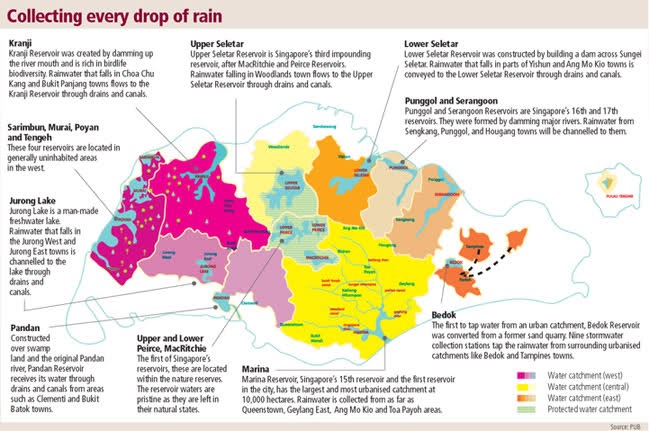
Singapore's water strategy comes in three parts. First of all, we have to maximise our own yield. So we strive to collect every drop of rain that falls here. This means turning as much of Singapore as possible into a water catchment, and keeping our drains, canals and waterways pristine.

Second, we have to think of water as an endlessly reusable resource. In our minds, the H2O molecule is never lost. Water can always be reclaimed and re-treated so that it can be drunk again.

PUB is a world leader in this. Today, we are able to turn wastewater into sweet water for very little money. We reclaim every drop of sewage and turn much of it into drinking water again.

And third, because Singapore is surrounded by sea, we turn seawater into drinking water. When membrane separation technology made desalination economically viable, PUB adopted it with great zeal. And we continue to research better desalination technology to find less expensive ways of desalting water.

Our plan, in the long run, is for fully 80 per cent of Singapore's water needs to be met by desalinated and recycled water.

TECHNOLOGY, INNOVATION, INGENUITY

The future of water security in Singapore may lie with desalination and reuse, but we also know that if we just do more of the same, the next drop of water will always be more expensive to collect, to treat and to deliver. So, PUB is always looking for new ways of doing things, new innovations that will let us produce water cheaper, and in an easier way.

Because the heavens do not give us enough water or the space to keep it, we have looked to clever science and high technology, and to human ingenuity, for improvements... It will be technology and innovation that will allow us to collect and clean our wastewater, and continue to keep our soil, rivers, lakes and seas clean and hospitable.

We are crystal clear about achieving three outcomes for research and innovation in the water sector: to increase water resources; lower the cost of production; and improve security and system resilience.

In order to achieve and sustain these outcomes, PUB has invested and continues to invest a lot of money in water-related scientific research, in nurturing human talent in water technology and engineering, and in actively developing a thriving and globally competitive water industry.

Water R&D is an exciting and fast-moving area. The cutting-edge science that PUB is supporting in research laboratories all over Singapore suggests that we are on the cusp of realising some truly game-changing technologies. Let me provide a few examples.

• Desalination may be weather- resistant, but it is energy- intensive and a costly means of making seawater drinkable. Working with collaborators, PUB is ready to demonstrate electro-deionisation - the use of a new separation technology - as a far more energy-efficient way of taking salt out of seawater. But why stop there? Mother Nature, as always, does it best. Mangrove and fish in the sea need fresh water too, and they are able to remove excess salt with minimal effort. Biomimicry offers great promise and is another area of research that we have devoted considerable resources to.

• PUB engineers who have made wastewater treatment their life work will tell you that there is "gold" in sewage. Sludge, an inevitable by-product of sewage treatment, is concentrated organic material. Energy can be readily recovered from sewage sludge in the form of methane gas. Because sludge management technology is advancing by the day, modern sewage treatment facilities are fast becoming waste-to-energy plants. PUB's planned Tuas Water Reclamation Plant will be just that. To be developed jointly with the National Environment Agency's Integrated Waste Management Facility, this combined unit will be a world first, bringing unprecedented synergies in terms of land use, energy savings and operational efficiency.

• Leaky pipes are enemy No. 1 for water network engineers. It is quite senseless to expend effort and energy in making water potable only to lose it through leaks in the water transmission network. Losses because of leaks are a perennial challenge for water utilities the world over, and the water systems in some countries can lose as much as half of their production due to leaks. Despite fastidious attention to finding and plugging pipe leaks here, keeping our losses at the current 5 per cent is a daily challenge for our engineers and technicians. Again, technology offers a solution. PUB is busy fitting out our extensive water conveyance network, most of which is underground, with sophisticated pressure and acoustic sensors. These not only detect pipeline ruptures, but careful study of sensor data will even help us predict imminent leaks before they happen, allowing us to do pre-emptive repairs.

Despite severely limiting geographic constraints, today's Singapore is not short of water.

As long as we at PUB continue to be smart and clear-eyed about our nation's water situation, and do our work well, there should always be enough water. This is possible only because we have used our imagination, researching and testing continuously, and have exploited technology to overcome our water challenges.

In this way, we have turned disadvantage into strength, and seemingly insurmountable vulnerability into endless opportunity.


Mr Ng Joo Hee, 49, leads PUB, Singapore's national water agency. In this role, he is responsible for the supply of potable water, the reclamation and treatment of used water, and the management of storm water in Singapore. He also holds a concurrent appointment as the Deputy Secretary (Special Duties) in the Ministry of the Environment and Water Resources.


Source: 

Straits Times
http://www.straitstimes.com/singapore/ensuring-theres-enough-water-always?utm_campaign=Echobox&utm_medium=Social&utm_source=Facebook#xtor=CS1-10


Thursday, November 19, 2015

Water water everywhere but not a drop to drink?

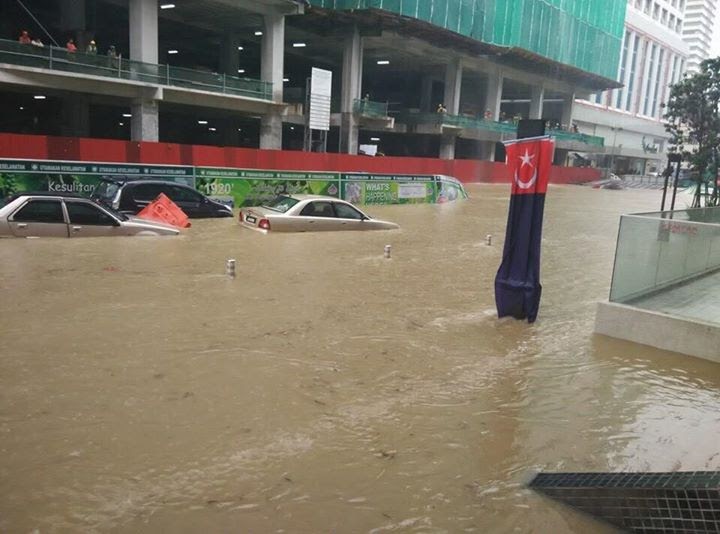
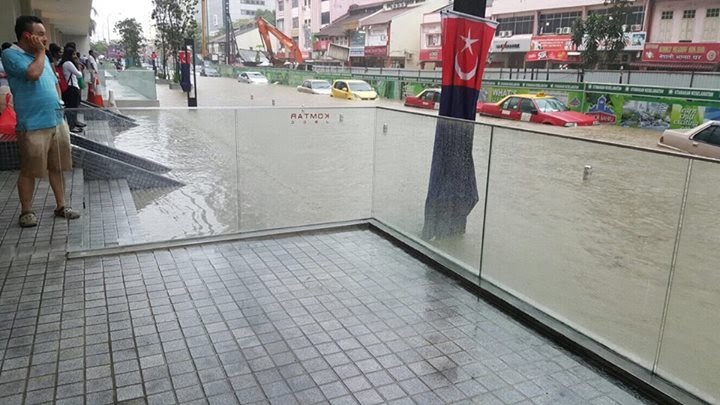
On 16 Nov 2015, our neighbours in JB experienced a storm due to the annual northeast monsoon. The two-hour long heavy rains resulted in severe flash floods right in the heart of JB town.

Severe flash floods in the heart of JB (FiveStarsAndAMoon)
Severe flash floods in the heart of JB (Fabrications About The PAP)
Ironically, in the previous months JB had been experiencing a dry spell which has resulted in the water level of Johor's Linggiu Reservoir dropping down to a historic low.

According to the Straits Times report, the reservoir is at about 43% capacity. And many parts of Johore are already being subjected to water rationing.

Picture from Masagos Zulkifli Minister, Environment and Water Resources

So what has all this got to do with Singapore?

Well, first of all, the Linggiu Reservoir regulates the flow of Johor River, from which Singapore and Johor draw water for treatment. So if the Reservoir runs out of water, Singapore would lose a part of its water supply.

But wait, wasn't there a flood in JB? Should the storm have at least filled up the reservoir a little?

Well, the answer is no, it didn't. The heavy rains that caused the JB floods had little impact on the reservoir's water levels.


"The heavy rain and subsequent floods in JB are in a different catchment area from the Linggiu Reservoir, which is further upstream," a PUB spokesman told The Straits Times yesterday. "While there has been some rain in the Linggiu Reservoir catchment, the water levels remain largely the same, at around 43 per cent."

In other words, all that rainfall in JB was "lost" to the sea instead of being diverted and captured in their reservoirs.

But how come Singapore hasn't been subjected to water rationing like JB? Don't we get most of our water from Malaysia?

Well, this article will shed some light on the mystery.

Tech Insider: Singapore has come up with an ingenious way to save water

In a nutshell, we have been described as a "giant sponge" that soaks up all the rain water we get and channel them into our own reservoirs. This together with an almost obsessive building up of reservoirs and catchment areas, and reclaiming sewage water with the NEWater technology, is providing Singapore with a substantial hedge against drought.

And all this wouldn't have been possible if Singapore hadn't taken a long term approach to invest and build up her self-sufficiency in water.

NEWater plant. Photo: PUB

As to why Singapore could do this, and Malaysia couldn't, well, I leave it to the readers to discern for themselves.

Read more here:

ST: Water level in Linggiu Reservoir hits record low, continued dry spell could affect Singapore

ST: JB downpour fails to raise reservoir level