Showing posts with label SG Patriots. Show all posts

Thursday, October 5, 2017

A Singaporean mother’s letter to her daughter on her 21st birthday

Saint Andrew's Cathedral, an Anglican cathedral in Singapore: "... Habib Omar’s journey to Singapore was also an act of faith. He was deeply religious and believed that Allah’s Rahmah (love) and compassion was for all humanity. Today, one of his legacies, the Masjid Omar Kampong Melaka, stands as the oldest and first mosque in Singapore. Soon after Masjid Omar was built in 1824, Habib donated a plot of his land to the Anglican community, so that they too could built their place of worship there. Today, St Andrews Cathedral stands as a beautiful testimony to the fundamental belief that “if God is important to you, God is important to everyone else, too”. Never forget this simple truth. ..."


A Singaporean mother’s letter to her daughter on her 21st birthday
BY MARIAM ALJUNIED
PUBLISHED: 7:50 PM, OCTOBER 2, 2017, TODAY Online


This is a letter from chartered psychologist Mariam Aljunied to her daughter Sara when she turned 21 this year, in which Dr Mariam Aljunied spoke about their family history dating back to the year Singapore was founded in 1819 and what it means to be a Singaporean growing up today.

Dr Mariam Aljunied’s great-great-great-grandfather, Syed Omar Ali Aljunied, built Singapore’s first mosque - Masjid Omar Kampong Melaka - in 1820 and also donated the land on which St Andrew’s Cathedral now stands to Sir Stamford Raffles.

Dear Sara,

You’ve been a blessing and a gift to both me and your dad. Your late Habib (granddad) once reminded me that the two things we must bequeath to our children are “roots to stay anchored, and wings to fly”. I’ve never forgotten this message. So in this significant year, your 21st, I want to share with you some things that I hope you too will never forget. These are messages that I’ve learnt in my lifetime: messages from the past, present and future; and messages that are forever.

MESSAGES FROM THE PAST

Sara, you’re a sixth generation of Aljunied in Singapore. In 1819, the same year that Raffles arrived in Singapore, your ancestor Sheikh Omar Aljunied came to Singapore from Tarim in Yemen, via Palembang.

He was a merchant, a trader and a philanthropist. His contribution as one of the founders of modern Singapore and his legacies to the nation are well documented in the National Archives and Museum. There are two things in particular about Habib Omar’s legacies that we should never forget:

Habib Omar came to Singapore with his wife, Sharifah Alwiyah Alkaff.

They had five sons and two daughters. All of his children were born in Singapore. Clearly, Habib Omar was not looking for ‘hotel Singapore’; he was finding a place to make a home for his children and his children’s children.

He was neither a refugee nor a runaway; he did not come to Singapore because of despair or desperation. He chose to come here to pursue a shared dream: the collective belief that this place was special, and could become even more special in the future.

For the next 200 years, when things were good, this dream was the driving force that spurred Habib Omar and other pioneers like him to reach for new successes. When things were bad, it was this belief that propelled them to persevere and fight-on.

Never forget that you and I are inheritors of this inspiration that they shared.

Habib Omar’s journey to Singapore was also an act of faith. He was deeply religious and believed that Allah’s Rahmah (love) and compassion was for all humanity.

Today, one of his legacies, the Masjid Omar Kampong Melaka, stands as the oldest and first mosque in Singapore.

Soon after Masjid Omar was built in 1824, Habib donated a plot of his land to the Anglican community, so that they too could built their place of worship there.

Today, St Andrews Cathedral stands as a beautiful testimony to the fundamental belief that “if God is important to you, God is important to everyone else, too”. Never forget this simple truth.

MESSAGES FOR THE PRESENT AND FUTURE

While we recognise and acknowledge where we came from, we must never forget where our roots are currently planted.

You and I have a historical link to Tarim and the Middle East, but emotionally, our connections are here. It is the people that we interact with daily - our families, friends, neighbours and community - that become ‘our people’; they are our Tribe.

It is with this Tribe that we share our everyday concerns and hopes for the future. An invisible thread joins our collective consciousness.

Our Tribal Tapestry is special; its colours expand as we embrace anyone and everyone who shares the same collective dream. This is how it has been for the past 200 years.

Never forget that we need to always strengthen this invisible thread. The stronger it is, the thicker and richer the Tapestry we can create for our Tribe.

I remember well the first time I brought you to the National Day Parade. You were 5 years old, and we got tickets for our neighbour Eline and her mum, too. You and Eline had been best friends since you first met each other during the playgroup session at the Sims Drive void-deck centre.

You became inseparable, and we enrolled you in the same preschool. You and Eline thoroughly enjoyed Singapore’s birthday celebration, and were dancing and singing loudly throughout the parade. That day, you asked me a curious question: “Mama, Singapore was born today, right? Who is Singapore’s mum and dad?”

Let me attempt to answer that question again.

Singapore does not have a mum or dad.

Singapore is unique, because we are simply born out of an idea. When we became independent in 1965, there was no invasion, mutiny or civil war. 
Our birth was driven by the ferocity of an idea. The idea that different people can live side-by-side and pursue their dreams together, without any one group being given special privileges over another, and at the same time, with everyone being given equal opportunity. 
52 years ago, enough people believed in this collective dream to make it come alive. 52 years on, we are still pursuing this idea. Never forget that it is our shared responsibility and collective actions that can make this ideal become a reality for all of us. It is always work in progress.

MESSAGE FOR FOREVER

At 21 years old, you are on the cusp of many exciting adventures in your life. Many of the pathways the future holds are ones which you have yet to even dream about. In navigating your future, I want to share one tip that I learned from someone much older than me.

A few months ago, while I was taking a group of students with physical impairment to learn dragon-boat racing at Bedok Reservoir, I met Mrs Lim, an 85 year old lady.

She was one of a group of seniors in wheelchairs at the same session. As we were taught to paddle, Mrs Lim began singing. Her enthusiasm and exuberance were so infectious that soon we all joined her and became a ‘singing dragon-boat’.

Later, I quietly asked Mrs Lim, what was her secret? How did she maintain such vibrant vigour and positive energy?

Mrs Lim smiled and whispered, “The secret is… to always do the things that makes you feel most alive”. Over the years, Mrs Lim had taken on the jobs of a baker, a kitchen hand and a sales assistant. Regardless of the role she held, she took any opportunity to sing, because for her, singing was what made her feel most alive.

Happy 21st birthday Sara. Never forget to do the things that make you feel most alive.


ABOUT THE AUTHOR:
Dr Mariam Aljunied is a chartered psychologist with more than 20 years experience working with schools, children with special needs and their families. She has a daughter, Sara, who turned 21 this year, for whom this letter is dedicated to. This piece first appeared in The Birthday Book 2017, a collection of 52 essays that examines challenges and opportunities for Singapore with the theme “What Should We Never Forget?”

Article Source: TODAY Online


Wednesday, September 20, 2017

[Defending the Lion City] Poignant observations


Original FB post here.


Thank You for your Service & Sacrifice.  
Rest in Peace


According to an Mothership article, the Family of the late 3SG Gavin Chan has welcomed the public to pay their respects.


Update 21 Sept: Mothership Editor’s note: A previous version of this story said the siblings of the late Gavin Chan were welcoming members of the public to pay respects to Chan. We were subsequently informed by them, via MINDEF, that this message was misconstrued and it was not intended to be open to everyone in Singapore; they were merely inviting their own friends to attend the wake. We have accordingly adjusted this article to reflect this.


Tuesday, September 19, 2017

[Defending the Lion City] Death of a Singapore Armed Forces Full-time National Serviceman


Update 21 Sept: Mothership Editor’s note: A previous version of this story said the siblings of the late Gavin Chan were welcoming members of the public to pay respects to Chan. We were subsequently informed by them, via MINDEF, that this message was misconstrued and it was not intended to be open to everyone in Singapore; they were merely inviting their own friends to attend the wake. We have accordingly adjusted this article to reflect this.

Update: 20 Sept According to an Mothership article, the Family of the late 3SG Gavin Chan has welcomed the public to pay their respects.
======================================

My heart sank when my Facebook feed showed Mindef’s post stating that a NSF had died while training at the Shoalwater Bay Training Area.


Military operations inherently carry significant risks, even during peace time training and exercises, hence the numerous safety measures and guidelines that are drilled into everyone all the time.

But even with the best laid plans, safety measure and what-not , no one can fully mitigate or eliminate such risks.

It is a tragedy that one of our Singapore Sons had paid such a heavy price for our country’s defence.

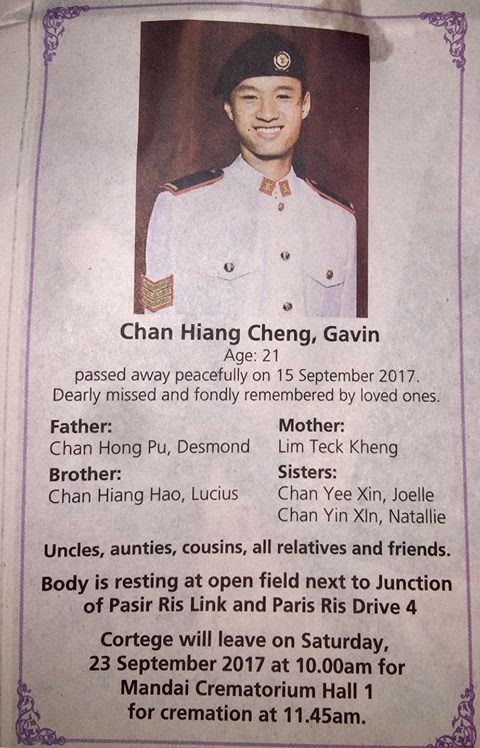
My condolences to the family and loved ones of 3SG Chan Hiang Cheng Gavin.

Rest in Peace bro.


============================================================


Death of a Singapore Armed Forces Full-time National Serviceman
Posted: 16 Sep 2017, 0030 hours (GMT+8)

A Singapore Armed Forces (SAF) Full-time National Serviceman, 3rd Sergeant (3SG) Chan Hiang Cheng Gavin, 21, a Vehicle Commander from 41st Battalion Singapore Armoured Regiment, was involved in a vehicular incident at the Shoalwater Bay Training Area in Queensland, Australia at around 1815hrs (SG time) on 15 Sep 2017.

3SG Chan was travelling in a Bionix Infantry Fighting Vehicle as part of an exercise when the incident happened. An SAF medic commenced resuscitation efforts on 3SG Chan, who was unconscious. 3SG Chan was evacuated via a helicopter to Rockhampton Hospital, where he succumbed to his injuries and was pronounced dead at around 2236hrs (SG time).

A safety pause on training in Shoalwater Bay Training Area has taken effect, and an investigation of the incident is ongoing.

The Ministry of Defence and the SAF extend their deepest condolences to the family of the late serviceman and are assisting the family in this time of grief.


Source: Mindef


Media Reports


============================================================


Updates:

20 Sept: The Central Queensland Plane Spotting Blog has more pictures here.

19 Sept, 11am: The Central Queensland Plane Spotting Blog has posted on their FB page of what seems to be an Honour Guard for 3SG Gavin Chan before he is being flown home.
Thank you for sharing.

19 Sept: 3SG Chan Hiang Cheng Gavin will be accorded the honours of a military funeral. (Source: ST)


============================================================

Straits Times: NSF's death in Australia: Vehicle landed on its side
Published Sep 17, 2017, 5:00 am SGT

The 21-year-old Singapore Armed Forces (SAF) full-time national serviceman who died on Friday at the Shoalwater Bay Training Area in Queensland, Australia, was guiding a vehicle out of difficult terrain when it landed on its side.

The Ministry of Defence (Mindef) said in an update yesterday that 3rd Sergeant (3SG) Gavin Chan Hiang Cheng, who was the vehicle commander of a Bionix Infantry Fighting Vehicle, was found unconscious next to the vehicle.

The driver and two other passengers travelling in the vehicle were unhurt, the statement said.

An SAF medic carried out resuscitation on 3SG Chan, and two SAF medical officers arrived shortly after to treat him.

He was evacuated via an SAF helicopter to Rockhampton Airport, and later transferred by local ambulance to Rockhampton Hospital, where he died from his injuries.

He was pronounced dead at 10.36pm Singapore time on Friday.

3SG Chan's next of kin arrived in Australia yesterday morning, accompanied by family-liaison officers from the SAF.

The serviceman, who was from the 41st Battalion Singapore Armoured Regiment, was taking part in Exercise Wallaby when the incident happened at 6.15pm (Singapore time).

Exercise Wallaby, an annual event now in its 27th year, is the SAF's largest unilateral overseas drill.

Mindef said that an investigation into the incident is ongoing. It added that a safety pause on training in the Shoalwater Bay Training Area has taken effect.

Mindef and SAF said that they are assisting 3SG Chan's family in this time of grief.

Source: Straits Times

============================================================


Thursday, March 23, 2017

We Remember - In Mr Lee's later years, the world turned to him as seer and sage


Straits Times: In Mr Lee's later years, the world turned to him as seer and sage

His insights led him to be regarded as the man who helped make history
BY RAVI VELLOOR, ASSOCIATE EDITOR , 24 Mar 2015

PERHAPS this article should begin with Henry Kissinger, the guru of realpolitik who was secretary of state to United States president Richard Nixon and shared a long association with Mr Lee Kuan Yew. Perhaps with the words of another lifelong friend of Mr Lee's, former German chancellor Helmut Schmidt, or Britain's Margaret Thatcher. Maybe even India's Sonia Gandhi, whose famous mother-in-law, the late Indira Gandhi, had a sometimes testy association with Singapore's founding father.

But that would be all too predictable.

So let's start with what an African American cabby in a city not known to have a particularly deep interest in the wider world had to say about Mr Lee.

It was 1998 and, visiting New York, I was in a yellow top from my hotel near Central Park to catch up with friends at a micro-brewery pub off Times Square. The driver was an emigre from Nigeria and, as in the manner of cabbies everywhere, curious to know more about his ride.

When he heard I lived in Singapore, he chuckled loudly.

"Hey, you are the guys who caned the American kid," he said. "You stood up to President Clinton and you did damn right. Who's that old man who runs your country - Lee?"

He was referring to Singapore's punishment, in 1994, of teenager Michael Fay for vandalism. After then President Bill Clinton intervened, Fay's caning sentence was reduced from six strokes to four.

Singapore's decision to go ahead with the punishment made headlines around the world. Annoyed at the island's steadfastness, Washington voted against plans to hold the inaugural meeting of the World Trade Organisation in Singapore.

Fortunately, diplomacy and good sense prevailed. The inaugural summit, held in late 1996 at Suntec City, went through smoothly, highlighting Singapore as the world's pre-eminent trade-driven economy.

In many ways, the Fay incident and how it was received abroad underscores the world's perception of Mr Lee and the foundations on which he built Singapore.

Intellect and integrity, common sense above compassion, inclusiveness in domestic and foreign policy, a practical, non-ideological approach to issues, an unwavering commitment to globalisation and free markets, and a firm determination to enforce the rule of law - these are the qualities the world came to recognise in Mr Lee, and today, Singapore.

Some years later, when I was posted to India as the South Asia bureau chief for this newspaper, I would become aware that the world viewed Mr Lee's Singapore as more than an efficiently administered state - that it also stood for a healthy, throbbing habitat.

Outside a golf course in Greater Noida, a boom town in the notoriously poorly run state of Uttar Pradesh, I would frequently pass a billboard advertising a new, tree-lined condominium complex with plenty of water bodies. The promise was "Singapore-style living".

Without question, the reputation of an irascible, combative, Western lackey preceded the hallowed image of the sage and seer Mr Lee bore in his later years.

In the post-colonial era and its emphasis on non-alignment and suspicion of Western multinationals, his hard-nosed, contrarian approach and his open welcome of foreign investment evoked much disdain. "Lee is like a banana - yellow of skin, white underneath," then Chinese Premier Zhou Enlai complained at the Bandung Conference in 1955, echoing the Chinese view of the time.

A quarter-century later, the Chinese leadership would instruct rising party figures to travel to the island to study its growth and governance model.

In 2012, no less than President Xi Jinping ordered China Central Television to produce a series on Singapore.

From the mid-1970s, global companies such as Silicon Valley legend Hewlett-Packard, Seagate, DuPont and Sony would arrive in droves on an island with few resources except having a good location in South-east Asia and a clean, efficient government run by Mr Lee. The jobs they provided and the technology they brought elevated Singapore to new heights - which was precisely why Mr Lee had invited them.

In 1999, Mr Lew Platt, retiring as chairman and chief executive of Hewlett-Packard, made a farewell visit to Singapore with his successor Carly Fiorina. As always, they used the opportunity to touch base with the leadership here and exchange ideas. "He is a mensch," Mr Platt told me later of Mr Lee, using the Yiddish word for a wise man who radiates fortitude and firmness of purpose.

The fortitude, which rose from deep conviction, came with a price on occasion. Mr Lee, it was well-known, was prone to hectoring his interlocutors, especially when he believed they were under-performing in their potential, either as individuals or as leaders.

The Malaysians, particularly, did not take it well and it continues to rankle with the old guard. Several years ago, in a blog posting, former Prime Minister Mahathir Mohamad called Mr Lee a "little emperor... who likes to lecture us on how Malaysia should be run".

Mr Maurice Baker, one of Singapore's first-generation diplomats, once told me of a time he had arranged a visit to Singapore by then Malaysian Deputy Prime Minister Musa Hitam, at a time of particularly prickly ties.

Mr Baker, then High Commissioner to Malaysia, had sent word ahead that Mr Lee must be careful to hold himself back and give Mr Musa a good hearing. "Musa came back fuming," Mr Baker recalled. "Rather than listen, LKY had given him a long lecture."

Another person he rubbed the wrong way was Mrs Indira Gandhi, the Indian prime minister who was so powerful in her time that some worshipped her as the incarnation of the demon-slaying Hindu goddess Durga.

In the early 1980s, on the sidelines of a multilateral meeting in New Delhi, Mr Lee, who had a long association with the Nehru-Gandhi family, is said to have pressed Mrs Gandhi to roll back her socialist policies. He thought India was best served by building a free-market economy that would propel the country to the heights he thought it could achieve. Mrs Gandhi is said to have responded frostily, causing a slight chill in an old friendship.

In later years, Mr Lee, watching China's rise and frustrated by the slow-footedness of the South Asian giant in catching up, was often publicly critical of India's tedious democracy, massive bureaucracy and litigious society that he thought held back the country.

Years later, a successor Congress government would set in motion policies that would open India's economy, spur growth and place it on the world stage as an emerging power. And in 2005, the Indian government would honour Mr Lee by asking him to deliver the Nehru Memorial Lecture where he announced that he had revised his view of India.

Speaking at the function, Congress party chief Sonia Gandhi turned to him and said: "Mr Lee, we in India have listened to you with great respect - even when you were critical of us."

Little surprise that when her son Rahul, seen as a potential prime minister himself, decided to enter politics, he came to Mr Lee for advice. Some say his decision to bide his time while building the Congress organisation from the grassroots up is based on advice from Mr Lee.

By the turn of the century, Mr Lee's reputation as a clear-headed visionary had encompassed the globe. From Mr Nixon to Mrs Thatcher and the two Bushes who occupied the White House, all had turned to him as a trusted resource on the great changes in Asia, particularly China. It was perhaps his measured analysis and deep insights that helped the Western world accept the rise of China without feeling undue unease or a need to block it.

At a White House meeting in October 2009, President Barack Obama hailed Mr Lee as "one of the legendary figures of Asia in the 20th and 21st centuries".

Perhaps most satisfying for Mr Lee would be that he lived to see the Western media's sniping at him, and Singapore, turn to grudging respect, even admiration.

Singapore's tough position on long hair, chewing gum and its "fine city" reputation gave plenty of grist to the mills of the global media. As recently as August 2002, New York Times columnist William Safire, criticising Bloom-berg News for settling a libel lawsuit brought by Mr Lee, sniped that Singapore was "an island I cannot visit because I like to chew gum and don't want to risk a caning for it".

But that would change, particularly as Mr Lee stepped down at the height of his power, signalling to the world his belief in planned transitions.

In December 2005, Time Magazine Asia, after interviewing him for more than five hours, put him on the cover as "the man who saw it all".

"Everybody who lives in Asia today thinks they are watching history being made," the Time editors wrote. "Lee Kuan Yew is one of those who can say, without fear of contradiction, that he helped make it."


Source: MFA , Straits Times

We Remember - The Man Who Saw It All


The Man Who Saw It All
Monday, Dec. 12, 2005
By Simon Elegant and Michael Elliott | Time


In years past, Lee Kuan Yew's office was famous among visitors for its arctic air conditioning and Spartan furnishing. A few Chinese scrolls apart, there was little decoration and sometimes barely a sheet of paper to be seen. Singapore's founding father first moved into the office on the second floor of the former British governor-general's residence in 1971, having already served six years as Prime Minister. He retired in 1990 to become Senior Minister and later Minister Mentor, but still works out of the same rooms.

The L-shaped office may have changed little over the years, but at a recent meeting there were small but telling signs that the formidable 82-year-old leader has mellowed — a little. For one thing, the temperature has crept up noticeably. And while most surfaces are still bare, the table behind Lee's computer is covered with untidy piles of books. Lee says that his current favorite isn't one of the stacked tomes on terrorism or economics but the sprawling 17th-century Spanish novel Don Quixote. "A new translation," he enthuses. "Very good." It's something of a shock that the man best known for his cold-eyed pragmatism is reveling in a book whose hero spent his time tilting at windmills and gave his name to an English adjective meaning impractical and idealistic.

Still, despite his more relaxed demeanor, when Time spoke to him for nearly five hours over two days this fall, it was clear that neither age nor heart surgery 10 years ago have changed Lee's basic personality: sharp intelligence allied with an unsentimental, almost clinical rationality and supreme confidence in his own judgment. But there is another side to Lee that has been blossoming in recent years — that of the geopolitical thinker and analyst, a role he clearly relishes. The man who once concerned himself with every aspect of Singaporeans' lives — right down to who they should marry and how many children they should have — now seems to be less obsessed with the fate of the island state, and more concerned with China's "peaceful rise" and the threat of militant Islam. Asked about Singapore's future development over the next 10 years, Lee shrugs. "My son will do what he wants to do with his team," he says, referring to Singapore's current Prime Minister, Lee Hsien Loong. "Let him decide," the elder Lee adds later. "It's his call."

Lee can be forgiven for lifting his eyes to the horizon. Once the subject of withering criticism from human-rights groups for his authoritarian ways and intolerance of dissent, he is now widely acknowledged as Asia's most respected senior statesman. Others may pen lengthy memoirs and seek to use their years on the world stage to tout their punditry and powers of prediction. Some can even lay claim to having guided far larger countries or served as leaders for longer than Lee. But Lee is unique. It is not just that his cold-eyed, totally nonideological analysis has set him apart from other observers of Asia. There is another factor that is just as important an explanation of Lee's influence. From his days as a clerk and a black-market broker during the brutal Japanese occupation of Singapore — which he was lucky to survive — through his years as an agitator for independence from Britain, from his time spent talking to the Americans during the Vietnam years to his role as a confidant of China's leadership, Lee has seen it all. He has been a participant observer of the most significant historical shift of our times — the steady ascent of Asia, home to 60% of the world's population, from the twin shames of Western colonialism and poverty to its coming economic and political dominance. Everyone who lives in Asia today thinks they are watching history being made; Lee Kuan Yew is one of those who can say, without fear of contradiction, that he helped make it.

Now, with his own son and a hand-picked team of technocrats in place in Singapore, Lee has time to turn his thoughts outward, to Asia — and beyond — while trying to divine the forces that will confront a new generation of leaders. It is an opportune time for such musings, a moment of balance when the critical observer can look back and forward and see the region on the cusp of profound change. Symbolic of a new order has been a string of summits and conferences in Asia. The parade of presidents, prime ministers, princes and their attendant ministers began with the Asia-Pacific Economic Cooperation summit held in mid-November at South Korea's seaside city of Pusan. And it will end with the opening on Dec. 14 of the first East Asia summit in Kuala Lumpur.

The summit may not live up to its hype; few such gatherings do. But it is not unreasonable to see the meeting in Kuala Lumpur as a punctuation mark in the 60-year-long progress of Asia. The leaders of the 10 countries of the Association of Southeast Asian Nations will meet together with those of Japan, South Korea, India, Australia, New Zealand — and China. The U.S will not be present. Some of the more breathless commentary on the summit sees parallels to the meeting of European leaders in Messina in 1955, which laid the foundations for what has become the European Union. Lee, characteristically, takes a view which is more hardheaded yet fully aware of the historical significance of the meeting. "I see the first stage as an ever-enlarged series of free-trade areas, [leading to] one big free-trade area within 10 to 15 years," Lee told Time. "The next step would be a kind of low-key European economic community, 20 to 30 years down the road, because [Asia is] at very different stages of economic development." Lee recognizes that bringing India and China into the fold marks a moment of profound significance. The revival of these "two ancient civilizations," he says, is a double-edged sword. "It would mean great prosperity for the region, but could also mean a tussle for power."

After nearly 50 years in government, Lee is more than qualified to speak about power and its dangers. But it is not only years of experience and his dispassionate intelligence that have led to his eminence. Lee also embodies a uniquely Asian approach to governance that has often been at odds with the democratic principles espoused by many Western politicians. For decades, he has spoken in favor of what has come to be termed "Asian values" (he prefers "Confucian values"), a political philosophy that might be loosely summed up as respect for authority and order, while putting the good of society above that of the individual. His criticisms have focused on the excesses of unfettered democracy — particularly freedom of speech — and the impact they have on the search for economic growth.

In the past, Lee has not been shy about singling out those nations (the Philippines has been a favorite target) in which an excess of democracy's messiness — as he might put it — has tempered steady economic progress and the betterment of the life chances of ordinary folk. But the strength of his argument does not rest only on other nations' failures. Above all, it is bolstered by Singapore's success. For as any visitor can attest, the scale of what Lee and his colleagues have achieved by applying his principles — in what Singaporean academic and fiction writer Catherine Lim has described as "an authoritarian, no-nonsense manner which has little use for sentiment" — is simply astonishing.

When Singapore was ejected from Malaysia in 1965, it had no natural resources save for the enterprise of its largely Chinese population and its port's position astride one of the world's major shipping lanes. It possessed little industry or infrastructure besides a naval base and ship-repair facilities left behind by Britain's shrinking navy. Most of the population lived cheek by jowl in ramshackle two-story shophouses or traditional village houses fashioned of rattan and bamboo. It was poorer than Mexico. Today, the city is one of Asia's most modern metropolises, the business district bristling with skyscrapers and ringed by highways. Over 90% of the population own their own homes, most of them well-maintained and scrupulously clean apartments in government-built blocks. Singapore's cultural life — a phrase that was once oxymoronic — is now at least as vibrant as those of other cities in Southeast Asia, with a sparkling new performing-arts center and some of the best restaurants in the world. After decades of strong economic growth, per-capita income last year was $24,220, about the same as Italy. As they trip around Asia, popping off to Bali or Perth for the weekend while dressed in Prada and Gucci, wealthier Singaporeans could be forgiven for pitying their former European masters, whose day in the sun — they will sometimes tell you — is now all but over.

It is an almost miraculous achievement, and one in which Lee and his colleagues take justifiable pride. It is, moreover, something that has been much admired, to the point of imitation, around the region. Asian leaders like Malaysia's Mahathir Mohamad, Thailand's Thaksin Shinawatra and Indonesia's Suharto may rarely have chosen to admit it, but their "economy first" strategy owes much to the intelligence of a Cambridge-educated lawyer who — he admits — was himself "distraught" when his island state found itself independent and alone. Above all, with their horror of chaos, luan, China's leaders have for three decades come to Singapore to listen, to learn, and to admire. Progress coupled with order and limited freedoms has been the maxim of those who have ruled China since Mao Zedong's death; it is a philosophy whose modern origins have their wellsprings in Singapore.

Yet for all Singapore's success, there remains a feeling that it has come at a price. Lee's methods — which despite a deliberate attempt to soften the image of the ruling People's Action Party (PAP) remain at the core of his successors' approach to governing — have found plenty of critics at home and abroad. The reaction of ordinary Singaporeans when questioned about politics or Lee and his family is telling. Without them quite knowing it, there is often an instinctive lowering of the voice and a glance over the shoulder. "People are still too frightened to talk about the taboo subjects," Catherine Lim wrote in a lengthy essay published in the Straits Times in May. There is no effective political opposition to the PAP, and few voices prepared to speak out in favor of wider democratic debate. "I think [Lee] taught us fear," says theater director Ong Keng Sen. Lim argues that the stress on order and discipline, arguably essential to an earlier stage of Singapore's development, may harm it now. "A model of governance that has no place for political openness carries with it the seeds of its own decline or even demise," she wrote. "For it will have bred a politically naive, dependent, manipulable people who ... can be compared to artificially nurtured hothouse plants, unable to survive if thrown among the sturdy plants in the wild."

For his part, Lee acknowledges that there is a need to make Singaporeans less dependent on the government and to encourage more open debate. He insists that the PAP can absorb and benefit from dissenting voices. "Anybody can join the PAP and change the policy from within," he says. "If you've got a better idea, you come in, you convince us, you take over." But he is adamant that Singaporeans are not yet ready for the vociferous free market of ideas that typifies, for example, politics in the U.S. "I see the marketplace of ideas, as in the Philippines, and I see chaos," he says, while adding: "Gradually, we will loosen up."

Those who wish Asia well will hope that Singapore does so. This is not just because modern Singaporeans deserve the chance to show that they are sufficiently talented to hold their own in any clash of ideas and ideologies (which they most certainly are.) It is because Singapore's achievements, and Lee's influence, extend far beyond the shores of an island of just 700 sq km and 4 million people. Lee's little nation is a testimony to what hard work and discipline can do to improve lives. That, perhaps, is legacy enough. But what a place in history there would be for Lee if his successors prove that Singapore can marry continued economic prosperity to a more open, tolerant, creative, and, yes, messy society — and hence create a new miracle, from which other nations, bigger, more powerful and more potentially frightening than Singapore, could one day learn anew.


We Remember - Mr Lee Kuan Yew, 1923 - 2015

Mr Lee Kuan Yew, 1923 - 2015


Mr Lee left us two years ago.

There were some who gleefully remarked that his death would mark the beginning of the end of Singapore.  Is there any truth to their ominous prediction?

Two years later, Singapore is still as vibrant as ever if not more, even in today's challenging global economy and uncertainty.

In fact, Singapore is yet again in the mist of transforming itself , gearing up its people to meet the realities of a future where information and data is the lifeblood of the global economy.

And yet, many of the national institutions that Mr Lee and his generation had built up and put in place, have withstand the test of time, and remain just as relevant and important to us.

Institutions like our like our education system, our strong SAF and Home Team agencies, tirelessly seeking water independence, our healthcare system, CPF, housing - all these institutions, while evolving to the needs of Singaporeans, remain as the critical pillars of our nation that enable Singapore to go seek out new heights.

Singapore continues to thrive and grow, boldly meeting challenges and headwinds with confidence in ourselves and a determination to succeed.

This, and this alone, is the greatest memorial and tribute that we can ever have for Mr Lee and the Pioneer Generation who spent their lives laying the foundations of today's Singapore.


Wednesday, March 15, 2017

[Defending the Lion City] If Singaporeans don't defend Singapore, who will?


If we don't defend Singapore, who will?
By First Warrant Officer (Retired) Ali Pawiro, 14 March 2017
Published by The New Paper


I remember they barged into my home, taking all the canned food off our shelves. On both their wrists were watches, probably stolen from the households they raided before ours.

I asked: "Who were they? How could they just come in and take our stuff?"

I was just a 10-year-old boy.

When I was older, I worked in a bank as an office boy. I heard about the opportunity to enlist in the Singapore Volunteer Corps and went to sign up eagerly. But my application was rejected as I was underage. I applied again as soon as I was eligible.


Singapore Volunteer Corps Cap Badge circa 1928 - 1942 


While I cannot say exactly why I wanted to volunteer so badly, I believe my childhood experience might have been a major factor.

After joining as a volunteer in 1952, I worked my way up to become a corporal. They soon discovered I had a knack for instructing, so in 1954, 15 of us were selected as permanent staff instructors, trained by the British army.

I was eventually appointed regimental sergeant major of the Officer Cadet School, in charge of drills and weapons training.

I served as an instructor for years and had the opportunity to watch my son Azlan, and more recently my grandson Afiq, serve the nation.

I have seen some things change over the years, but there are also some which will always remain the same.

One key difference is the role of technology in the Singapore Armed Forces (SAF).

Since my time as an infantry instructor, our weapons have become lighter and they shoot faster. This has made us more agile.

I started off with the bolt-action rifles, then the self-loading ones, and finally the M16 rifles.

Now, I hear they have upgraded to the SAR-21 rifles.

I am a little jealous because Afiq tells me that the SAR-21 is even equipped with a laser-aiming device for better accuracy.

Even the changes in the SAF uniform over the years bear testament to the important role that technology plays in upgrading the SAF's capabilities.


Different SAF uniforms over the years 
Pic: AsiaOne


The pixelated uniform that Afiq wears is far lighter and more comfortable than the Temasek Green uniform I had.

Training methods have also improved. I remember when we were training under the Israeli Defence Force advisors before my posting to SAF Training Institute, we were told to dig trenches with our hands.

We tried to tell them this was impossible because the ground was hard rock. It was only after I showed them that even my cangkul (Malay for hoe) broke from digging that they conceded that their instruction was not very logical.

We have come a long way since. Our national servicemen today are highly educated, and lessons are now very detailed and structured.

Azlan and Afiq have told me of how their instructors explained what they were doing and why they were doing it.

This has helped them to better understand the rationale behind the training session and consequently, for the soldiers to train with stronger conviction.

As a former instructor myself, I cannot help but agree that those with a strong conviction are more committed to give of their best in training.

I have had my fair share of challenges, but never once did I feel that my sacrifices and hard work were not worth it.

My commitment to serve is still as fresh as it was when I signed up to be a volunteer. Azlan and Afiq feel the same way.

In our conversations after they enlisted for national service, they came to understand what an honour and great responsibility it was to put on the SAF uniform and defend Singapore.

I am confident that our servicemen and servicewomen feel the same.

Despite the many years of peace and prosperity that Singapore has enjoyed, we must never forget that what you cannot protect is not yours.


Skulls, bones and other grisly remains being exhumed from a mass grave of Operation Sook Ching victims in Bedok on June 10, 1966. Pic: The Straits Times


For this reason, NS is vital to our nation's survival and continued way of life.

Although technology has contributed to a strong NS system, our people and their sense of purpose are what matters most.

I think there was an important lesson for us to learn that day as we were digging the trenches.

Nobody likes to dig a trench, not even with a cangkul, especially under the hot sun, but we still do it anyway.

Why? Generation after generation, if we cannot overcome hardship, how can we think of doing the bigger things like defending our families and protecting this land we call home?

And if we don't protect Singapore, who will?


The writer spent 29 years in the army and was the Singapore Armed Forces Officer Cadet School's first Regimental Sergeant Major. Today (14 March 2017) is the 50th anniversary of the NS (Amendment) Bill.


Article Source: The New Paper


Read more here:
Mindef: Standard Singapore Military Rifles of the 20th Century

NLB Infopedia - Singapore Volunteer Corps

Singapore and Malaya Volunteer Corps

Mindef: Looks do matter - new SAF combat uniform

AsiaOne: Meet Singapore's No. 1 military buff who's spent over $80,000 on his collection


Monday, November 14, 2016

[Defending the Lion City] In memory of 2LT Tay Seow Kai

2LT Tay Seow Kai (1949 - 1970)

Most of us would have been fortunate enough to have gone through our NS stint without much drama, save perhaps a few bruises and light injuries.

However, there are the rare few who have made the ultimate sacrifice in service to the nation.

2LT Tay Seow Kai is one of the few who made sacrifices that as a nation, we should not and cannot forget.


=================================================================


'Let Singaporeans remember the real Singapore heroes' 
By Sim Boon Leng (via Facebook), 12 Nov 2016

I would like to share the story of a forgotten hero, 2LT Tay Seow Kai. A true hero who gave his life at the young age of just 21 years old to save others' life.

He was the 3rd son and brightest of a family of 12 siblings. He was good in painting and many more.

He joined the Singapore Arm Force after his studies. And with the monthly allowance, he provided for the family and took care of the younger siblings.

He did well in the SAF and was then promoted to an officer. However, tragedy struck. On that faithful day during a live grenade exercise, a recruit Kwok fumbled while handling a live grenade. Uncle Seow Kai grabbed the grenade from Kwok'. It then exploded in his hand, killing him in the process. Recruit Kwok life was saved along with another corporal.

This incident happened on 26 August 1970. Uncle Seow Kai's name has been forgotten by many. It is an injustice to him if his bravery and heroism are forgotten as well.

Please share this story if you can. Let Singaporeans remember the real Singapore heroes and Uncle Seow Kai is one of them.

Source: https://www.facebook.com/sim.boonleng/posts/10155106605462289

Photoshttps://www.facebook.com/sim.boonleng/posts/10155109973392289?pnref=story


=================================================================

The following is the description of 2LT Tay Seow Kai's actions, extracted from a RSIS Commentary written by Samuel Chan.

2LT Tay Seow Kai
"... there was the distinguished action of 2LT Tay Seow Kai when a recruit fumbled with a grenade during live practice on 26 August 1970.  
The watchful 21 year-old platoon commander snatched the grenade to shield his recruits from danger.  
The ensuing detonation fatally wounded Tay but his selfless action saved two recruits that fateful day.  
He was buried in Chua Chu Kang Cemetery with full military honours on 28 August 1970. ..."
Source: S. Rajaratnam School of International Studies (RSIS)

The following paragraph is extracted from a RSIS Commentary written by Samuel Chan.

Sending a clear message 
"... The actions of Lieutenants Teo, Tay, and Zulhelmi are also testaments to the dedicated individuals found in the SAF. 
Their devotion to duty does not pale in comparison to those awarded the SAF Medal for Distinguished Act. 
Perhaps, they only failed to qualify for the decoration by virtue of time and administration. In fact, it can be argued that these three examples warrant the retrospective award of (or upgrade to) the medal. 
By making this so the defence establishment would be sending a clear message that dedication to service is valued and will never be forgotten. 
It will speak volumes that individual commitment to defence will be recognised and acknowledged consistently regardless of era, and that time does not age or separate distinguished acts. 
This is especially poignant as the SAF undertakes a relentless schedule of operations and exercises both domestically and internationally. 
Honouring these past deeds in a consistent manner is part and parcel of doing the right things. This goes beyond the medal as an object and heraldry as a system. 
It delves into the very heart of what makes the SAF strong – the people and its values. This SAF Day on 1 July would be an opportunity to make things right. ..."

Source:
Making Things Right: Retrospective Honours for Distinguished Acts

=================================================================

Perhaps it is about time that Singapore should consider having a monument dedicated to the memory of those who have made the ultimate sacrifice in the line of duty to the nation - not just only for the SAF but for the SPF, SCDF and other govt agencies.

In addition to recognizing their sacrifice to the nation, the monument would also serve to remind Singaporeans who our heroes are, what they believed in, and ensure that the story of their heroic deeds will never be lost to time.


Friday, September 16, 2016

One Singaporean's view


Fireworks during the National Day Parade preview on July 23, 2016. ST PHOTO: KEVIN LIM


By Ganesh Sundram (via FB post), 16 Sept 2015

So.... my country has one neighbour thats always having "forest fires" at only one particular time... every year.... without fail.... causing a huge smog issue.... every year.... without fail.... and when my country offers help... that neighbour refuses.... it also blames my country abt the smog... saying that the smog is caused by companies owned by singaporeans burning stuff... in their land....not only that... that same neighbour is now complaining about airspace that my country is using... saying that it wants to take that airspace back....


Then... my country has another neighbour... whose leader jus anaconda swallowed a heap load of money.... and now... there is a protest going on in the capital of that country.... to a point where riot police have been engaged....


My country is an island... set in the centre of these two juggernauts.... and it doesnt have issues like this.... it is also so small that if u zoom out on the world map... so that u can see the entire size of my two neighbours.. you cannot see my country..... my country also jus held its elections.... and after that... i could still go out freely... work... shashay around and come home like nothing happened.........

You know whats the strange part??? My two neighbours... if i walked up to any of their citizens and scorned at their countries.... i would probably get slapped and slashed..... they have this undying love and patriotism towards their countries... its not funny...

But here... in my own country.... where i am protected... fed... educated... sheltered and given a standard that compares to the world's superpower..... i have fellow countrymen and women who scorn and scoff at my country....

I have my own countrymen and women questioning my government's intergrity....


My dad always said...

"you can wake someone who is sleeping... but you cannot wake someone who is pretending to sleep"

Thank you singapore... thank you... my government.

Thank you very much.

Pics inserted by DTCL.


Tuesday, August 23, 2016

The many facets of Mr S R Nathan


The early years
Born in Singapore on July 3, 1924, Mr S R Nathan had a difficult life growing up. He lost his father when he was 8. He was expelled twice from school, first by Anglo Chinese Middle School and then by Victoria School.


PIc: Remembering S R Nathan Facebook page A portrait of Mr Nathan at around age 18.

At 16, he left home for Muar to look up an old barber and stayed with him while working as a clerk, reuniting with his family four years later during the Japanese Occupation. 
When the war ended, Mr Nathan worked as a clerk in the Public Works Department. When he started university at the age of 28, he took no pay leave from work but would still go back during vacations to earn extra pocket money. 
Source: Remembering S R Nathan Facebook page


As a Social Worker
After completing his diploma in social studies with distinction at the University of Malaya, he entered the Singapore public service as a medical worker in 1955, and took up a posting with the seafarers union a year later. 
As a seamen’s welfare officer, he helped seafarers to resolve their grievances, such as wrongful discharge, unpaid wages or bad treatment. During his stint, the young Mr Nathan built a reputation for being willing to go above and beyond to help the seafarers, and even earned the confidence of employers in the shipping companies that he had to negotiate with.
Read more here: TODAY - S R Nathan, 'who always put country before self', dies

As a Unionist in NTUC

Mr. Nathan was pivotal in reshaping the Labour Movement from that of antagonistic, adversarial unionism to that of rational discussion of mutual interests. The Labour Movement was to have a large role to play in nation building. 
Mr. Nathan helped workers in every way possible. From individual assistance, collective bargaining, solving disputes and laying the bricks for tripartite partnership, he was involved every step of the way. 
“He understood human beings”, quotes Mr. R.O. Daniel, 77, a retired civil servant who worked with him in the Labour Research Unit. “He had diplomacy inherent in him even from the early days”
Read more here: Five Stars and a Moon -  The world of SR Nathan in 1961

As a Diplomat


On 31 January 1974, four men armed with submachine guns and explosives attacked the Shell Oil Refinery on Pulau Bukom Besar, an island south of mainland Singapore. After they failed to blow up the oil tanks, the group – dubbed the “Bukom bombers” by the newspapers – hijacked the ferryboat Laju at the Bukom jetty and held five crew members hostage.


Pic: The New Paper - The marine police negotiated with a Laju hijacker


After several days of negotiation that involved the governments of Singapore and Japan, the hijackers agreed to release the hostages in exchange for a party of guarantors to ensure their safe passage out of Singapore.  
The Singapore guarantors – comprising eight government officials and four Singapore Armed Forces commandos – were led by S. R. Nathan, who was then director of security and intelligence at the Ministry of Defence. 
The incident ended on 8 February 1974, when the hijackers left for Kuwait with the Singapore guarantors. 
Upon arrival in Kuwait, the Singapore party handed the matter over to the Kuwaiti and Japanese governments and returned to Singapore, arriving the following day on 9 February. 
This incident was our young nation’s first encounter with international terrorism. Singapore was then the world’s third-largest oil refining centre, and supplied a substantial amount of oil to countries in the region. There would have been severe and far-reaching economical impact on Singapore had the terrorists succeeded in their objective to destroy the oil refinery at Pulau Bukom. 
The Singapore government’s experience in the long, drawn-out negotiations with the terrorists as well as with the Japanese and North Korean governments during the Laju Incident reminded Singapore’s political leadership of the need to have an effective, dedicated force in the event of any terrorist attacks on Singapore. This led to the development of the Special Operations Force (SOF) from the SAF Commandos in 1985. The SOF was deployed in the hijacking of Singapore Airlines Flight SQ117 in 1991 to great effect and the incident was resolved within a few hours, compared to the 9 days it took for the Singapore government to resolve the Laju Incident.
Read more here: NLB's Singapore Infopedia - The Laju Hijacking
Watch the Channel News Asia - Days of Rage: Laju Hijack YouTube video 


As Singapore's 6th President


At 75, he became the sixth President of Singapore, and the longest-serving President to date. 
With his people-oriented disposition, Mr Nathan actively engaged and interacted with Singaporeans and various groups and communities even when he was well-advanced in years.  


Most importantly, Mr Nathan had a heart for ordinary people. He was warm, gracious and well-loved by Singaporeans.  
Spurred by his deep personal desire to help those who were less fortunate, Mr Nathan founded the President’s Challenge in the year 2000. Aimed at fostering a cohesive and caring Singapore, the Challenge brought Singaporeans from all walks of life together to raise funds and volunteer their time to help the less fortunate.  
This legacy of his compassionate vision still burns strong within the Public Service. Every year, I am heartened to see our public officers and agencies actively contributing their time and energy towards helping our society’s less privileged members through the President’s Challenge. Mr Nathan’s admirable qualities have earned him a place in our hearts and minds. 
Excerpts from tribute by Peter Ong, Head of Civil Service. Read the entire tribute here


Learn more about the life of Mr S R Nathan here: http://bit.ly/2bOFErR

You may pen your thoughts about Mr Nathan at:


[Defending the Lion City] Former President S. R Nathan stands with our Soldiers


15 Jan 2011 - Former President S. R. Nathan reviewing the OCS Commissioning Parade despite of the heavy rain. Quote is attributed to Mr S.R. Nathan by an unverified source.


The following is an unverified account of what Mr Nathan had done when he was the President reviewing the OSC Commissioning Parade in 2011.

Post Source: Neralo, Reddit Singapore. (as of 23 Aug 2016)

Gonna share a story about the former President.

When I was a lowly officer cadet in 2011, and the senior batch were about to commission, he was the reviewing officer, for his last commissioning parade as President.

As luck would have it, it rained cats and dogs that day, but the cadets continued to March in the rain. Normally there's a parade review, but if it rains, that part is taken out so that the reviewing officer doesn't need to get drenched. Except he did get absolutely soaked. Because he chose to do the review.

Later during my own commissioning parade training I had a chance to talk to Warrant Albert my encik while facing disciplinary action for an unrelated incident.
 
The conversation came around to the previous batches commissioning parade, the one where President Nathan braved the rain to review the cadets. He told me they tried to stop the review but Nathan himself refused. 
He even refused an umbrella, saying, 
"if the cadets who give their lives in service of our nation can stand in the rain, the least I can do is stand with them"
That incident cemented my utmost respect for the man. So much so that I went out of my way to take an unrelated module in uni just so that I could have the pleasure of being taught by him.

President Nathan, you've earned your rest.

edit:
 
Obligatory thanks for the gold. I mis-remembered which encik told us about this incident, and only realised my mistake when I was talking to a coursemate about it this morning. I won't say the actual encik's name though. 
Also, I received a couple of pms questioning the veracity of the quote, and I admit, it may have been bullshit fed to us by the encik to invoke more nationalistic pride in us cadets (it is a 2nd hand account after all), but I choose to believe it's true because I trust that encik, and because President Nathan, the few times I met him, struck me as a gentlemen who would do exactly what he did in the story.

Video credit: Chesed Mercado


Some comments following that Reddit post.


Source: Reddit Singapore


Learn more about the life of Mr S R Nathan here: http://bit.ly/2bOFErR

You may pen your thoughts about Mr Nathan at:


Monday, August 22, 2016

Former President S R Nathan has passed away


Former President S R Nathan passed away this evening, 22 August 2016. Mr Nathan was 92.


Thank you Mr Nathan for your long and faithful service to Singapore.

We will miss you.

Rest in peace.

===================

Learn more about the life of Mr S R Nathan here: http://bit.ly/2bOFErR

You may pen your thoughts about Mr Nathan at:

===================

From PM Lee Hsien Loong's Facebook post:

Deeply saddened by the passing of Mr SR Nathan today. He passed away peacefully at the Singapore General Hospital, surrounded by family and loved ones, three weeks after suffering a stroke. 
Mr Nathan’s life is an inspiration to us all. His was a story of how a young boy strove to triumph over his circumstances and make a contribution to society. He held many public service posts, and occupied the highest office in the land. 
Mr Nathan was our longest serving President. He was a warm and approachable President who endeared himself to Singaporeans. He impressed visitors with his knowledge of world affairs, and served with dignity and distinction.

I have known Mr Nathan for 40 years, since I was a young officer in SAF. I remember him as a man guided by a deep sense of duty to the nation. He stepped up each time duty called. He was a true son of Singapore.
 
My condolences to Mrs Nathan and the family. Our thoughts and prayers are with you in this time of grief. – LHL

===================

Mr S R Nathan was a true hero.

"... During his time in Ministry of Defence (Singapore), he risked his life in the Laju hijacking incident, in exchange for the safe release of Singaporean hostages. As Ambassador to the USA under MFA, he dealt with the Michael Fay incident, firmly and diplomatically defending our point of view. His charm and toughness showed the world that we were no pushovers. ..." 
Minster K Shanmugam S C's Facebook post

===================

Mr S R Nathan
Sixth President of  the Republic of Singapore
(1 Sep 1999 to 1 Sep 2011)


Mr S R Nathan was born in Singapore on 3 July 1924.

Mr Nathan received his early education in several schools – Anglo-Chinese Primary and Middle School, Rangoon Road Afternoon School and Victoria School. He started working before completing his studies. After the war, whilst working, he completed his secondary education through self-study and entered the University of Malaya (then in Singapore) where he graduated in 1954 with a Diploma in Social Studies (Distinction).

Mr Nathan began his career in the Singapore Civil Service as a medical social worker in 1955. He was appointed Seamen’s Welfare Officer the following year. In 1962, he was seconded to the Labour Research Unit of the Labour Movement, first as Assistant Director and later as Director, until January 1966. He continued as a Member of its Board of Trustees until April 1988.

In February 1966, Mr Nathan was transferred to the Foreign Ministry. He served as Assistant Secretary and rose to be Deputy Secretary before being appointed Acting Permanent Secretary of the Ministry of Home Affairs in January 1971. In August of the same year, Mr Nathan moved to the Ministry of Defence where he was a Director with the rank of Permanent Secretary.

In February 1979, Mr Nathan returned to the Ministry of Foreign Affairs and became its First Permanent Secretary until February 1982, when he left to become the Executive Chairman of the Straits Times Press (1975) Ltd. At various times from 1982 to 1988, Mr Nathan also held directorship of several other companies including the Singapore Mint Pte Ltd, The Straits Times Press (London) Ltd, Singapore Press Holdings Ltd and Marshall Cavendish Ltd. He was Chairman of Mitsubishi Singapore Heavy Industries – a ship-repairing and engineering joint-venture with the Mitsubishi Group of Japan – from 1973 to 1986.

From 1983 to April 1988, Mr Nathan was Chairman of the Hindu Endowments Board. He was a founding member of the Singapore Indian Development Association (SINDA), and was its Term Trustee until August 1999.

In April 1988, Mr Nathan was appointed Singapore’s High Commissioner to Malaysia and in July 1990, he became Ambassador to the United States of America where he served until June 1996.

On his return from the US, Mr Nathan was made Ambassador-at-Large and was concurrently Director of the Institute of Defence and Strategic Studies (IDSS) at the Nanyang Technological University. He held a directorship in the Singapore International Media Pte Ltd between September 1996 and August 1999.

Mr Nathan resigned as Ambassador-at-Large and Director of IDSS on 17 August 1999 and was elected President of the Republic of Singapore on 18 August 1999. He began his six-year term from 1 September 1999. On 17 August 2005, Mr Nathan was re-elected and he was sworn-in for his second term of office on 1 September 2005.

Mr Nathan was conferred the Public Service Star in 1964, the Public Administration Medal (Silver) in 1967, and the Meritorious Service Medal in 1974.

Mr Nathan, a Hindu, is married to Urmila (Umi) Nandey and has a daughter, a son and three grandchildren.
Source: The Istana