Showing posts with label National Service. Show all posts

Wednesday, September 20, 2017

[Defending the Lion City] Poignant observations


Original FB post here.


Thank You for your Service & Sacrifice.  
Rest in Peace


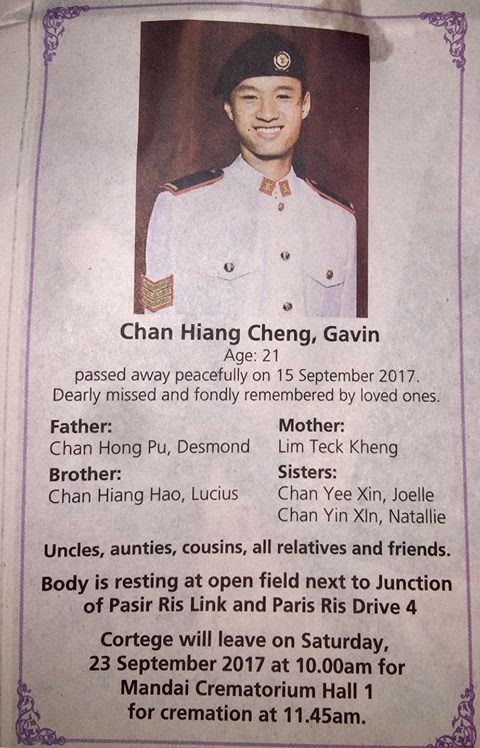
According to an Mothership article, the Family of the late 3SG Gavin Chan has welcomed the public to pay their respects.


Update 21 Sept: Mothership Editor’s note: A previous version of this story said the siblings of the late Gavin Chan were welcoming members of the public to pay respects to Chan. We were subsequently informed by them, via MINDEF, that this message was misconstrued and it was not intended to be open to everyone in Singapore; they were merely inviting their own friends to attend the wake. We have accordingly adjusted this article to reflect this.


Tuesday, September 19, 2017

[Defending the Lion City] Death of a Singapore Armed Forces Full-time National Serviceman


Update 21 Sept: Mothership Editor’s note: A previous version of this story said the siblings of the late Gavin Chan were welcoming members of the public to pay respects to Chan. We were subsequently informed by them, via MINDEF, that this message was misconstrued and it was not intended to be open to everyone in Singapore; they were merely inviting their own friends to attend the wake. We have accordingly adjusted this article to reflect this.

Update: 20 Sept According to an Mothership article, the Family of the late 3SG Gavin Chan has welcomed the public to pay their respects.
======================================

My heart sank when my Facebook feed showed Mindef’s post stating that a NSF had died while training at the Shoalwater Bay Training Area.


Military operations inherently carry significant risks, even during peace time training and exercises, hence the numerous safety measures and guidelines that are drilled into everyone all the time.

But even with the best laid plans, safety measure and what-not , no one can fully mitigate or eliminate such risks.

It is a tragedy that one of our Singapore Sons had paid such a heavy price for our country’s defence.

My condolences to the family and loved ones of 3SG Chan Hiang Cheng Gavin.

Rest in Peace bro.


============================================================


Death of a Singapore Armed Forces Full-time National Serviceman
Posted: 16 Sep 2017, 0030 hours (GMT+8)

A Singapore Armed Forces (SAF) Full-time National Serviceman, 3rd Sergeant (3SG) Chan Hiang Cheng Gavin, 21, a Vehicle Commander from 41st Battalion Singapore Armoured Regiment, was involved in a vehicular incident at the Shoalwater Bay Training Area in Queensland, Australia at around 1815hrs (SG time) on 15 Sep 2017.

3SG Chan was travelling in a Bionix Infantry Fighting Vehicle as part of an exercise when the incident happened. An SAF medic commenced resuscitation efforts on 3SG Chan, who was unconscious. 3SG Chan was evacuated via a helicopter to Rockhampton Hospital, where he succumbed to his injuries and was pronounced dead at around 2236hrs (SG time).

A safety pause on training in Shoalwater Bay Training Area has taken effect, and an investigation of the incident is ongoing.

The Ministry of Defence and the SAF extend their deepest condolences to the family of the late serviceman and are assisting the family in this time of grief.


Source: Mindef


Media Reports


============================================================


Updates:

20 Sept: The Central Queensland Plane Spotting Blog has more pictures here.

19 Sept, 11am: The Central Queensland Plane Spotting Blog has posted on their FB page of what seems to be an Honour Guard for 3SG Gavin Chan before he is being flown home.
Thank you for sharing.

19 Sept: 3SG Chan Hiang Cheng Gavin will be accorded the honours of a military funeral. (Source: ST)


============================================================

Straits Times: NSF's death in Australia: Vehicle landed on its side
Published Sep 17, 2017, 5:00 am SGT

The 21-year-old Singapore Armed Forces (SAF) full-time national serviceman who died on Friday at the Shoalwater Bay Training Area in Queensland, Australia, was guiding a vehicle out of difficult terrain when it landed on its side.

The Ministry of Defence (Mindef) said in an update yesterday that 3rd Sergeant (3SG) Gavin Chan Hiang Cheng, who was the vehicle commander of a Bionix Infantry Fighting Vehicle, was found unconscious next to the vehicle.

The driver and two other passengers travelling in the vehicle were unhurt, the statement said.

An SAF medic carried out resuscitation on 3SG Chan, and two SAF medical officers arrived shortly after to treat him.

He was evacuated via an SAF helicopter to Rockhampton Airport, and later transferred by local ambulance to Rockhampton Hospital, where he died from his injuries.

He was pronounced dead at 10.36pm Singapore time on Friday.

3SG Chan's next of kin arrived in Australia yesterday morning, accompanied by family-liaison officers from the SAF.

The serviceman, who was from the 41st Battalion Singapore Armoured Regiment, was taking part in Exercise Wallaby when the incident happened at 6.15pm (Singapore time).

Exercise Wallaby, an annual event now in its 27th year, is the SAF's largest unilateral overseas drill.

Mindef said that an investigation into the incident is ongoing. It added that a safety pause on training in the Shoalwater Bay Training Area has taken effect.

Mindef and SAF said that they are assisting 3SG Chan's family in this time of grief.

Source: Straits Times

============================================================


Wednesday, March 15, 2017

[Defending the Lion City] If Singaporeans don't defend Singapore, who will?


If we don't defend Singapore, who will?
By First Warrant Officer (Retired) Ali Pawiro, 14 March 2017
Published by The New Paper


I remember they barged into my home, taking all the canned food off our shelves. On both their wrists were watches, probably stolen from the households they raided before ours.

I asked: "Who were they? How could they just come in and take our stuff?"

I was just a 10-year-old boy.

When I was older, I worked in a bank as an office boy. I heard about the opportunity to enlist in the Singapore Volunteer Corps and went to sign up eagerly. But my application was rejected as I was underage. I applied again as soon as I was eligible.


Singapore Volunteer Corps Cap Badge circa 1928 - 1942 


While I cannot say exactly why I wanted to volunteer so badly, I believe my childhood experience might have been a major factor.

After joining as a volunteer in 1952, I worked my way up to become a corporal. They soon discovered I had a knack for instructing, so in 1954, 15 of us were selected as permanent staff instructors, trained by the British army.

I was eventually appointed regimental sergeant major of the Officer Cadet School, in charge of drills and weapons training.

I served as an instructor for years and had the opportunity to watch my son Azlan, and more recently my grandson Afiq, serve the nation.

I have seen some things change over the years, but there are also some which will always remain the same.

One key difference is the role of technology in the Singapore Armed Forces (SAF).

Since my time as an infantry instructor, our weapons have become lighter and they shoot faster. This has made us more agile.

I started off with the bolt-action rifles, then the self-loading ones, and finally the M16 rifles.

Now, I hear they have upgraded to the SAR-21 rifles.

I am a little jealous because Afiq tells me that the SAR-21 is even equipped with a laser-aiming device for better accuracy.

Even the changes in the SAF uniform over the years bear testament to the important role that technology plays in upgrading the SAF's capabilities.


Different SAF uniforms over the years 
Pic: AsiaOne


The pixelated uniform that Afiq wears is far lighter and more comfortable than the Temasek Green uniform I had.

Training methods have also improved. I remember when we were training under the Israeli Defence Force advisors before my posting to SAF Training Institute, we were told to dig trenches with our hands.

We tried to tell them this was impossible because the ground was hard rock. It was only after I showed them that even my cangkul (Malay for hoe) broke from digging that they conceded that their instruction was not very logical.

We have come a long way since. Our national servicemen today are highly educated, and lessons are now very detailed and structured.

Azlan and Afiq have told me of how their instructors explained what they were doing and why they were doing it.

This has helped them to better understand the rationale behind the training session and consequently, for the soldiers to train with stronger conviction.

As a former instructor myself, I cannot help but agree that those with a strong conviction are more committed to give of their best in training.

I have had my fair share of challenges, but never once did I feel that my sacrifices and hard work were not worth it.

My commitment to serve is still as fresh as it was when I signed up to be a volunteer. Azlan and Afiq feel the same way.

In our conversations after they enlisted for national service, they came to understand what an honour and great responsibility it was to put on the SAF uniform and defend Singapore.

I am confident that our servicemen and servicewomen feel the same.

Despite the many years of peace and prosperity that Singapore has enjoyed, we must never forget that what you cannot protect is not yours.


Skulls, bones and other grisly remains being exhumed from a mass grave of Operation Sook Ching victims in Bedok on June 10, 1966. Pic: The Straits Times


For this reason, NS is vital to our nation's survival and continued way of life.

Although technology has contributed to a strong NS system, our people and their sense of purpose are what matters most.

I think there was an important lesson for us to learn that day as we were digging the trenches.

Nobody likes to dig a trench, not even with a cangkul, especially under the hot sun, but we still do it anyway.

Why? Generation after generation, if we cannot overcome hardship, how can we think of doing the bigger things like defending our families and protecting this land we call home?

And if we don't protect Singapore, who will?


The writer spent 29 years in the army and was the Singapore Armed Forces Officer Cadet School's first Regimental Sergeant Major. Today (14 March 2017) is the 50th anniversary of the NS (Amendment) Bill.


Article Source: The New Paper


Read more here:
Mindef: Standard Singapore Military Rifles of the 20th Century

NLB Infopedia - Singapore Volunteer Corps

Singapore and Malaya Volunteer Corps

Mindef: Looks do matter - new SAF combat uniform

AsiaOne: Meet Singapore's No. 1 military buff who's spent over $80,000 on his collection


Friday, March 3, 2017

[Defending the Lion City] Budget 2017 - 3 new MINDEF/SAF initiatives


During the Budget 2017 debate, Defence Minister Ng Eng Hen unveiled 3 initiatives for the SAF.
(1) Beefed up cyber defence command - Cyber Defence Group (CDG)
(2) Labs to research on Robots, AI and Data Analytics
(3) SAFTI City


Straits Times - "A new Cyber Defence Group (CDG) will also be created. It will comprise two operational units responsible for the 24/7 defence of the SAF's networks, and a Cyber Test and Evaluation Centre (CyTec). The two units - a Security Monitoring Unit and an Incident Response and Audit Unit - will perform round-the-clock monitoring of military networks, and deploy response teams to identify, contain and neutralise cyber threats. Under their watch, the security of SAF's networks will also be audited to boost their resilience."
FB post by Defence Minister Ng Eng Hen


Straits Times - SAFTI City Video - A new training ground roughly the size of Bishan town will be built in western Singapore to let soldiers hone their urban fighting skills in real-life settings such as high-rise buildings, warehouses, and even an MRT station with multiple exits. This 88ha area, dubbed the Safti City, will allow soldiers to train in a dense urban environment that closely resembles Singapore's landscape when it is completed in the west of the country in 10 years


Pic: Channel NewsAsia - A closer look at the new SAFTI City, where soldiers can train in urban settings such as high-rise buildings and even an underground MRT station.


Straits Times - "Safti City, which will cost about $900 million, will be outfitted with instruments and video cameras that will instantly track the actions of units and individual soldiers. The first-of-its-kind facility here will allow troops to train in different types of operations, from counter-terrorism to coastal defence and to disaster relief."
Pic via FB post by Defence Minister Ng Eng Hen


Straits Times - "As part of the revamp of the military premises in western Singapore, new grounds for infantry and armoured vehicle drills will be developed in the existing training areas of Pasir Laba, Ama Keng and the Murai Urban Training Facility. A variety of training scenarios - called Instrumented Battle Circuits - can be simulated in these areas. Like Safti City, the battle circuits will feature battlefield effects and monitoring systems."


Straits Times - "Singapore's soldiers will have robots fighting alongside them in the future, in the form of unmanned ground vehicles armed with machine guns. In the skies, micro unmanned aerial drones will provide troops with greater situational awareness. These were the scenarios for the next generation of Singapore Armed Forces (SAF), which were revealed by the Defence Ministry on Friday (March 3) during the Budget debate in Parliament."


My initial first impressions -

  • So many exciting future developments. It almost makes me want to do NS all over again - that is  ONLY IF I could also be 18 again too! 
  • NS training is going to be a whole lot more diverse and realistic, almost perhaps like 'Counter-Strike'. 
  • No more "unlimited' bullets ("Bang Bang Bang!" hahaha...) or buggy 'laser bullets' during training. Now if you get "hit" more than 3 times in training, will you kena sign extra duty for lousy training performance?
  • GPGT - Will soldiers be able to "replay" their attack/fire movements ala Counter-strike
  • Cyber Defence Group (CDG) sounds very interesting and will be important to S'pore. However I'm pretty sure the memes/teases about being Keyboard Warriors for those assigned to the CDG are going to just flood the internet very soon.


Is this how the new Cyber Defence Group will look like on Parade?? #justkidding


Will CDG soldiers be teased about their "Matrix" powers? #justkidding


Read more here:

Straits Times - Mindef sets up new cyber command to beef up defence against cyber attacks (3 Mar 2017)

Straits Times - New cyber vocation 'selective and demanding' comparable to commandos and naval divers: Ong Ye Kung (3 Mar 2017)

Straits Times - New $900m training ground the size of Bishan to give soldiers realistic urban combat experience (3 Mar 2017)

Straits Times - Robots armed with machine guns to fight alongside soldiers (3 Mar 2017)


Monday, February 20, 2017

What does it mean to be a Singaporean?


What does it mean to be a Singaporean?

Who defines a Singaporean?

How do you define who is a Singaporean?

What makes a Singaporean, a Singaporean?


#OneUnitedPeople

See more here: https://www.citizensofsingapore.sg/

Video source: National Integration Council (via YouTube)

Friday, February 17, 2017

[Defending the Lion City] Operation Sook Ching - The Bloody Purge begins


After Singapore came under Japanese control,  the Japanese, apart from stripping Singapore of its name and calling her "Syonan-to", began brutal actions to cower the local populace so as to solidify their grip on Singapore.

People were made to bow to the Japanese soldiers. Those who did not, or refuse to do so, would be severely beaten, some even killed.

But that was not the end of their cruelty.

The Japanese started the "Sook Ching" (a Chinese term meaning "purge through cleansing") operation which was intended, not only to purge the Chinese populace in Singapore of any anti-Japanese opposition, but seemly targeting mainly the chinese in revenge for their support to China in the war against Japan.

"... On 17th February, our new masters issued their first public order in Singapore,  now called Syonanto: all male Chinese adults were to report the very next day at designated camps – under threat of “severe punishment”, a phrase quickly to become familiar. Most of us presumed then it was only for some kind of registration of people. 
But those concentrations of the Chinese were actually for a sinister purpose. 
The conquering Japanese troops had  arrived with horrendous baggage: memories of bloody encounters with the mainland Chinese in the still ongoing Sino-Japanese war. 
And they were sorely aware that the  Chinese in Singapore had been anti-Japanese, staging demonstrations, organising boycotts of Japanese goods and raising money (the China War Relief Fund) to help the Chinese on the mainland in their fight  against invasion. And there were the Singapore  Chinese who took up arms against the Japanese: volunteers with the British forces as well as those MCP (Malayan Communist  Party) diehards, who struggled against them in the jungles of the Malay Peninsula. 
Led by the ruthless Kempeitai (Japanese Military Police), the victorious soldiers went all out to screen the Chinese, however hasty and slapdash the operation, to seek and destroy anyone suspected of being  hostile, no matter how flimsy the evidence,  no matter how many were fingered. ..."
Goh Sin Tub
Goh Sin Tub 
(Read more here: The Sook Ching)


Pic: Stomp


Many families, even till today, still grieve over the fate of their loved ones who went through the screening, and never came back. And many families had to assume that their loved ones were lost to the war.


Skulls, bones and other grisly remains being exhumed from a mass grave of Operation Sook Ching victims in Bedok on June 10, 1966. Photo: The Straits Times (via AsiaOne)
Skulls, bones and other grisly remains being exhumed from a mass grave of Operation Sook Ching victims in Bedok on June 10, 1966.
Photo: The Straits Times
- See more at: http://news.asiaone.com/news/singapore/75-years-singapore-fell-operation-sook-ching-during-japanese-occupation#sthash.KgXzdJ1J.dpuf
Skulls, bones and other grisly remains being exhumed from a mass grave of Operation Sook Ching victims in Bedok on June 10, 1966.
Photo: The Straits Times
- See more at: http://news.asiaone.com/news/singapore/75-years-singapore-fell-operation-sook-ching-during-japanese-occupation#sthash.KgXzdJ1J.dpuf


"... Thousands of other men were not so fortunate. Suspected of being anti-Japanese elements, these men were loaded into lorries and transported to remote areas such as Changi, Punggol and Bedok for execution.  
At these sites, the suspects were machine-gunned to death and often their bodies were thrown into the sea. In some instances, British prisoners of war (POWs) were tasked to bury the bodies. 
Known massacre sites include beaches at Punggol, Changi, Katong, Tanah Merah and Blakang Mati (now Sentosa island). Massacres were said to have also occurred at Hougang, Thomson Road, Changi Road, Siglap, Bedok and East Coast. 
Due to a lack of written records, the exact number of people killed in the operation is unknown. The official figure given by the Japanese is 5,000 although the actual number is believed to be much higher. 
Lieutenant Colonel Hishakari Takafumi, a newspaper correspondent at the time, claimed that the plan was to kill 50,000 Chinese and that half that number had been reached when the order was received to stop the operation. ..."
Singapore Infopedia


After the war ended, seven , seven Japanese officers were charged during a war crimes trial in Singapore for their participation in Operation Sook Ching in 1947.

All seven officers were found guilty. Two officers, Lieutenant General Saburo Kawamura and Lieutenant Colonel Masayuki Oishi, were sentenced to death while the remaining five were given life sentences.

In 1962, more mass graves were found in the Siglap area - dubbed as the 'Valley of Tears' by the press. The remains of the victims from various sites were exhumed and gathered for reburial in a dedicated memorial site, which would later be the Civilian War Memorial.


The Civilian War Memorial


Completed in 1967, the Civilian War Memorial stands prominently along Beach road in Singapore's civic district, and is dedicated to the memory of not only the victims of the Sook Ching operation, but for all civilians who had died as a result of the Japanese Occupation.


"... Comprising four tapering columns at a height of 67 metres, the Civilian War Memorial is affectionately known as the ‘Four Chopsticks’ by locals. Each column represents one of the four main ethnic groups in Singapore who perished during the Japanese Occupation: Chinese, Malays, Indians, and Eurasians. ..." 
"... Painted white, the prominent structure can be seen from afar, both in the day and at night. It sits on a raised platform enclosing a vault that holds the victims’ remains in 606 urns. Within the four columns, an empty urn placed on a pedestal, together with inscriptions commemorating the deaths of countless civilians, brings visitors’ attention to the burial chamber underneath. ..."
Roots.SG

"...  a black urn (sits) atop a high white pedestal with lion heads in relief. The words "In deep and lasting sorrow this memorial is dedicated in memory of those of our civilians who were killed between February 15, 1942 and August 18, 1945 when the Japanese Armed Forces occupied Singapore" are inscribed on the pedestal. There are translations in Malay and Tamil on the right and left respectively. ..."
Picture.SG

"... Then finally the Monument was unveiled by Prime Minister Mr. Lee Kuan Yew, on 15 February 1967, the 25th anniversary of the Fall of Singapore. 
In his speech, Mr. Lee said, "We meet not to rekindle old fires of hatred, nor to seek settlements for blood debts. We meet to remember the men and women who were the hapless victims of one of the fires of history. This monument will remind those of us who were here 25 years ago, of what can happen to people caught completely unaware and unprepared for what was in store for them. It will help our children understand and remember, what we have told them of this lesson we paid so bitterly to learn". 
Before the Prime Minister unveiled a plaque, and laid the first wreath on behalf of the Government and the people of Singapore, prayers were said by leaders of the Inter-Religious Council representing Muslims, Buddhists, Christians, Hindu, Jewish, Sikh and Zoroastrian faiths. A 3-minute silence followed the laying of the wreaths. Many families of the dead were there, especially their weeping mothers. ..."
Singapore Infopedia

In the years that would follow, there would be various ceremonies and services that would take place on 15 Feb to mark the anniversary of the 'Fall of Singapore' when Singapore was surrendered to the Japanese by the British.


#NeverAgain #DefendingtheLionCity #SAF #NationalService #NS50 #WhyMustWeServe #LestWeForget #TotalDefence

Read more here:

Singapore Infopedia - Operation Sook Ching

Biblioasia - The Sook Ching by Goh Sin Tub

AsiaOne - 75 years since Singapore fell: Operation Sook Ching during the Japanese occupation 

Mothership - The Sook Ching (YouTube)

Singapore Infopedia - The Civilian War Memorial

Roots.SG - Civilian War Memorial

Picture.SG - Civilian War Memorial urn


Thursday, February 16, 2017

[Defending the Lion City] They Died for All Free Men

Kranji War Cemetery
'They Died for All Free Men'


Bell of remembrance rung at Kranji War Cemetery to mark 75th anniversary of the fall of Singapore
Straits Times, 15 Feb 2017

SINGAPORE - The casualties of World War II were honoured at Kranji War Cemetery on Wednesday (Feb 15), the 75th anniversary of the fall of Singapore.

In a solemn ceremony attended by dignitaries, diplomats, and military officials and veterans, a bell of remembrance was rung five times - once for every year that the war raged in the Pacific.

Under an overcast sky from which a slight drizzle fell at times, Japanese Ambassador to Singapore Kenji Shinoda was one of the first VIPs to lay a wreath of poppies - which traditionally symbolise blood shed on the battlefield.

This is the first time Japan is working with former Allied countries, including Singapore, to organise a World War II commemoration ceremony here.

Three World War II survivors were the last to lay their wreaths near the Singapore Memorial, inscribed with the name of more than 24,000 soldiers and airmen who died during the war in Malaya and Indonesia and have no known grave.

See the full article and videos here: Straits Times


"I express my feelings of profound grief and heartfelt condolences. I believe that such feelings are shared by the overwhelming majority of Japanese." 
Kenji Shinoda
Japanese Ambassador to Singapore


"... While many have never experienced the horrors of war, they must never forget the lessons learned and the commitment and sacrifices of their forefathers in protecting the country and its way of life. 
This commitment to remember the horrors of war and to defend Singapore is at the core of Total Defence. 
It is when every Singaporean is resolved to play their part, and contribute to keeping Singapore strong on all fronts, that we can be confident of safeguarding our nation and our home against different threats and challenges that come our way. ..." 
Vikram Nair
Chairman of the Government Parliamentary Committee for Defence and Foreign Affairs


Video: By Tedd Jong, 22-year-old student who was there as part of the NUS History Society.


#NeverAgain #DefendingtheLionCity #SAF #NationalService #NS50 #WhyMustWeServe #LestWeForget #TotalDefence

[Defending the Lion City] Syonan-to - So begins the Japanese Occupation of Singapore


Not long after the British Surrender on 15 Feb 1942, the Japanese moved quickly to consolidate their control of Singapore.

One of the first things they did was to re-name Singapore as 'Syonan-to' ( 昭南島 Shōnan-tō), which means "Light of the South".

But they didn't just stop there.

The Tanjong Pagar Railway station was renamed as "Syonan Station".

Japanese Troops posed triumphantly in front of Tanjong Pagar Railway Station. “昭南驛” translates into “Syonan Station”. Pic: SG Film Hunter


The Japanese took over 'The Straits Times' offices and the paper was renamed as  "The Shonan Times". The paper would see two more name changes - "The Syonan Times" and then later as "Syonan Sinbun".


The local time in Singapore was moved forward by 1½ hours so as to be in sync with Tokyo time.

Schools were made to teach the Japanese language and textbooks were printed in Japanese. School children had to stand facing the direction of Japan and to sing the national Japanese anthem.


This was the wartime currency that was issued by the Japanese Government for the occupied territories of Malaya and Singapore during the Japanese Occupation.


The British currency was replaced with Japanese currency which was known as “Banana money” due to the picture of a Banana tree on the note. The currency would ultimately became worthless due massive amounts printed.

These changes would be the least of the problems that Singapore would face during the Japanese Occupation

The next three and a half years under the brutal Japanese rule would prove to be the darkest period in Singapore's history.


Voices From Syonan-To


History Of Singapore During The Japanese Occupation


Fall of Singapore during World War Two - Kartar Singh, eyewitness to atrocities


Japanese Occupation in Singapore


#NeverAgain #DefendingtheLionCity #SAF #NationalService #NS50 #WhyMustWeServe #LestWeForget #TotalDefence


Read more here:


[Defending the Lion City] Keeping Us Safe Everyday - Singapore's Home Team


FRONTLINERS - Episode 1
Frontliners is a web series about National Servicemen in the SPF and SCDF produced to commemorate 50 years of National Service this year. Catch a glimpse of the extraordinary experiences the National Servicemen faced in this prologue.


Very often, our Brothers serving in the S'pore Police Force (SPF), S'pore Civil Defence Force (SCDF) and other Home Team agencies, are often overlooked when the topic of National Service comes up. The spotlight is always on the SAF - not because of any other reason, except that the armed forces makes up the largest intake of NS servicemen -therefore the most visible.

There may be endless friendly debates or jibs about whose service is more "siong" (hardship) but that doesn't mean that Home Team servicemen serve Singapore in any lesser capacity or importance.

The reality is that Home Team servicemen are often exposed to real-life situations which can be dangerous and horrifying on a daily basis. Here's an extract of what one SDCF serviceman (‘longtailbutterfly’) had to say.

"... 
At lunch the next day my friend (SAF LTA) tells me how stressful being an instructor at SAFTI has been recently. I remember as my cylinder got trapped on the fallen wire, and how I thought of my family in those few struggling seconds. I nod my head and grunt. " SAF has it tough with JCC and everything huh?" I joke. He agrees enthusiastically.
All in a day’s work for the NSFs in SPF/SCDF. If we fail, someone dies from our direct actions. Welcome to NS. No second chances or semula. Just death. I wish the public knew the risks that some NSFs take each day. We might not be as fit as NDU or as garang as commandos, but we put our lives on the line literally every day.
As an NSF I can say I have contributed to Singapore. No play acting or training for a war that will never happen (though I understand the incredible need for an armed military). I love my job, I love NS and wouldn't trade it for anything else (maybe an EMT vocation).
I am still amazed that many members of public still associate NS with army. I wish more people would know. There's no greater feeling in this world than knowing some uncle I helped rescue on my first duty at 0200 will live to eat his favourite mee pok or talk cock with his kakis because of my direct actions. Take a look at every fire or major rescue / ambulance incident in the news. Chances are 70% of the people that responded to that incident are NSFs. Whenever I get my haircut at QB the auntie always asks me "boy you army ah?" and I've run out of effort to correct her. Pride and care right?  ..."
SDCF serviceman ‘longtailbutterfly’ (See the full Reddit Post here)

No matter what your NS service branch, vocation or role, we should all recognize that all of us are small but extremely vital cogs in a larger whole called Singapore.

Keep safe and Thank you all for your service to our country.


#DefendingtheLionCity #NationalService #NS50 #OurHomeOurTeam 

Wednesday, February 15, 2017

[Defending the Lion City] Sounding the Sirens


On 15 Feb at 6.20pm, Singapore's network of Public Warning System (PWS) sirens will sound the "Important Message" signal to mark Total Defence Day.


6.20pm of 15 Feb also marks the time when the British surrendered Singapore to the Japanese Imperial Army in 1942.


"The PWS sounding serves to give due significance and remembrance to this historical moment. It also underscores the importance of emergency preparedness and for Singaporeans to defend our homeland."
SCDF 


Upon hearing the signal, the public can tune in immediately to any local radio station for a brief message on the PWS, or visit the SCDF website to learn more about PWS signals.


"... The PWS also has a long genesis. It was commissioned more than two decades ago in 1991 and builds on plans laid in the mid-1980s that recommended several measures to harden Singapore against air raids. 
To keep the network running 24/7, engineers are rostered to service around seven PWS sirens every day. Crisis planners have also built in several fail-safes to ensure that the sirens will blare when they have to. Each siren is powered by electricity from the national grid and has a back-up battery. The system to sound the siren comprises landlines and radio back-up. 
This long-term approach to national emergency preparedness planning could be better appreciated by the average Singaporean as we live in a country better prepared than most for crisis situations. 
It is a wake-up call one hopes Singaporeans will not be forced to heed. 
When that wake-up call arrives, NEST will be ready. What about you? ..."
David Boey (Senang Diri)


Ex-Wallaby 2010, Soldiers from 3rd Battalion, Singapore Guards, heading to their holding area to prepare for a troop lift by Super Puma helicopters.


#NeverAgain #DefendingtheLionCity #SAF #NationalService #NS50 #WhyMustWeServe #LestWeForget #TotalDefence
Read more here:


[Defending the Lion City] Singapore Falls to the Japanese Imperial Army

Lieutenant-General Percival and his party carry the Union flag on their way to surrender Singapore to the Japanese. Pic: Imperial War Museums


75 years ago, on 15 Feb 1942, Lieutenant-General Arthur Ernest Percival met with General Tomoyuki Yamashita at the Ford Factory in Bukit Timah, where the British formally surrendered Singapore to the Japanese.

Singapore had fallen to the Japanese in just over 7 days after the Japanese Army’s initial landing on 8 Feb.


Japanese Troops Marching through Fullerton Square. Pic: Wikipedia 


The surrender was a huge shock to the British as Singapore had long been considered to be an “impregnable fortress” – the “Gibraltar of the Far East”. The forces in Singapore, comprising of British, Indian, Malaya and Australian troops, fought bravely and as best as they could to defend the island but to no avail. 


Generals At War - Battle of Singapore


Singapore was renamed by the Japanese as ‘Syonan-To’ (meaning ‘Light of the South’), thus marked the beginning the Japanese Occupation.

The Japanese Occupation, lasting almost 4 years, would be one of the darkest chapters in Singapore’s history. The populace as well as the captured Allied Forces were brutalized and suffered many atrocities during the Japanese Occupation. The Japanese was estimated to have executed 50,000 civilians as part of their efforts to eliminate any resistance to the Japanese Occupation. 


The Singapore Story (Japanese Occupation of Singapore 1942 - 1945)

Quote: Mr Lee Kuan Yew, speaking on the importance of NS, 21 Feb 1967.


Tuesday, February 14, 2017

[Defending the Lion City] Total Defence Day Message 2017

Total Defence Day 2017 Message from Defence Minister Ng Eng Hen

"... On 15 February, 75 years ago, Singapore fell, as British forces surrendered to Japanese invaders. 
In this video, I stand in the very room in the former Ford Factory along Upper Bukit Timah Road in which the surrender took place. 
Three and a half years of suffering and deprivation followed for those living in Singapore under Japanese Occupation. 
This is why we commemorate Total Defence Day on 15 February every year – a reminder that only when everyone plays a part through Military, Civil, Economic, Social and Psychological Defence, can we ensure a Singapore that is safe, secure and sovereign. ..."
Defence Minister Ng Eng Hen (via FB post)

Read more about Singapore's Total Defence here.


Pic: SGAG


#NeverAgain #DefendingtheLionCity #SAF #NationalService #NS50 #WhyMustWeServe #LestWeForget