Wednesday, September 20, 2017

[Defending the Lion City] Poignant observations


Original FB post here.


Thank You for your Service & Sacrifice.  
Rest in Peace


According to an Mothership article, the Family of the late 3SG Gavin Chan has welcomed the public to pay their respects.


Update 21 Sept: Mothership Editor’s note: A previous version of this story said the siblings of the late Gavin Chan were welcoming members of the public to pay respects to Chan. We were subsequently informed by them, via MINDEF, that this message was misconstrued and it was not intended to be open to everyone in Singapore; they were merely inviting their own friends to attend the wake. We have accordingly adjusted this article to reflect this.


Tuesday, September 19, 2017

[Defending the Lion City] Death of a Singapore Armed Forces Full-time National Serviceman


Update 21 Sept: Mothership Editor’s note: A previous version of this story said the siblings of the late Gavin Chan were welcoming members of the public to pay respects to Chan. We were subsequently informed by them, via MINDEF, that this message was misconstrued and it was not intended to be open to everyone in Singapore; they were merely inviting their own friends to attend the wake. We have accordingly adjusted this article to reflect this.

Update: 20 Sept According to an Mothership article, the Family of the late 3SG Gavin Chan has welcomed the public to pay their respects.
======================================

My heart sank when my Facebook feed showed Mindef’s post stating that a NSF had died while training at the Shoalwater Bay Training Area.


Military operations inherently carry significant risks, even during peace time training and exercises, hence the numerous safety measures and guidelines that are drilled into everyone all the time.

But even with the best laid plans, safety measure and what-not , no one can fully mitigate or eliminate such risks.

It is a tragedy that one of our Singapore Sons had paid such a heavy price for our country’s defence.

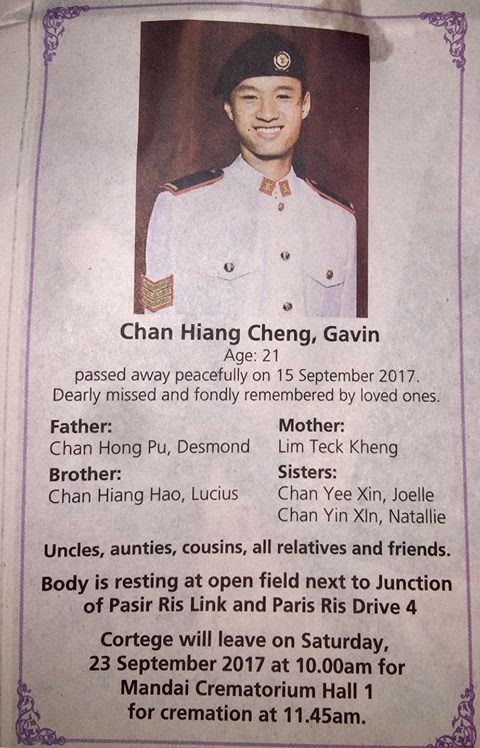
My condolences to the family and loved ones of 3SG Chan Hiang Cheng Gavin.

Rest in Peace bro.


============================================================


Death of a Singapore Armed Forces Full-time National Serviceman
Posted: 16 Sep 2017, 0030 hours (GMT+8)

A Singapore Armed Forces (SAF) Full-time National Serviceman, 3rd Sergeant (3SG) Chan Hiang Cheng Gavin, 21, a Vehicle Commander from 41st Battalion Singapore Armoured Regiment, was involved in a vehicular incident at the Shoalwater Bay Training Area in Queensland, Australia at around 1815hrs (SG time) on 15 Sep 2017.

3SG Chan was travelling in a Bionix Infantry Fighting Vehicle as part of an exercise when the incident happened. An SAF medic commenced resuscitation efforts on 3SG Chan, who was unconscious. 3SG Chan was evacuated via a helicopter to Rockhampton Hospital, where he succumbed to his injuries and was pronounced dead at around 2236hrs (SG time).

A safety pause on training in Shoalwater Bay Training Area has taken effect, and an investigation of the incident is ongoing.

The Ministry of Defence and the SAF extend their deepest condolences to the family of the late serviceman and are assisting the family in this time of grief.


Source: Mindef


Media Reports


============================================================


Updates:

20 Sept: The Central Queensland Plane Spotting Blog has more pictures here.

19 Sept, 11am: The Central Queensland Plane Spotting Blog has posted on their FB page of what seems to be an Honour Guard for 3SG Gavin Chan before he is being flown home.
Thank you for sharing.

19 Sept: 3SG Chan Hiang Cheng Gavin will be accorded the honours of a military funeral. (Source: ST)


============================================================

Straits Times: NSF's death in Australia: Vehicle landed on its side
Published Sep 17, 2017, 5:00 am SGT

The 21-year-old Singapore Armed Forces (SAF) full-time national serviceman who died on Friday at the Shoalwater Bay Training Area in Queensland, Australia, was guiding a vehicle out of difficult terrain when it landed on its side.

The Ministry of Defence (Mindef) said in an update yesterday that 3rd Sergeant (3SG) Gavin Chan Hiang Cheng, who was the vehicle commander of a Bionix Infantry Fighting Vehicle, was found unconscious next to the vehicle.

The driver and two other passengers travelling in the vehicle were unhurt, the statement said.

An SAF medic carried out resuscitation on 3SG Chan, and two SAF medical officers arrived shortly after to treat him.

He was evacuated via an SAF helicopter to Rockhampton Airport, and later transferred by local ambulance to Rockhampton Hospital, where he died from his injuries.

He was pronounced dead at 10.36pm Singapore time on Friday.

3SG Chan's next of kin arrived in Australia yesterday morning, accompanied by family-liaison officers from the SAF.

The serviceman, who was from the 41st Battalion Singapore Armoured Regiment, was taking part in Exercise Wallaby when the incident happened at 6.15pm (Singapore time).

Exercise Wallaby, an annual event now in its 27th year, is the SAF's largest unilateral overseas drill.

Mindef said that an investigation into the incident is ongoing. It added that a safety pause on training in the Shoalwater Bay Training Area has taken effect.

Mindef and SAF said that they are assisting 3SG Chan's family in this time of grief.

Source: Straits Times

============================================================


Thursday, September 14, 2017

Chee Soon Juan tries to spin yet another lie


Sigh.. why is Chee Soon Juan agitating again for a By-Election?

There is nothing dubious or nefarious about why the Govt is not calling for a By-Election to fill the GRC seat vacated by Madam Halimah Yacob.

Madam Halimah Yacob resigned her position as MP for the Marsiling-Yew Tee Group Representative Constituency (GRC) to stand as a candidate for the Singapore Presidential Elections.

The main operative word(s) here being : "Group Representative Constituency (GRC)"

Section 24(2A) of the Parliamentary Elections Act clearly states that no writ of election can be issued unless ALL THE MPs in a GRC have vacated their seats in Parliament.


Source: Singapore Online Statues - Parliamentary Elections Act (Chapter 218), Section 24(2A)


Madam Halimah Yacob's resignation does not mean that all of the four seats of Marsiling-Yew Tee GRC are now empty. This is because the GRC still has three other MPs - Mr Lawrence Wong, Mr Alex Yam and Mr Ong Teng Koon.

And remember, the PAP Govt has never shied away from calling for a By-Election when it is required by the law, even if it meant that it may lose that seat to the opposition.

In 1981, PAP MP Devan Nair resigned to appointed as the President of Singapore. His resignation trigger the Anson By-Elections in which the PAP lost the single-seat constituency to then WP's J.B. Jeyaretnam. (Source)

In 2013, when PAP MP and Parliament Speaker Michael Palmer resigned due to personal indiscretions, the resulting By-Election resulted in PAP losing the single-seat constituency of Punggol East to the WP's Lee Li Lian.

The only GRC By-Election ever to have been held was in 1992 for Marine Parade GRC.

In this case, the GRC By-Election was trigger when ALL FOUR MPs (including then PM Goh Chok Tong) of the Marine Parade GRC had resigned from their seats. (Source)

Chee Soon Juan is simply lying when he says that "the Govt is refusing to call for a By-Election".

The facts here is simply, that our laws governing the GRC, does not require a By-Election to be held.

All things considered, Chee is simply just being Chee.

Character is indeed, permanent.


See more of the dubious shit things that Chee Soon Juan and SDP doesn't want voters to know.


Wednesday, September 13, 2017

Singapore Air Force supports hurricane relief in Texas

The RSAF's CH-47 Chinook helicopters


We are proud that Singapore is able to do whatever it can to support the hurricane relief efforts.

Our care and prayers goes out to all who have been affected by the hurricane.


Singapore Air Force supports hurricane relief in Texas
By Sgt. Michael Giles | 100th Mobile Public Affairs Detachment | September 06, 2017 
(Reposted)

CAMP MABRY, Texas—Thirty-four members of the Republic of Singapore Air Force in CH-47 Chinook helicopters coordinated with the Texas National Guard's 372nd Combat Sustainment Support Battalion to resupply Joint Task Force Harvey personnel with food and water.

The airmen with Singapore's Peace Prairie Detachment supported hurricane relief efforts by delivering supplies to Brenham, Texas, on Aug. 30 in support of Joint Task Force Harvey.

The contribution toward Harvey relief efforts reflects an ongoing partnership between Singapore and Texas, according to an Aug. 30 Singapore Ministry of Defence statement.

Prime Minister Lee Hsien Loong said, "This was a small gesture to express our appreciation and gratitude to the U.S., and in particular the State of Texas, which have been good hosts for our Peace Prairie Detachment."

Texas has hosted Singapore's Peace Prairie Detachment at the Grand Prairie Army Aviation Support Facility in Dallas since the detachment's inauguration in May, 1996. In that time, they received training at the Joint Readiness Training Center and in Exercise Red Flag, and trained alongside Texas Guard members in large-scale emergency response exercises. They put this training to use as they coordinated with the Texas Guard in response to Hurricanes Katrina in 2005, fire and flood operations in Texas in 2000, and Hurricane Floyd in 1999.

The Singaporean detachment has been fulfilling a crucial role in helping resupply food and water to service members on the ground, said Lt. Col. John Crawson, commander of the Texas Army National Guard's 36th Sustainment Brigade.

"We have Soldiers down in the joint operations area that are relying on our resupply," Crawson said. "They're relying on our MREs and bottled water. And when they begin to get very low on supplies, it's very crucial that I get them there."

Crawson said that sling load operations are necessary when flooding prevents effective ground travel. The Singaporean detachment is an ideal partner in these situations, because they frequently rehearse these capabilities with Texas Guard members during their annual training.

"We are extremely grateful for their support and we will continue to ask them to help us out," Crawson said.

Tuesday, September 12, 2017

Singapore's Lessons on Affirmative Action


A student from Elias Park Primary School dressed in a traditional Malay outfit during the school's racial harmony day celebration. TODAY FILE PHOTO


Singapore's Lessons on Affirmative Action
Balancing Meritocracy and Diversity
By Mathew Mathews, Foreign Affairs, 5 Sept 2017

In early August, the New York Times reported that the U.S. Department of Justice (DOJ) would be looking into lawsuits filed by Asian Americans against Harvard University, alleging anti-Asian racial discrimination in the school’s admissions policies. The move has set off fervent discussion in the United States over the future of affirmative action, or the practice, in place since the 1960s, of positive discrimination in favor of historically marginalized groups.

Yet the United States is not the only country trying to negotiate the delicate balance between upholding meritocracy and ensuring that racial minorities do not feel a sense of alienation. Singapore, a multiracial city-state that has assiduously avoided affirmative action policies, last year passed constitutional changes that pave the way for its first presidential election (on September 23) in which all candidates will come from the minority Malay ethnic group. The Singaporean government views any help it provides to ensure minority representation as a safeguard against instability. It is wary of implementing policies that affect a broad category of minorities, which may ultimately relegate them to be viewed as tokens.

THE AMERICAN WAY

In the United States, the DOJ’s move has reignited long-running debates about affirmative action. Such policies have long been opposed by conservative white Americans, and many fear that President Donald Trump’s administration is simply looking for any avenue it can find to bolster white privilege. Yet not all those who oppose affirmative action are white—some Asian Americans, often more recent immigrants, have also called for a purely meritocratic system of college admissions, since they need to obtain much higher test scores than students of other races to be admitted to highly selective colleges. Asian Americans, moreover, have often been presented by critics of affirmative action as so-called model minorities for having allegedly overcome discrimination through an emphasis on education and hard work.

American opponents of affirmative action argue that the United States is no longer the segregated country it was in the mid-1960s, when such policies began. Today the U.S. elite is much more diverse, and a black man, Barack Obama, served two terms as president. Allowing affirmative action to continue, they argue, simply perpetuates the existence of an underclass whose members require exemptions from normal standards and who are not fully accepted in prominent positions because they are viewed as tokens. Critics of affirmative action also see it as tantamount to reverse racism. Race-conscious policies, they claim, are biased against whites and high-achieving minorities. And in fact, one of the most under-represented groups on prestigious U.S. campuses is white, working-class Christians from conservative states.

Defenders of affirmative action generally counter that such measures should continue as long as racism and bigotry remain present in society—a charge that is hard to deny considering recent events in Charlottesville. It is unfair, they say, to expect minorities such as African Americans, who have faced a history of oppression (including slavery, segregation, and police brutality), to be measured according to the same metrics as other students. Some argue further that test scores alone are an incomplete measure of academic potential—they may reflect nothing more than hours of preparation with the help of tutors. And many fear that tampering with affirmative action can hurt minority representation. After California banned affirmative action in 1998, combined African American and Hispanic enrollment at the University of California, Berkeley, plunged from 22 percent to 13 percent of the school’s total.

The U.S. Supreme Court, in its 2016 ruling in Fisher v. University of Texas, defended the use of carefully thought-out affirmative action policies in pursuit of the broader goals of higher education, such as ensuring opportunities for minorities and giving students the benefit of learning in a racially and ethnically diverse environment. The latter consideration weighed heavily on the court’s decision in Grutter v. Bollinger (2003), in which a five-to-four majority affirmed the University of Michigan law school’s consideration of race as one among many factors in admissions. As Justice Sandra Day O’Connor noted in her opinion (quoting from a district court decision), a diverse campus promotes “cross-racial understanding,” helps to “break down racial stereotypes,” and enables students “to better understand persons of different races.” A 2016 review of empirical literature by the economists Peter Arcidiacono and Michael Lovenheim, however, found that the effects of affirmative action are inconclusive.

SINGAPORE'S MERITOCRACY

Affirmative action continues to inspire discomfort among many Americans. For instance, a 2016 Gallup poll found that 65 percent of Americans disapproved of the Court’s ruling in Fisher. Ultimately, affirmative action goes against the ideals of a meritocratic society, which holds that talent and not background should determine attainment. The need to balance this ideal with the quest for diversity in a multiracial society continues to present a difficult problem. Singapore—where about three-quarters of the population is ethnically Chinese, with Malays, Indians, and other minorities making up the remainder—provides an interesting comparison with the United States. Singapore is opposed to affirmative action for admissions into its competitive colleges, but has mechanisms in place to safeguard minority representation in the highest office of the land.

Singapore’s intensely meritocratic vision has long differentiated it from its northern neighbor, Malaysia, from which it separated in 1965. Whereas Malaysia has adopted policies to provide preferential treatment—ranging from university admissions to jobs in the civil service—for members of its ethnic Malay majority, the founders of modern Singapore were deeply committed to the principles of multiracialism. They sought to create a system in which all citizens are treated equally regardless of racial background, and opportunities are given to those who deserve them.

Meritocracy is a fundamental principle of governance in Singapore, but this does not equate to a race-blind approach to policymaking. In addition to allowing the talented to succeed, the Singaporean government accepts that it is responsible for the maintenance of a diverse society and designs policy to maintain peaceful coexistence between the country’s racial groups. Harmonious relationships, the government believes, can only be forged if each community is willing to cede some of its rights and tolerate those of the others. No community, moreover, should be marginalized.

As part of this responsibility, Singapore has sought to ensure representation of all races in different sectors of society. In higher education, which has long been associated with better job opportunities in the city-state,

the government has had some success in increasing the proportion of minority groups who are able to be admitted to the university. (In Singapore, university admissions are highly competitive and primarily based on performance in examinations.) In 1980, among the cohort of Malays who had entered the first grade together, only 0.5 percent had been admitted to a publicly funded university. By 2005, that number had risen to 5.4 percent, and in 2015 reached 7.7 percent. By comparison, for Singapore Chinese the cohort participation rate in 2005 was 30 percent; for Indians, 11 percent.

This increase among Malays was the result not of affirmative action but of official efforts to build Malay students’ capabilities starting in early childhood. In 1982, the government established ethnic self-help groups for Malays (known as MENDAKI) to look into resolving student underperformance. The agency has developed numerous strategies to improve educational attainment, including subsidizing tutoring services, establishing mentorship programs, and educating Malay parents on the value of academic achievement. The steady growth in Malay graduation rates suggests the partial success of these efforts. And Malay students in the universities are accepted as equals by their Chinese counterparts, who know they have qualified with similar scores on the national examinations.

Despite such progress, however, Malays still lag behind Chinese and Indians in terms of education. Partly as a result, 41 percent of Malays age 18–25 support preferential treatment for minorities, according to a nationally representative survey conducted by the Institute of Policy Studies (IPS) in 2013, whereas only 24 percent of Chinese supported such policies. But the government has not shifted its position. Instead, it periodically highlights the achievements of the Malay community, while pointing out that these have been the result of talent and hard work rather than official preferences.

BALANCING ACT

Although the Singaporean government has hesitated to use affirmative action to improve minority representation at universities, it does not shy away from policies that may appear to buck its official ideology of meritocracy.

One such policy is the Group Representation Constituency (GRC) scheme, implemented in 1988, in which parties field a team of candidates to represent a constituency in parliament, at least one of whom must be an ethnic minority. One of the main purposes of the policy is to ensure that Singapore’s minorities are always represented in parliament in proportion to their share of the population.

In 2016, Singapore made the latest addition to its suite of race-based policies by updating the law governing election to the country’s presidency. (In Singapore’s  parliamentary system, the prime minister is the head of government while the president plays a largely custodial role that includes safeguarding the nation's financial reserves and approving appointments to key government posts, such as the attorney general.) Under the new modifications, the office of president must from time to time be held by members of each of Singapore’s constituent races. If one of the races has not been represented after five election cycles, parliament can call for a restricted election, open only to candidates from the excluded group. The coming presidential election on September 23, for instance, will feature only Malay candidates.

The proximate cause of this change was the absence of any Malay president since the death of President Yusof Ishak in 1970. This led government leaders to become concerned that the issue could be politicized, thereby threatening Singapore’s carefully managed ethnic harmony. Yet the restricted election solution has been challenged. In the public hearings on the subject, many questioned whether the restriction of presidential candidates by race would shift Singapore away from its race-neutral aspirations. Others, such as Gillian Koh (a colleague of the author at IPS), asked whether such restrictions might result in a president who was seen as an ethnic token who would lack the legitimacy to check the government. Singapore’s leadership, however, has maintained that the use of a restricted election does not amount to affirmative action since it does not reduce the qualifications required for an individual to serve as president. All candidates, regardless of race, must have held very senior positions in the public or private sector in order to run for the office. This high bar will not be lowered, even if the group in question has few members who can clear it.

The main purpose of the restricted election will be to address potential biases among the population. Despite more than 50 years of official attempts to combat it, there is still some racism in Singapore. An IPS survey on race relations conducted last year in collaboration with the broadcaster Channel News Asia revealed that although Chinese respondents would unanimously accept a Singaporean Chinese as the country’s president, only 59 percent of them would accept a Malay and 68 percent of them an Indian. The survey does not take into account many other considerations that might determine voter preferences, but it suggests that biases could unfairly penalize otherwise stellar minority candidates from being elected. This is especially so in the presidential election, in which candidates are expected to be non-partisan. Without a political platform, racial biases are even more likely to play a role in voting.

Singapore’s approach to managing racial issues is certainly not perfect, and has its detractors both domestically and internationally who claim that the government’s foray into issues of race further entrenches the persistence of racial stereotypes. But the city-state’s example shows that by intervening in carefully designed ways, there is scope for a pluralistic country to fine-tune policies that ensure minority representation without compromising on the principle of meritocracy. At a time when the issue of race has emerged as one of the most threatening potential fault-lines in meritocratic societies, finding a balance between the two will likely become much more urgent.


Article source: Foreign Affairs


The Jakarta Post - Editorial: The mighty red dot


The special #RISING50 flypast executed in sync by F-16s of The Republic of Singapore Air Force and TNI Angkatan Udara. TNI-AU formed the number 5 while RSAF formed the number 0. (MCI Photo by Chwee) - Lee Hsien Loong's FB page.


The Jakarta Post - Editorial: The mighty red dot
Jakarta |Fri, September 8, 2017 | 07:53 am

How is it that Singapore, once mocked as a mere “red dot” state by then president BJ Habibie, became the largest foreign investor, and sent the largest number of tourists to a much more “gigantic” Indonesia in 2016? The moral of the story is: Size alone does not always matter.

In Thursday’s joint press conference with his guest President Joko “Jokowi” Widodo, Singaporean Prime Minister Lee Hsien Loong announced that his country invested US$9.2 billion in Indonesia last year. Indonesians, who have often blamed the city-state for harboring corruption suspects, may sneer that the investment value is just a “red dot” compared to the huge amount of money invested by corrupt Indonesians and unscrupulous conglomerates in Singapore.

For many Singaporeans, the “red dot” mockery later became a source of pride because, despite their extremely small size, they became much more prosperous and advanced in nearly all aspects of life compared to their neighboring “big brother.”

At the time he made his comment, Habibie was upset because, according to him, then prime minister Goh Chok Tong was very late in sending his congratulatory message on his appointment as Indonesia’s third president in May 1998.

In an interview with the Asian Wall Street Journal, Habibie, who had just replaced Soeharto following his abrupt decision to end his nearly 32-year dictatorship, pointed to a map, and said, “It’s OK with me, but there are 211 million people [in Indonesia]. All the green [area] is Indonesia. And that red dot is Singapore.”

Singapore denied Habibie’s allegation of belatedly congratulating Indonesia’s new president; but Singaporeans have since taken the phrase as their own, and it has become both a source of pride and an endless source of jokes to tease Indonesia and themselves.

President Jokowi arrived in Singapore on Wednesday and attended a bilateral summit to commemorate the 50th anniversary of relations between the two countries. Two years after Singapore’s separation from Malaysia to become an independent republic in 1965, Singapore and Indonesia agreed to end military tensions between them.

In the same year, the two countries, along with Thailand, the Philippines and Malaysia, established ASEAN. Soeharto is always remembered by Indonesia’s neighbors as a leader who created political security and stability in the region, letting them grow and progress together.

There have always been ups and downs in relations between Indonesia and Singapore, especially after the fall of Soeharto. From the very beginning, Singapore always stood firm against its larger neighbors, including Indonesia — sometimes unnecessarily — while Indonesia is often tempted to show off its muscles to its smaller neighbor, but to no avail.

PM Lee’s revelation about the investment is strong evidence that Singapore plays an important role in Indonesia’s economy, while Singapore also needs Indonesia’s market and resources. As a pragmatic leader, Jokowi knows very well how to conduct business with his counterpart, based on mutually beneficial relations. Neither Singapore nor Indonesia will ever tolerate bullying from their neighbor.

Indonesia and Singapore have learned a lot in the last 50 years.


See more photos here: 

Lee Hsien Loong's FB album - RISING50: Singapore-Indonesia Leaders’ Retreat 2017
Exactly 50 years ago, Singapore’s then-Foreign Minister S Rajaratnam signed a joint communique with his Indonesian counterpart, Adam Malik, establishing formal diplomatic relations between the two countries. 

Since then, our relationship has grown and prospered. While we are neighbours by geography, we are partners by choice. Last year’s retreat with Presiden Joko Widodo was in Semarang (http://bit.ly/2fU8uqw), so I was happy to reciprocate and welcome him here to celebrate our 50 years together. 

We discussed more areas that we can work on together, such as investments and skills training, digital technology, as well as tourism. You can watch my speech here: https://youtu.be/SrcRyMBaRGw

Hope that our close partnership will continue to strengthen and prosper. I look forward to Singapore and Indonesia rising together to greater heights over the next 50 years! – LHL #RISING50