Wednesday, January 10, 2018

Singapore’s vote on recent UN resolution on the Status of Jerusalem

A view of the Al-Aqsa compound (Temple Mount) in Jerusalem's Old City. PHOTO: EPA-EFE


Minister for Foreign Affairs Dr Vivian Balakrishnan responding to Member of Parliament Mr Vikram Nair's Parliamentary Question on Singapore's vote in the recent United Nations General Assembly resolution of the 10th Emergency Special Session (ESS) on the Status of Jerusalem. He was speaking in Parliament on 9 January 2018. (Source: Gov.SG Youtube Channel)


MFA Press Release: Transcript of Minister for Foreign Affairs Dr Vivian Balakrishnan’s reply to the Parliamentary Question and Supplementary Questions, 9 January 2018

Source: Ministry of Foreign Affairs, Singapore


January 09, 2018 MFA Press Release: Transcript of Minister for Foreign Affairs Dr Vivian Balakrishnan’s reply to the Parliamentary Question and Supplementary Questions, 9 January 2018

QUESTION:
Mr Vikram Nair: To ask the Minister for Foreign Affairs whether he can explain Singapore’s vote in favour of the recent United Nations General Assembly resolution of the 10th Emergency Special Session (ESS) on 21 December 2017 on the Status of Jerusalem which indirectly criticised the US’ decision to recognise Jerusalem as the capital of Israel.

REPLY:
1             Mr Deputy Speaker Sir, Singapore voted in favour of the recent United Nations General Assembly resolution at the 10th Emergency Special Session on the Status of Jerusalem. Our vote in favour of this resolution is consistent with our longstanding position on the unfortunately long-running Israeli-Palestinian conflict.  Our position over the years has been based on the principle of seeking peaceful resolution of conflicts by upholding international law and abiding fully with United Nations Security Council resolutions.

2             Jerusalem is a unique city. It has profound religious significance for Muslims, Jews and Christians. The status of Jerusalem is a very complex and sensitive issue with a very long history, fraught with political and religious dimensions, and the special circumstances of Jerusalem have been addressed by numerous United Nations resolutions, with the most recent instance being the resolution that was voted upon on 21 December 2017. In fact, an almost identical resolution was considered by the UN Security Council a week earlier on 18 December 2017. At that UN Security Council session, fourteen of the fifteen members of the Security Council voted in favour of the resolution, and the US was the sole member to vote against and ultimately to cast a veto against the resolution. And that is why the resolution then came to the General Assembly.

3             The resolution in the General Assembly reaffirms previous UN resolutions and in particular rejected any decisions or actions which purport to alter the character and the status of Jerusalem, and the same resolution calls on all States to comply with the existing UN Security Council resolutions on Jerusalem.

4             Singapore’s position on this has been consistent.  We do not take sides in the Israeli-Palestinian conflict.  Our objective has always been to support a peaceful resolution to this conflict. We have been a steadfast advocate of a negotiated two-state solution, with Israel and Palestine living side-by-side in peace and security.  Accordingly, the future status of Jerusalem should be determined through direct negotiations between both sides and any unilateral and premature action that might alter the status of Jerusalem would only serve to further destabilise the region. It would impede progress towards a just and durable solution to the Israeli-Palestinian conflict.

5             Our vote on the recent resolution is therefore consistent with this policy position. It has at its foundation, a key principle of Singapore’s foreign policy, which is the promotion of a rules-based global community governed by the rule of international law, and always seeking peaceful resolution of disputes.  It is also in this context that Singapore has always strictly abided by all UN Security Council resolutions.  Indeed the UN Security Council Resolution 478 (1980) specifically calls on all UN Member States not to take any action that purport to alter the character and status of Jerusalem.

6             Singapore’s position on this issue is well known and our vote at the various UN resolutions related to the Israeli-Palestinian conflict have been guided by this same principle, regardless of the positions of others.  Although other states, including bigger powers, may occasionally differ or disagree with certain positions that we take, we maintain the consistent application of this principle. This ability to maintain consistency over the long term has enabled us to be taken seriously and to be regarded as a reliable partner who can play a constructive role in international affairs.  Indeed, Singapore remains a steadfast partner of the US, of Israel and of the Palestinian people.  Our longstanding bilateral relations with all countries are strong and multifaceted, and our shared interests far exceed the differences.  At the same time, this gives us access and a strong relationship based on trust with the Palestinians and indeed with the Middle East as a whole.

7             Mr Speaker Sir, Singapore’s vote in favour of the United Nations General Assembly resolution on the 21 December 2017 was actually a vote for peace and stability.  As a small country with a multi-racial and multi-religious population, Singapore, of all countries, fully appreciates that tolerance and the peaceful resolution of disputes are vital for social harmony, for our success as a nation, and indeed for world peace.  We therefore hope that the parties involved will work towards a resumption of direct peace negotiations. This can only be achieved when both sides approach these longstanding sensitive issues in a spirit of good faith and appreciation of each other’s beliefs, values, aspirations, hopes and anxieties.
 .    .    .    .    .


TRANSCRIPT OF MINISTER FOR FOREIGN AFFAIRS DR VIVIAN BALAKRISHNAN’S ORAL REPLIES TO SUPPLEMENTARY QUESTIONS, 9 JANUARY 2018


QUESTION:
Mr Vikram Nair: Thank you Mr Deputy Speaker. Just two supplementary questions. First, was there a reason Singapore chose to vote in favour of the resolution rather than, say, abstain, because that is clearly taking a position on the matter? And second, Singapore has always advocated a two-state solution and a change in the status of Jerusalem, I believe the Minister is implying, would make that more difficult. What steps has Singapore taken to facilitate the two-state solution given its strong relationships with both sides?


REPLY:
1             Thank you for those two questions. I think, on your first question, when you are faced with a resolution there is always a choice. You can vote in favour, you can abstain, or you could vote against. In fact, there is a fourth choice, which is to be absent, but I think members of this House will know that that is not Singapore’s style. When we are confronted with a question, we face it head-on and we make what we believe is an appropriate choice that is consistent with our position, our policies and our values. So we looked very carefully at this resolution, and as I explained earlier, the real problem or the catalyst for this current resolution – and I am going to say so without naming names, and without identifying countries – but what really precipitated this was an announcement. An announcement which could be construed as changing the status quo and hence, in our view, would be a unilateral and premature pronouncement, which instead of helping peace, would actually impede the peace process. So that is why after very careful consideration and consultation, we decided to stand by our principles and say we do not think this is a good idea and therefore we are voting in favour of the resolution. It is a principled position because we are actually not taking sides. We are not saying one party or the other, or its supporters are right or wrong.


2             This relates to your second question. Singapore is not a superpower. We are not a regional power and we are not a key player in the Middle East. Our approach – I would look at it at two levels. First, we do want to be friends with everyone, but we want to be not just fair weather friends; we want to be long-term, reliable, principled friends. Now, for that kind of relationship to occur, and you have two parties who have been fighting for thousands of years, you can imagine that it is a very difficult role to play.  Nevertheless, because both the Israelis as well as the Palestinians, and the Arab and all the other countries in the Middle East know that Singapore does not take sides, they know that we do not bend for the sake of pressure or inducements, and that we genuinely stand for peace and for development.


3             So that gives us special access. I felt this special access when in April 2016, Prime Minister Lee made the first visit as the incumbent Prime Minister of Singapore to both Jordan and Israel. And amongst various parts of the trip, I think the most significant was when we had a chance to go up to Temple Mount or in the Arabic, Al-Haram Al-Sharif, where the Dome of the Rock is, where the Al-Aqsa Mosque is. And at the risk of being long-winded, let me tell you my sentiments as the Prime Minister and our delegation including Masagos and – I think Rahayu went along with us. Intan, was it? Yes, Intan. I remember, the first sense I felt was a sense of awe. Whether or not you are religious, when you visit Jerusalem and you go to those sites, you cannot help but feel that this is a special place, a sacred place:  a place where Heaven and Earth seem to come to a confluence. That's the first sense.


4             My second sense was gratitude for being a Singaporean. Because here we were, accompanied by security from both the Israelis and the Jordanians, and they gave us full access. Minister Masagos even had a chance to pray in the cave beneath the Dome of the Rock. They gave us full access to the Al-Aqsa Mosque, and we are non-Muslims. But everyone knew, we were from Singapore, and this was a multi-religious, multi-racial group. We were welcomed and protected by both parties.  That sense of gratitude, that sense of special access – you know people talk about the Singapore passport being very powerful. It is not really about the passport, but the fact that the world welcomes and trusts us.


5             The third sentiment I felt during that trip was sadness as I thought about the thousands of lives that had been lost, and the blood that had been shed on that hill in the name of race, language and religion. It made me more determined than before to appreciate what we have in Singapore; that when we say we believe in peaceful resolution and we believe in direct, honest negotiations, and that we believe in living side-by-side even to the point where we need an ethnic integration policy. We are not just prescribing to the world, we are a living, real example of multi-racial, multi-religious peace. When we say to live side-by-side in peace and security, we are a working vision, a working example of that future.


6             So that, in a sense, in an anecdotal way, what informs our attitude to this issue. So on any particular resolution, and there have been lots of UN resolutions on this, I will not be able to tell you a priori whether we are going to abstain or vote against, or for. But I am sharing with you the principles behind which we will interpret the resolution, and then we will vote accordingly. From time to time we will have to take a different position from friends and supporters, but I am confident that they know Singapore and Singaporeans well. They know that we do not grandstand, we do not take political postures for the sake of posturing. But we do so in all sincerity as a reflection of who we are. As a multi-religious society and our long-standing friendship, support, and advocacy for peace in the Middle East. That in a nutshell is about all that we can do. We are not a superpower. Thank you.


QUESTION:

Assistant Professor Mahdev Mohan: Mr Deputy Speaker, I thank the Minister for his very detailed and heartfelt response to Mr Nair’s questions. The vote by Singapore was not only an enlightened one, it was fully in accordance with international law and the rule of international law. My only question is, at the time when the vote was cast, were there efforts for ASEAN to speak with one voice at that vote? I ask this question because I noticed that both Myanmar and Philippines abstained from the vote.

REPLY:

1             The short answer is that no, there was no time and no opportunity to cobble together a consolidated ASEAN position. But having said that, I am not even sure that that would have been ideal. As I said, this was a very sensitive and delicate situation, and I think every country had to take a position based on its own analysis of its own national interests. So this was not an occasion to try to corral or to put pressure on the individual members of ASEAN. And there will be, and I say this in full cognisance that there will be I am sure, future situations and future resolutions, where it may be even harder for us to get together and to settle on a common position, so I would not, a priori, aim to do that and I don’t view that, therefore, as a setback – that a couple of ASEAN Member States abstained, and that all the rest of us voted in favour.
.    .    .    .    .
MINISTRY OF FOREIGN AFFAIRS
SINGAPORE
9 JANUARY 2018

Monday, January 8, 2018

M’sia’s PM: M’sia has less debts than Singapore!


If you follow M’sian politics, you will know that M’sia politicians, be it the ruling BN govt or their opposition, like to use Singapore for comparisons, if not as a convenient scapegoating target.

And this behavior is more evident when M’sian is gearing up for their general elections.

A recent example which had most S’poreans, and not a small number of M’sians too, rolling their eyes in disbelief, was the claim from the M’sian Deputy Education Minister that Malaysians' command of English was better than Singapore’s. (See here, here and here)

The latest salvo in the SG vs MY debate was fired by none other than the M’sian PM himself.

In a recent blog post, the M’sian PM said that:

 “… Not only that, (the M’sian) Government debt to GDP ratio is better than developed countries like Singapore at 112 percent, United Kingdom at 89.3 percent, Canada at 92.3 percent and many other examples. …”


Najib must have a taken a leaf from the SG opposition’s playbook of half-truths. Time and time again, the SG opposition wannabes will throw out this misleading statistic to scare and try to stir resentment in the SG electorate.

“Look! The PAP Govt is so corrupt! Not only are they refusing to return your CPF money but they are racking up so much debts! It is true! Look at the World Bank reports!”

Sounds scary, isn’t it. The SG Govt has external debts that are equivalent to 112% of its GDP, or about US$1.766 trillion depending on which article/source you are reading. (See here, here and here.)

But here’s the problem.

While the statistics quoted is quite correct, the interpretation of that statistic is wrong.

I’m not going to attempt to explain why Najib’s interpretation is wrong. It’s a hard topic to explain ‘cos my English is not that powderful as Najib’s (according to his education minister).

Plus this external debt question has been explained to death so many times by tons of better writers than me who can, and have clearly explain the facts. Here are some of them:

Mothership: Najib claims that S’pore government debt higher than our GDP, but here’s why you shouldn’t panic (6 Jan 2018)

Straits Times: askST: Why does Singapore have an external debt of US$1.766 trillion? (20 Nov 2016)

The Middle Ground: Why Singapore’s high external debt is nothing to worry about (19 Sept 2016)

The Scarlet Ibis: Singapore Government Debt – A Cause for Alarm or a Misunderstanding? (12 Sep 2011)

Quora: Why does Singapore have such high public debt?

And here’s what the SG Govt has publicly stated about its debt levels and national reserves.

SG Factually: Is it fiscally sustainable for Singapore to have such a high level of debt?

SG Ministry of Finance: FAQs about Singapore’s Reserves

Bottomline: Don’t just read the headlines, or take other’s words at face value. Read up, see what the facts are and decide for yourself.


Oh, and Najib, it would be great if you and your colleagues can stop dragging S’pore into M’sian politics. It’s rather tiresome and doesn’t do any good for our bilateral relations.


Monday, December 18, 2017

Amos reaps what he sows


According to Amos’s recent posts on FB, he has been evicted from his current shelter due to his controversial video/views advocating for pedophilia (yes its true, Amos thinks pedophilia is ok), and so now he is “sleeping on a couch owned by modern-day hippies”.
Even more serious, he’s also received death threats. And yet, he still has the arrogance to spell out his many “requirements” (like free Wifi) for anyone who wants to take pity on this dumbass and offer him shelter for a pittance. 


Amos thinks that there are stupid suckers out there who would become his de-facto parents - providing everything that he WANTS with little to no rent.


Is Amos’s latest plight at all surprising to anyone? 
                                          
There are some commenters who think that Amos was simply trolling for attention/shock-value (yes) to boost his flagging YouTube viewership/income (yes) and he doesn't really support pedophilla (I highly doubt so).
There are also an increasing number of Americans who are actively calling for Amos’s asylum status to be revoked and be expelled from the country. 


Sorry America, Singapore has a “Sold Goods not Returnable” policy. You can keep Amos for yourselves. We don’t want him either.


Whatever Amos’s motivation for his pedophilia video, all I can say is too bad dumbass. You reap what you sow. Amos's actions and words are what have landed him in his current situation. 


Amos and his supporters like to think that America has freedom of speech, which allows for any, and everything to be said or done without consequence. 

What naïve Amos is only now realizing to his horror; even in the Land of the Free, there will be direct and adverse consequences to what you say or do.


Monday, December 11, 2017

Why we have little to no confidence in SG's "Activists"


Tell me lah.. how to believe or support these Activists when they have a credibility/trust issue?

You can be passionate about your cause BUT that does not give you (or your cause) the license to bend the truth or manufacture half-truths or cast any baseless aspersions. Such actions neither aids you, nor help the cause you are championing.

In fact, in the eyes of the public, such lies will destroy any shred of credibility you or your cause may have - no matter how worthy the cause.


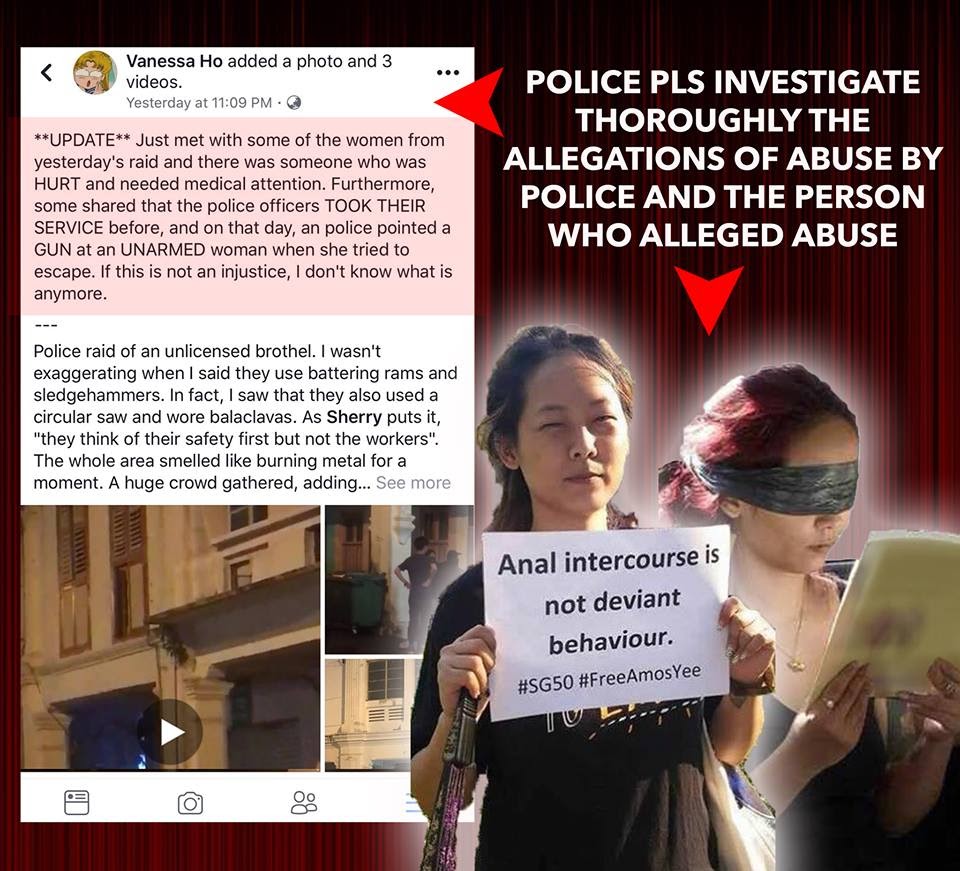
Source: FLOP FB Page
It is not called a "raid" for nothing. You think that these criminal elements are going to play nice when they are about to be arrested for their illegal activities? Grow some brain-cells can?


And further more, by casting such baseless accusations at the police, you are putting the interests of one group (ie: sex workers) over the interests of another group (ie: the police/general public).

Who are you to decide whose interests are more important? Are you saying the for the sake of your interests/cause, the ends justify the means?

The trust between the public and the police is paramount. It allows the police to carry out their work without any unnecessary duress or bias, and it enables the public to believe that the police are carrying out their duties without favor or fear, to the spirit as well as the letter of the law.

Look at what is happening in other countries where there is low trust/respect between the police and the public. Justice takes a back seat to all the political bickering and posturing. There are charges of corruption and abuse of power being thrown about. The police force becomes increasingly ineffective against crime and are regarded as lacking legitamacy in their actions. Crime levels go up. Is that what you want to see happening in S'pore? (See more here)

As such, any allegations of wrong-doing by the police must be properly reported to the appropriate authorities and be investigated.  And if any wrong-doing is found, either by the police or by the accuser, then the guilty parties must be punished according to the full-extend of the law.

And this is not just an isolated case of an Activist trying to stretch the truth in order to gain public sympathy.

Other NGOs/causes have been found to be taking a more than liberal interpretation of the facts when they post their "complaints" about the Govt or {Insert Govt agency name here}. (See here).

If you cannot advocate for your cause without dealing in the facts, then you are simply a waste of everyone's time. Don't pretend to be ignorant or claim innocent sharing on social media when you post such baseless accusations without any evidence.

Interestingly, she has already taken down her posts.

So what does that mean? The allegations made in her post are serious charges. And we believe if the police were found guilty of these charges, there would be serious consequences.

Was she lying? Does she stand by what she had posted? Or was it simply a vicious, unjustified and baseless attack on the police, made to advance her cause? If she truly believes what she posted, then she should be making a report to the police or CPIB. Where's her integrity?


And here is what K Shanmugam (Min. for Home Affairs and Law) had to say: 

Monday, November 27, 2017

Americans are starting the realize the truth about Amos


Americans are starting to realize what many of us Singaporeans already know about Amos  - that he is simply a attention-seeking brat.

Recently, Amos was interviewed by Jeff Holiday (a YouTuber) for more than 2 hours about Amos's views on pedophiles and child pornagraphy.

And here is a follow up video by Jeff, stating out what he thinks of Amos.

TLDR version? I think its summed up in this quote.

"Amos Yee is not worth the emotional trauma that you can get from having to listening to his absolutely stupid dog shit ideas. Don't let him get under your skin." - Jeff Holiday (21:33)

hahahahah.....


Meanwhile, back in Singapore, the Government is considering new penalties for sex crimes targeting women and kids online. (Read here).


Amos sets the world on fire again


ICYMI (or more likely couldn’t give a damn about him), Amos was given refugee status in Sept 2017 and has been released from detention (after 10 months +-) in America. (Read here).

Needless to say, he has been back to his usual antics - which is posting a video on a controversial topic and trying to milk some money off YouTube/social media/donations. 

So what’s new right?

What's new that is Amos is touching on a very sensitive topic, even for the US.

Amos has chosen to advocate for pedophiles, and even makes the outrages claim that child pornography should be permitted and that babies/children can consent to sex.

His views are so ridiculously bat-shit crazy and gives so much weird anecdotal evidence and assumptions that you can’t help but wonder at WTF is going on in his head.

To date, Amos has made about 3 YouTube videos on this topic but his 20th Nov one is probably the most controversial one.

I’m not going to post his video links here (simply because I do not want to drive traffic to him and hence make him a couple of cents) but you should be able to find it quite easily, together with tons of rebuttal videos.

Instead, here are some articles and rebuttal videos about what Amos has said.


In this video, Jeff Holiday calmly talks to, and rebuts Amos about his views, and from Amos's incoherent and often nonsensical responses here, we see exactly how bat-shit crazy he is.

Update: In a follow up video here (21 Nov 2017), Jeff analyses what Amos is, and it is telling. Why am I not surprised at his conclusions?

Priceless quote


"Amos Yee is not worth the emotional trauma that you can get from having to listening to his absolutely stupid dog shit ideas. Don't let him get under your skin." - Jeff Holiday (21:33)


When he was in Singapore, the views that he was espousing caused so much public outrage that a man actually lost control and went up to him in front of the Subordinate Courts (Vigilantism is wrong but this dude’s got some balls to do this in such a heavily policed location.) and slapped Amos right across the face. (Read here). In that context, I’m not sure if Amos fully understands the implications of the fact that he is now in America, the world’s most gun-crazy country.

Any how I wonder what Amos’s supporters and his donors think of him now.


Guess Amos is slowing finding out that absolute freedom of speech does not exist - even in America.


Tuesday, October 24, 2017

What President Trump Can Learn From Singapore Next Week


By Walter Lohman, Director, Asian Studies Center
20 Oct 2017
KEY TAKEAWAYS

(1) Singapore's Prime Minister Lee Hsien Loong will visit Washington next week. He is the fourth Southeast Asian leader to meet President Donald Trump.

(2) Key topics of discussion are likely to be economics, China, and North Korea.

(3) As President Trump prepares for his trip to Asia next month, he can learn a great deal from Prime Minister Lee.

Next week, when Singapore's Prime Minister Lee Hsien Loong visits Washington, he will become the fourth Southeast Asian leader to meet President Donald Trump. This early engagement, to be followed next month by Presidential attendance at the East Asia Summit in the Philippines and the Asia-Pacific Economic Conference in Vietnam, is a very encouraging indication of continued American commitment to the Western Pacific.

When President Trump came into office, there was quite a bit of anxiety about his commitment to American alliances in Northeast Asia. The 2016 Presidential campaign was an extraordinarily contentious one. As a presidential candidate, Trump made statements about America’s Asia policy that raised concerns in Japan and South Korea, and among American military, and foreign policy experts. Ultimately, however, as time is showing, it is difficult to overlook U.S. allies in Japan and South Korea. They occupy too central a role in America’s foreign policy and force posture in the Pacific. There were more than enough people, including the Japanese Prime Minister himself, to help President Trump understand that, if he truly did not before taking office.

Focusing on Southeast Asia requires more subtle strategic awareness. There are small constituencies that speak for it in the American electorate and a relative handful of Southeast Asian experts in Washington to go to bat for U.S. interests there. Yet, despite this – and very much to its credit—the Trump Administration appears to appreciate its importance. The official statements from Southeast Asian engagements coming out of the White House, including the one announcing Prime Minister Lee’s visit, are replete with references to strategic priorities. That said, the President himself would be well-advised to take on board some of the finer points Prime Minister Lee will make about the strategic picture in the region and the American role in it.

Singapore is a small country with a highly developed economy. Its lack of strategic depth, its economic success, and the fact that it is a multi-ethnic Chinese-majority country, surrounded by countries with Chinese minorities, means it is vulnerable. As a result, leaders of Singapore are very carefully attuned to geopolitical disturbances. They do their best to contribute to stability. Singapore hosts critical U.S. naval logistics capabilities – a role they stepped into in the 1990’s when the U.S. and the Philippines failed to agree on terms that would keep them at Subic Bay. It constructed a naval base, Changi, deliberately designed to berth a U.S. aircraft carrier. And it accommodates the rotation of American littoral combat ships and P-8 patrol aircraft through Singaporean facilities.

On the diplomatic side of things, Singapore offers wise council in the Association of Southeast Asian Nations (ASEAN) and they maintain a very constructive, determinedly independent relationship with China. Accordingly, although they are quiet about it, American audiences in particular will appreciate that Singapore maintains the most positive—albeit, like the U.S., unofficial—relationship with Taiwan that Southeast Asia has on offer. This is worth mentioning because it points to the value Singapore places on the autonomy of its foreign policy. There would be no easier calculation for it than to jettison Taiwan, downgrade or rescind reciprocal representation, and end military exercises it has conducted there since 1975. It could kill its free trade agreement with Taiwan. Every other country in Southeast Asia—as well as the U.S.—have apparently calculated that an FTA with Taiwan is not worth inconveniencing Beijing.

On the face of it, Singapore’s interests in China dwarf anything it can accomplish with Taiwan. But what Singaporean leaders know is that if Beijing can dictate its policy on Taiwan, it will assume it can dictate other aspects of its policy, on the South China Sea, on its relationship with Japan, on military cooperation with the U.S., and on its positions in ASEAN.

So as high as the stakes are in Singapore’s relationship with China, its long-term investment in strategic priorities that contribute to regional stability and principles essential to its survival—like freedom of the seas—are more important. From a Singaporean perspective, it is the Chinese who will have to make the mental adjustment that allows the relationship to work as it does—and they are perfectly prepared to help them do so.

So, what messages is Prime Minister Lee likely to bring to Washington?

First, economics. Singapore has a free trade agreement with the U.S.; it also runs a trade deficit with it. So while trade balance is an indicator too broad to be of much use in any regard, at least in the case of Singapore, it will not distract from a discussion of the larger strategic imperative of American economic engagement. Prime Minster Lee warned the U.S. that a pullout from the Transpacific Partnership (TPP) would be a setback for its strategic interests in the region. With this decision already made, he is not likely to revisit this criticism. One hopes, however, that the Prime Minister will talk to the President about the options the region has for moving forward without the U.S. There is the real prospect of a TPP-11, an agreement modified to exclude the U.S—temporarily the Singaporeans hope. There is the Regional Comprehensive Economic Partnership (RCEP). There is China’s one-belt, one-road infrastructure project. Regarding the latter, there are signs that the Administration is coming to understand the significance of this, but it cannot beat something with nothing. TPP may be dead as far as the U.S. is concerned. These other initiatives are Asia’s plan B. The U.S. desperately needs a plan itself, something more encompassing than renegotiation of trade agreements and imposition of trade remedies.

Second, China. Singapore is very much interested in the trajectory of US-China relations. This is because leaders there understand the challenge that China presents the region. It does not see China’s rise as a “threat” or as a clash between Western and Confucian civilizations. It certainly will not subscribe to the U.S. waging an “economic war” with China—as some of President Trump’s supporters have advocated. Singapore sees the rise of China as a reality that must be managed. Beijing has presented the U.S. with some difficult decisions, on the South China Sea, for instance. And Singapore is both publicly and privately supportive of pushing back in areas like these where it threatens to overturn the regional order. Poor management of the relationship on the part of the United States, however, would also represent a danger to regional stability, and to Singapore. For these reasons, Singapore has an interest in helping American officials understand China in all its complexity. Expect the Prime Minister to appeal to President Trump’s better angels on matters related to China.

Third, North Korea. In one of the Trump Administration’s earliest efforts to reach out to the Southeast, Secretary of State Rex Tillerson met with ASEAN’s foreign ministers in Washington. The very real threat from North Korea’s nuclear weapons program was high on the agenda. Singapore appreciates that and has said so publicly. They can be trusted to comply with UN Security Council (UNSC) Resolutions regarding North Korea’s nuclear weapons program and cooperating with U.S. intelligence agencies and the UNSC’s Panel of Experts to do so.

Singapore is squeezing its limited contact with North Korea, but it does maintain diplomatic relations with it, as do all other members of ASEAN and more than 150 other countries. North Korea is also part of the annual ASEAN Regional Forum. Singapore has no diplomatic mission in North Korea; North Korea has a bare-boned, two person embassy staff in Singapore. Singaporean companies conduct a miniscule amount of trade with North Korea estimated at 0.2% of North Korea’s total—the same share as Luxembourg, Taiwan and Sri Lanka—and declining. During Prime Minister Lee’s visit to Washington, if not in his meeting with Trump, then on Capitol Hill or in other Administration meetings, this contact and ASEAN’s relationship as a whole might be raised. One can expect the Prime Minister to be constructive and open to suggestion.

Singapore is a sovereign country. As such, it is, of course, occupied with protecting its own national interests. The analysis of its leaders and diplomats is honest and insightful. It is not entirely objective. It is colored, at least in part, by Singapore’s geostrategic fate and what Michael Leifer—the most prominent scholar of Southeast Asian international relations of his generation—once called a “foreign policy rooted in a culture of siege and insecurity.” Singapore’s prescriptions cannot be bought wholesale by American political leaders and officials. They come at foreign policy from a much different historical and material perspective. But Singapore does offer extremely valuable advice and an enlightened concept of its national interest that has consistently aligned it with the United States. As a result, for decades, it has long been among the most persistent advocates of for a robust U.S. presence in the Asia-Pacific. As President Trump prepares for his trip to Asia next month, he can learn a great deal from Prime Minister Lee about how best to establish and maintain this.


Notes: 

  • As director of The Heritage Foundation’s Asian Studies Center, Walter Lohman oversees the think tank’s oldest research center.

  • Prime Minister Lee Hsien Loong is currently in the United States on an official working visit to Washington D.C. and will be meeting President of United States (POTUS) Donald Trump in the White House on 23 Oct.

Article source: The Heritage Foundation