Wednesday, June 27, 2018

Lee Kuan Yew's words on relations with Malaysia


Ever since Mahathir is back as the PM of M'sia, relations between S'pore and M'sia have seemingly taken a turn for the worse.

First there's M'sia's flip-flopping over the High-Speed Rail project, being conducted over the media instead of direct Govt-to-Govt talks.

Then now the apparent revival of one of Mahathir's favourite pet peeve - the Water Agreements.

Should S'poreans panic?

If you were old enough to have known about his antics tactics as the 4th PM from 1981 to 2003 in dealing with S'pore, you would have recognize that the current situation is very similar to what he was doing when he was the 4th PM.

We have to remember that Mahathir is an extremely shrewd politician who has made a come-back as PM again despite being out of Govt for more than 15 years. If anything, he is a master at using rhetoric to shape public opinion for his own purposes.

So let Mahathir rant on and on about his unhappiness with whatever deals.

Notice that he only rants to the media. Yet the S'pore Govt is still waiting for official communication on the HSR project. So efficient. M'sia Boleh ya?

We just have to recognize that that's just one of his antics tactics to cast S'pore in an unfavourable light to M'sians, and make us a convenient bogeyman/scapegoat/whipping boy to pin whatever policy failings of his administration; to rile up and enlarge his political support base, and to manipulate public opinion to pressure and bully S'pore.

My opinion is that S'poreans should just chill.

Our position on the High-Speed Rail project, the Water Agreements and whatever other bilateral dealing we have with M'sia have been made very clear by the SG Govt.

Mahathir knows his hands are tied by the agreements. Should Mahathir decide to unilaterally change or cancel any agreements, he is well aware that the consequences of such an action would be much more damaging to M'sia than to S'pore.

While S'pore may suffer some short-term losses/pain, Mahathir knows that he would have effectively destroyed all of M'sia's credibility and trustworthiness in the eyes of the world. No one would dare to invest or do business with M'sia after that.

So let's all just be calm, carry on and let the SG Govt settle lah. World Cup is on now leh..


Lee Kuan Yew's quote reference: From Third World to First: The Singapore Story, 1965-2000, Volume 2 (See here)

Wednesday, April 25, 2018

Nobody wants a trade war

Singapore’s prime minister: Nobody wants a trade war

The Washington Post 
Lee Hsien Loong is the prime minister of Singapore.


Trade friction between China and the United States has been brewing for some time. But with the Trump administration’s announcement of unilateral tariffs on imports, targeted at China, the specter of a trade war has never been clearer.

There is broad political support in the United States for such measures. American businesses that had previously advocated China’s accession to the World Trade Organization now feel disadvantaged doing business in China. They feel, with some justification, that the playing field is uneven, market access is limited and investments are restricted, especially in the financial and technology sectors. Trade arrangements and concessions made in the past when China was about 5 percent of the world’s gross domestic product are less readily accepted today with China’s share rising to 15 percent.

But unilateral tariffs are not the correct solution. A trade war between the United States and China is far from inevitable, but if one breaks out, it will gravely undermine the rules-based multilateral system that has underpinned global prosperity since the end of World War II. Countries around the world, big and small, will be hurt.

We believe trade disputes should be resolved within the WTO framework. As economists have pointed out, when assessing economic relationships, what matters is not a country’s bilateral trade balance with a specific trading partner but its overall trade balance with the rest of the world.

Furthermore, the cause of a country’s trade deficit lies at home. A trade deficit is the result of a country consuming more than it produces, and it is neither caused nor cured by trade restrictions.
The United States and China share the most important bilateral relationship in the world. Both countries have benefited from an open, rules-based international order and multilateral trading system. This has fostered economic cooperation within the Asia-Pacific region and deepened interdependence among Asia, the United States, Europe and the rest of the world.


"A trade deficit is the result of a country consuming more than it produces, and it is neither caused nor cured by trade restrictions."


Asia is the fastest-growing export market for U.S. goods and services. As the world’s second-busiest port and fourth-largest financial center, Singapore is a global hub that connects the economies of the United States and Asia. We are a small, open economy with trade flows more than three times our GDP. A trade war between the two largest economies in the world will have a big, negative impact on Singapore.

Since China joined the WTO in 2001, its weight in the global economy and its share of world trade have grown enormously. This has shifted the overall strategic balance. It has also raised reasonable expectations for China to liberalize its markets further and contribute more to the multilateral trading system.

China has declared its commitment to upholding openness and multilateralism. The Asian Infrastructure Investment Bank and the “Belt and Road Initiative” are two major efforts by China to strengthen trade and investment ties, and to enhance integration and interdependence. At the recent Boao Forum for Asia Annual Conference, President Xi Jinping announced further plans to open up China’s financial sector, liberalize foreign investment rules, protect intellectual property rights and lower tariffs on automobile imports. These moves have been acknowledged and welcomed by President Trump. We look forward to seeing these steps elaborated, implemented and bearing fruit.

Although most Asia-Pacific countries continue to pursue trade and economic liberalization — for example, through the Trans-Pacific Partnership and the Regional Comprehensive Economic Partnership — these initiatives will not compensate for the damage caused by a trade war.

Beyond the economic loss, strained ties between the United States and China will make it harder for them to cooperate on other pressing issues such as the denuclearization of the Korean Peninsula, regional security, nonproliferation and climate change. None of these issues can be solved without the full participation of both countries. If any of these disputes escalates and destabilizes relations between the United States and China, the consequences for the world would be disastrous.

Competition between the United States and China is to be expected. But whether this competition takes place within a framework of interdependence and generally accepted international rules makes all the difference. Ultimately, what is at stake is war and peace, and the security and stability of the world. The United States, China and the rest of the world have too much at stake.


This article was first published by The Washington Post.


Tuesday, April 3, 2018

A Wolf in Sheep's clothing


Thum Ping Tjin or PJ Thum, grabbed headlines when he made a submission to the Select Committee on Deliberate Online Falsehoods, where he made the most ridiculous claim:

There is clear source of “fake news” which has spread falsehoods, with major impact, and hitherto escaped sanction. That is the politicians of Singapore’s People’s Action Party. 
 The major examples of this are the numerous detentions under the Internal Security Act (ISA, and its predecessor, the Preservation of Public Security Ordinance) from 1963 to 1987. 
 Beginning with Operation Coldstore in 1963, politicians have told Singaporeans that people were being detained without trial on national security grounds due to involvement with radical communist conspiracies to subvert the state. 
 Declassified documents have proven this to be a lie. 
 Operation Coldstore was conducted for political purposes, and there was no evidence that the detainees of Operation Coldstore were involved in any conspiracy to subvert the government. (See Thum’s full submission here)

However his claim, as well as any credibility he had as a “historian” was soon shot to tiny little worthless pieces when it was revealed during the public hearing that Thum did not include, or chose to ignore any references and materials that would have contradicted his belief, including accounts from Chin Peng who was the chief of the Communist Party of Malaya.


Can PJ Thum be called an objective historian when he disregarded the leader of MCP claims that Operation Coldstore shattered the communist network in Singapore?

Posted by Shut down TRS on Monday, April 2, 2018


And what was his reason for this particular exclusion?  Thum rejected Chin Peng as 'unreliable' and as 'not true'. And yet, according to Thum, he has never explain any where in his work why Chin Peng's memoirs should be disregarded.

Would you believe this “historian” who selectively choses his material to write the “history” that he wants to Singaporeans to believe?


During the public hearing, Home Affairs and Law Minister Shanmugam essentially tore apart Thum's submission and claims over 6 hours, where Thum persisted in avoiding giving a straight answer to the Minster's questions on the veracity of Thum's claims.


Thum's supporters will say that Thum won out. But how does another historian view Thum’s “work” (from 2014!)?

“There are two main problems with Thum’s argument. First, he argues – citing Selkirk’s contemporaneous concerns – that at the time of Coldstore there was no direct evidence that Lim Chin Siong and other detainees were engaged in actual Communist subversion. 
 But the records do show that even careful British officials conceded that Lim was a skilful CUF operative and other detainees possessed a recent history of subversive activities. 
 Tunku also agreed that the detentions on preventive grounds were necessary. This was prudent.  CPM elements within the utterly penetrated Barisan Socialis that was challenging the PAP for power never ruled out switching strategy to armed violence at any time.  Historian T.N. Harper hence considers Selkirk’s attempted distinction between ‘political’ and ‘security’ grounds for detention as ‘problematic’. 
 Second, Thum emphasizes how Tunku and Selkirk disliked Lee’s personality and byzantine political machinations. But CUF leaders – said to possess ‘animal cunning’ themselves – in fact regarded the tactically agile Lee as the only serious obstacle to their plans to establish Communist rule in Singapore. 
 British envoy in Kuala Lumpur Geofroy Tory sympathized with Lee’s position, warning that playing by ‘Queensbury rules’ with the unscrupulous Communists would be folly.  Ultimately, cautious British officials in Singapore conceded that in view of what historian S. J. Ball called the ‘ruthless, fast-moving and mendacious’ nature of local politics at the time, Lee Kuan Yew, warts and all, was ‘the only man who can run this city’.  
Kumar Ramakrishna, Revising the Revisionists: Operation Coldstore in History (Read the full article here)


Another blogger even provides a copy of the letters and documents from the British Archives that showed how serious the communist threat was in Singapore during that era.


It is extremely troubling that a highly educated person like Thum would show such a poor regard for historical facts and objective assessment. Thum selectively choses 

Not to mention, those stupid moronic faces that he made during the Select Committee hearing just shows how much regard he has for Parliament. Why participate and make a mockery of the process if you don't believe in it?

Because of your irresponsible antics, you have deprived others of airtime when they had also prepared serious submissions to the Select Committee.


References

Singapore Parliament: Select Committee on Deliberate Online Falsehoods https://www.parliament.gov.sg/sconlinefalsehoods

Thum Ping Tjin’s Submission to the Select Committee

Thum Ping Tjin at the Select Committee hearing on 28 March 2018

IPS Commons, Kumar Ramakrishna, Revising the Revisionists: Operation Coldstore in History (Feb 19, 2014)

Operation Coldstore: Declassified British documents revealed a real communist threat in Singapore


Thursday, March 1, 2018

The Singapore Budget 2018: Together, a Better Future


Budget 2018

Every year, the government presents and debates its Budget in Parliament.

But do you actually know what the Singapore Budget is about, and understand its importance to the country, and how it can affect your life?


Here is mrbrown’s tongue-in-cheek take of the Singapore Budget via his altered ego Kim Huat. Lol


What is the Budget for?

The Singapore Budget is prepared for each financial year, which begins on 1 April of every calendar year and ends on 31 March of the next calendar year.

The Budget includes the revised Government revenue and expenditure projections for the current financial year, as well as the planned Government revenue and expenditure for the upcoming financial year.

A Balanced Budget

The Singapore Government is required under the Constitution to keep to a balanced budget over each term of the elected Government. Unlike many other countries, Singapore does not borrow money to fund government expenditure, and the Singapore Government does not have any external debt.

This practice of fiscal discipline ensures that the government funds can be put into good use for Singapore’s development in all sectors.

Here’s an extract of what the 2018 Budget has in store for Singaporeans. (Click here for the full summary.)


First, the bad news. GST will be increased.


Thankfully, the rest from here on is not too bad.


The SG Bonus was announced in Budget 2018 to share the fruits of Singapore’s development with all Singaporeans.


Here is the video of the full Budget Statement speech which was delivered in Parliament.

Minister for Finance, Mr Heng Swee Keat, delivered the FY2018 Budget Statement on 19 Feb 2018. 


Tuesday, February 27, 2018

[Defending the Lion City] Strengthening SG's response capabilities towards Terror threats

Image source: MHA


The Ministry of Home Affairs has introduced new laws to improve how the SPF can respond to terror threats and incidents.

======================================

Ministry of Home Affairs Press Release
27 Feb 2018 : Public Order and Safety (Special Powers) Bill 2018


         The Public Order and Safety (Special Powers) Bill was introduced for First Reading in Parliament today. The Bill is part of the Ministry of Home Affairs' (MHA) ongoing efforts to combat the threat of terrorism.

Updating of Existing Special Powers Legislation to Enable Police to Respond Effectively to Serious Incidents such as Terrorist Attacks

2.            Singapore continues to face a clear and present security threat, posed by home-grown radicalised individuals and foreign terrorists who view Singapore as a prized target. Attacks around the world have shown that the terrorists are continuously evolving their methods to inflict maximum casualties and deaths. It is therefore important to equip the Police with powers to be able to respond swiftly and effectively to attacks of any scale and of varying tactics.

3.            Over the last two years, MHA has significantly enhanced our ability to respond to the terrorism threat. The Public Order Act was amended and the Infrastructure Protection Act was enacted to enhance the security of large events and critical buildings respectively. The Police have also developed new capabilities for rapid and effective response to terrorist incidents.

 
4.            As part of these continuing efforts to combat terrorism, MHA is introducing the Public Order and Safety (Special Powers) Bill, to provide the Police with the powers necessary to deal with serious public order and safety incidents, including terrorist attacks. The Bill updates the existing Public Order (Preservation) Act (POPA), which was enacted in 1958 to provide special powers to deal with large-scale communal riots. As part of the Bill, POPA will be repealed.

Key Provisions of the Public Order and Safety (Special Powers) Bill

5.            The Public Order and Safety (Special Powers) Bill will:
  1. Enable the use of special powers for serious incidents affecting public safety;
  2. Enable the Police to protect the secrecy of tactical operations; and
  3. Enable the Police to respond to serious incidents more effectively.

Enable the use of special powers for serious incidents affecting public safety

6.            The special powers in the Bill are not available to the Police for routine operations. The Minister for Home Affairs must first issue an order to authorise the use of the powers in the Bill. To do so, the Minister must be of the opinion that (i) a serious incident has occurred or is occurring in Singapore, or there is a threat of such a serious incident occurring, and (ii) that the special powers are necessary to prevent the occurrence of the incident, reduce its impact, or control, restore or maintain public order.

 
7.            The existing POPA provides special powers to deal with large-scale public disorder, such as communal riots. However, they cannot be used in situations which seriously threaten public safety but there is no large-scale public disorder. For example, in the immediate aftermath of a terrorist attack when the pursuit of the terrorists is underway, but there is no large-scale public disorder. The Bill provides for special powers to be used in such serious incidents where public safety is threatened, and also where there is serious violence affecting the public.

Enable Police to protect the secrecy of tactical operations

8.            Denying the terrorists access to information on Police's ongoing tactical operations to neutralise the attack, is critical for the success of the operations. Leakage of such information to the terrorists could endanger the lives of security officers and members of the public who are caught in the attack.

 
9.            During the Mumbai attacks in 2008, live media broadcast of security forces preparing to storm the Taj Mahal Palace Hotel allowed the gunmen within to anticipate the actions of the security forces. In the January 2015 attack on the Hyper Cacher Deli in Paris, the terrorist who was holding several hostages in the deli was able to watch live television broadcasts showing Police officers outside preparing to storm the deli. In both incidents, there is no doubt that the information available to the terrorists made the Police operation more difficult, reduced the chances of a successful operation, and put the safety of the officers and hostages at greater risk.

10.          The Bill therefore proposes that after the Minister has issued an order to authorise the use of the powers in the Bill, the Commissioner of Police be empowered to make a communications stop order to require all persons in the incident area to stop making or communicating films or pictures of the incident area, and stop communicating text or audio messages about the ongoing security operations in the incident area. This is a special power which would only be used when the security situation calls for it.

11.          The Bill also provides the Police with powers to take down or disable any unmanned aircraft and autonomous vehicles and vessels in and around the incident area, regardless of their intention and activity.  Such unmanned aircraft and autonomous vehicles and vessels can be used for surveillance by the terrorists or even as weapons. Currently, the Police only has powers to take down unmanned aircraft and autonomous vehicles and vessels which are clearly posing a threat to public safety and security.

Enable Police to respond to serious incidents more effectively

12.          The Bill will incorporate and update several special powers already available in POPA. In addition, the Bill introduces new provisions needed for today's operational context.

13.          The Bill will enable the Police to direct owners of buildings within the incident area to take certain actions, such as closing their premises, restricting entry and exit, or to provide the Police with information about their buildings like floor plans. These directions will help the Police to manage the safety of the public in the incident area, and facilitate security operations.

 
14.          The Bill will also provide the Police with enhanced powers to stop and question individuals within the incident area in order to obtain information. Such powers are needed, for example, when the Police is conducting a manhunt. When these special powers are exercised, it is an offence for individuals to refuse to provide information to the Police. 


Source: Ministry of Home Affairs

Read more here:
Straits Times: Parliament: 3 proposals in Bill to give police special powers to deal with terror attacks

Channel NewsAsia: MHA tables Bill to expand Singapore police powers to better deal with terror attacks

Monday, February 26, 2018

[Defending the Lion City] Total Defence Day 2018 message

#NeverAgain


This year’s Total Defence Day message by the Defence Minister touches on the newer and less apparent forms of threats that Singapore faces - terrorism, the spread of fake news and cyberattacks – and how each one of us has an important role to play to help Singapore overcome these challenges.

The video message was released on Defence Minister Dr Ng Eng Hen’s Facebook page (https://www.facebook.com/ngenghen/) at 6pm on 14 February 2018. 

The 3-min message was recorded at Reflections at Bukit Chandu, where one of the most intense fighting took place on 14 February 1942 during the Battle for Singapore in WWII. 

As this year’s Total Defence Day (15 February 2018) falls on Chinese New Year eve, the backdrop of the fall of Singapore on Chinese New Year Day in 1942 reminds us that we must never take our peace for granted.

Together We Keep Singapore Strong

For more information on Total Defence, please visit our website: www.totaldefence.sg and Facebook: www.facebook.com/WeAreTotalDefence.


Source: TotalDefenceSG YouTube Channel


The peace and prosperity that we enjoy today, are only possible because of the sacrifices of the past.

Friday, February 23, 2018

[Defending the Lion City] Defence vs Healthcare - which is more important?


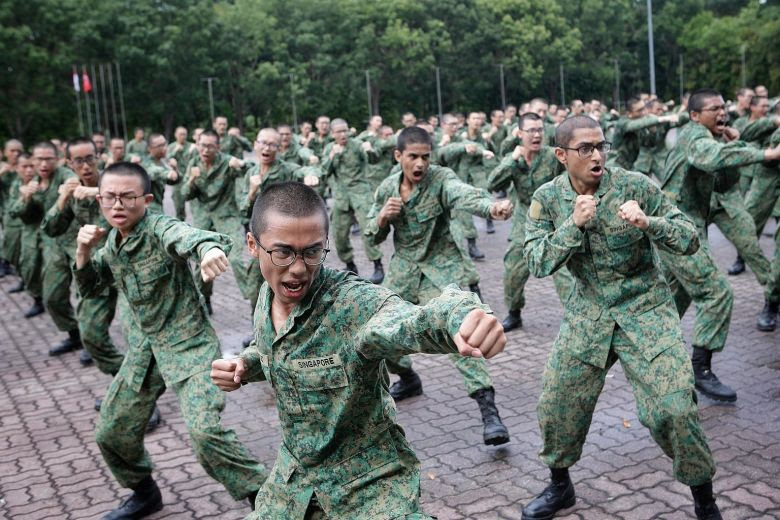
Recruits undergoing Basic Close Combat Training at an SAF unit at the Basic Military Training Centre (BMTC) at Pulau Tekong on Jan 23, 2018. ST PHOTO: KEVIN LIM


Health, defence spending not a zero-sum game

Dr Yik Keng Yeong suggests in his letter that the Government is spending too much on defence compared with healthcare (Rethink of our health, defence costs needed; Feb 22).

As a national serviceman on my third cycle as a Reservist on Voluntary Extended Reserve Service, I feel it is necessary for us to move away from the narrative that social needs and defence are in competition.

The proportion of our annual budget spent on security has dropped by 10 per cent over the last decade.


"Instead, it would be more relevant to see defence as a form of insurance - one we would never want to draw on, but which is there when we need it."


Conversely, spending on social needs now takes up the lion's share of the budget.

In Budget 2017, Defence Minister Ng Eng Hen said that future defence budgets will aim to keep pace with inflation through a trajectory of 3 to 4 per cent annual growth.

His ministry would reprioritise programmes to meet new challenges, while addressing overall budgetary pressures of an ageing society and slowing economic growth, he said.

This year's defence budget of $14.8 billion is in line with this trajectory, growing about 4 per cent from last year.


"Defence capabilities cannot be ramped up instantly when danger emerges, but require long-term planning, equipping and training."


A continued focus on defence versus healthcare spending as a zero-sum game is an incorrect approach.

Instead, it would be more relevant to see defence as a form of insurance - one we would never want to draw on, but which is there when we need it.

Defence capabilities cannot be ramped up instantly when danger emerges, but require long-term planning, equipping and training.


"And Singaporeans can build lives, grow businesses and care for their families under the umbrella of defence that is provided by the Singapore Armed Forces."


Built up over the past 52 years, the stable and secure environment we enjoy and often take for granted has enhanced our economic vibrancy.

Tourists and international companies come to Singapore because it is safe, stable and secure.

And Singaporeans can build lives, grow businesses and care for their families under the umbrella of defence that is provided by the Singapore Armed Forces.

The global security environment is increasingly uncertain, and we cannot take our peace and security for granted.

Investment in defence and the need for everyone to play their part remain paramount.

Without defence, we will not have the safety and security on which to build a successful healthcare system and other hallmarks of a strong nation.

Nicholas Fang


A version of this article appeared in the print edition of The Straits Times on February 23, 2018, with the headline 'Health, defence spending not a zero-sum game'.

Source: The Straits Times, 23 Feb 2018


=====================================================


Rethink of our health, defence costs needed


While our health budget at $10.2 billion, constituting 2.2 per cent of gross domestic product (GDP), seems like a lot of money, other countries spend far more on health care, with the United States topping the list withan expenditure of 17 per cent of GDP.

We all know why our healthcare costs are ballooning: ageing population, newfangled, exorbitant investigations and treatment regimes, reimbursements to doctors for procedures done rather than outcome efficiencies, all-in insurance without co-payments which encourage gouging by doctors, just to name the major ones.

Perhaps, because our health budget still seems far away from the levels of the US, there seems to be insufficient political will to manage health costs more strictly.

Allowing Medisave to be used for procedures in Malaysia (where, anecdotally, costs can be up to 10 times lower), mandatory use of generics where available (already enforced by some health insurances) and a more dedicated use of telemedicine will lower costs.

Our military budget has also ballooned over the last decade.

At $14.8 billion, it exceeds the combined budgets for trade and industry, national development, social and family development together with environment and water resources, which add up to about $13.7 billion.

Defence is paramount to our survival, but whereas we have not had a war for more than 50 years (granted that it may be because of our preparedness, as reflected by the oversized defence budget), we have need of trade, water, infrastructure and family support every single day - so, perhaps a rethink is needed?

Are there too many officers and generals who are paid too handsomely? Do we need the latest military planes when drones with smart bombs may suffice? Does the latest weaponry and the touting of a "4G army" really make us a better fighting force?

Yik Keng Yeong (Dr)


A version of this article appeared in the print edition of The Straits Times on February 22, 2018, with the headline 'Rethink of our health, defence costs needed'.

Source: The Straits Times, 22 Feb 2018

=====================================================


Defense vs Healthcare

How do we determine how much to spend on them?

But in my opinion, here’s the bottom line.

Without Defense, there can be no Country.

Without a country, there can be no Home.


And when Singapore falls*, we won’t even have a home, let alone worry about healthcare or anything else.


* ... and Singapore doesn't even need to fall like we did in WW2. Our enemies simply have to destabilize us enough that our daily lives are disrupted, and international confidence in Singapore falters. That would already be enough to break our ricebowls.