Wednesday, August 17, 2016

This is the type of lies that Opposition supporters like to tell


Opposition's dirty trick.

NMP Shiao-yin Kuik voted for the Administration of Justice (Protection) Bill. 

Now oppositions are trying to discredit and smear her with lies, taking one frame from a video when she is doing her hair and looking down, to allege she is sleeping in parliament.

A picture says a thousand words. But these words may be a lie.


Tuesday, August 16, 2016

WP kungfu simply cannot make it - Round 1: AGO Report on Govt lapses


So while most Singaporeans were caught up with the excitement over Schooling's Gold medal and the pokemon obsession, this happened in Parliament on Monday (15 Aug 2016).

Shanmugam, Low Thia Khiang cross swords on overpayment of volunteer policeTODAY, PUBLISHED: 6:40 PM, AUGUST 15, 2016, UPDATED: 1:14 AM, AUGUST 16, 2016 
In Parliament on Monday (Aug 15) Workers’ Party (WP) chief Low Thia Khiang crossed swords with Home Affairs and Law Minister K Shanmugam over a lapse flagged by the Auditor-General’s Office (AGO), which found that the police had overpaid its Volunteer Special Constabulary officers for seven years. The increase in the allowance was approved by officials who were not authorised under the legislation to do so.
During the exchange, Mr Shanmugam alluded to WP’s recent leadership challenge within its ranks and the opposition party’s management of Aljunied-Hougang Town Council. Here is an excerpt:
 
Mr Shanmugam: “The policy intent was to increase the allowance. The ministry headquarters agreed that the allowance should be raised and approved this... This was not the case of officers making decisions to increase allowances and deliberately by-passing the minister. The officers responsible for handling the earlier approval have been spoken to about their mistakes...” 
Mr Low: “The issue here is not how much we pay (the volunteers), we all appreciate their work. The issue is with the AGO’s report. First it was unlawful that officers who were not authorised to do so, approved the increase in payment. Then subsequently, the Minister decided to make it lawful… to approve, in retrospect. My question is, is this the correct way? For the Government to make an unlawful thing to become a lawful thing, an overpayment to become the correct payment, and is (this) the way to respond to AGO’s report?” 
Mr Shanmugam: “I thank Mr Low for his considerable interest in the matter, and I am glad he takes such a serious view of process errors. First of all, Mr Low heard me hear say quite clearly, what we have done is according to advice from AGC (Attorney-General Chambers). There are different types of errors. First there’s process error, then there can be an error in substance. And there can be an error both in process and substance. What happened here is a pure process error...contrast that with an error in substance, which may or may not have real consequences. 
For example, you have an association, and there’s going to be a challenge for the chairman, and the chairman raises some new voting members to defeat the challenge. The process is legal, but from the view of substance … is it correct? Depends on the circumstances. 
Take another situation. Let’s say a group takes over an organisation, and the organisation has a lot of money. The new group appoints its friends, and sets up a structure to help vacuum the money out of the organisation… and its own accountants say in writing, despite repeated requests, the organisation did not provide us with all the critical documents relating to transactions with the friends. Assume it happens every year, and yet the organisation doesn’t do anything. That is an error both in process and in substance, and that is unlawful, and that must have consequences. 
So let’s keep things in perspective. And since Mr Low is so interested in process errors… I’m sure he will be interested in errors of substance as well."

And what exactly is the implication of the 2016 AGO report?


Parliament - AGO found public funds properly accounted for, no systemic lapses or fraud
Straits Times

SINGAPORE - The Auditor-General's Office (AGO) report on government agencies highlighted several lapses, but the AGO has given an unmodified audit opinion for the Government's financial statements as well as the accounts of statutory boards all along.
This means the accounts are reliable and prepared in accordance with the law, Senior Minister of State for Finance Indranee Rajah told the House on Tuesday (Aug 16).
"Public funds are properly accounted for and we know what they are being used for," she said in response to questions from Mr Lim Biow Chuan (Mountbatten) and Mr Liang Eng Hwa (Holland-Bukit Timah GRC). 
"We have a system that is transparent and accountable, and with the Government responding to every weakness that is found," she added. 

The fact that the AGO reports lapses each year reflects this transparency and accountability and is part of how a robust system works, she said. 
Such a system includes a diligent and impartial AGO, agencies that willingly submit to AGO's audit, have their lapses displayed openly and seek to rectify them promptly. 
Mr Liang had asked whether the lapses reported by the AGO in its report for FY 2015/2016 uncover any systemic flaws and how agencies will strengthen their management of public resources to prevent future occurrence. Mr Lim had asked whether the latest report had highlighted any repeated breach of financial regulations and what action will be taken against officers who fail to take action to rectify these breaches. 
Ms Indranee said: "I can say with confidence from this year's AGO report and past years', that there is no evidence of a systemic weakness within government agencies with regard to compliance." 
Most of the lapses AGO highlighted are due to individual officers not complying with procedures, rather than weakness in the system as a whole, she said, adding that the respective agencies have - in all cases - taken steps to rectify the weaknesses identified. 
"It will be unrealistic to expect that there are no lapses found within the system each time a serious audit is done. With over 140,000 officers in the Public Service handling hundreds of thousands of transactions each year, human laxity or errors of judgment will happen," she noted. 
"We take each and every lapse seriously, but if nothing was found by AGO, we would be very concerned about the independence and rigour of AGO's audits." 
No findings of fraud, corruption or personal gain 
Neither is there any suggestion of financial malfeasance, such as fraud or corruption, in the AGO's findings, Ms Indranee said. 
"If there are any suspicions of wrongdoing, AGO does not hesitate to report them to the relevant authorities and highlight them in its report," she said. 
The Government also has zero tolerance for fraud or corruption, and acts promptly and thoroughly to investigate such cases, she said. 
Steps have been taken to rectify the lapses, including disciplining the officers responsible for them. Ms Indranee said 28 officers have been counselled or warned arising from this year's audit findings. One officer was put on a performance review process for repeated poor performance and subsequently left the organisation, she added. 
To improve how agencies manage contracts, the new Building and Infrastructure Centre of Excellence has been set up under JTC this year (2016). 
To strengthen procurement, since 2014, permanent secretaries and agency chief executives have been required to report to the Finance Ministry regularly with an assessment of the findings in procurement audits and their follow-up actions. 
"We will continue to tackle all lapses identified each year with the same resolve," Ms Indranee added.


Can WP and its supporters honestly and objectively say that the issue over the AHPETC / AHTEC Accounts has been handled by WP in a transparent manner?


Has WP come forward to give an explanation of what the AGO report found? Where is the accountability that WP always shouts about?


Read more here:


Saturday, August 13, 2016

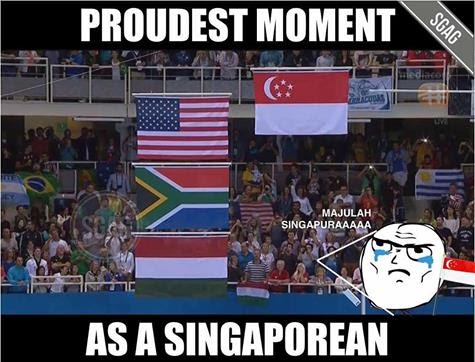
Joseph Schooling wins Olympic Gold Medal - the first ever for Singapore


Today (13 Aug'15) is a historic day for Singapore, at least in as far as her sporting achievements are concerned.

The last time Singapore had a Olympic Medalist was in 1960, when Mr Tan Howe Liang claimed the Silver Medal for Men's Weightlifting.

Singapore's National Swimmer Joseph Isaac Schooling has won Singapore's first ever Olympic Gold medal in the Men's 100m Butterfly in the Rio 2016 Olympic Games.

Not only did Schooling managed to out-perform world champions like László Cseh of Hungary, two-time world champion Chad le Clos of South Africa and his childhood idol Michael Phelps, 22-Olympic Gold medal winner; he did it and set a new Olympic record.

And the best part about his win?

Schooling paid tribute to all those who were with him, supporting, cheering him on  for his journey.

Straight after his historic golden feat, Schooling told Singapore media: 
"This swim wasn't for me. It's for my country. 
"Some people believe that Singapore has a lot of talent. I believe that. It doesn't matter where you're from really. I hope this opens new doors for sports in our country and I hope I've set a precedent for the young in our country. 
"It's been a hard road, I've done something that no one in our country has done before. I've received a lot of support and that's phenomenal, that's great. I can't really describe what that means. 
"But it's been a tough road, I'm not going to lie, the first guy through the wall is always bloody. I had to take that blow. 
"I'm thankful and I'm blessed that I have the ability to accomplish this. This moment is not about me, it's really for my country, it's all about my coaches, my family, my friends who believed from when I was a six-year-old kid, that I could do it."
Straits Times


Well done lah Bro. We are all sibei proud of you.


Update:
MOE is probably just as proud as any Singaporean of Schooling's win.
But they had to be the 'responsible adult' and remind the kids that Monday's going to be a normal schooling day. Sorry kids.

LOL


Friday, August 12, 2016

[Defending the Lion City] Nightmares are made of stuff like this


Singapore's 51st Birthday went on without a hitch.

The NDP celebrations at the new National Stadium were as grand and inspirational as one could have imagined.

However, in the midst of the festivities, one very significant piece of news seems to have been overshadowed - that is the fact that a terrorist plot to directly attack S'pore was foiled on 5 Aug, just days before S'pore's National Day.


This piece of news did not seemed to be very widely shared on social media. There were probably much more people who were more interested and conscious of the fact  that Pokemon Go was finally available in S'pore than those who read about the terror plot.

There are two ways that one could maybe explain this seemingly lack of alarm over the terror plot.

1 - That S'poreans generally have confidence that the Govt will handle it. Our Gahmen steady one okay. Dun need to worry lah..

2 - That S'poreans have become complacent and take for granted the peace and security that S'pore enjoys.


Confidence in the Govt and her security agencies

There are many reasons for S'poreans to feel safe and secure. Afterall, we all know that our Home Team and the SAF are on-the-job, 27 / 7.


The visible security, heavily armed police patrolling on our MRT and other public areas, adds to the sense of security and confidence that we, or at least our Govt, are ready to handle any incidents.


As most S'poreans know only too well (via our Ten-year-series books), practice makes perfect.

Out of the public eye, our public institutions and security agencies drill incessantly on their SOPs for various scenarios and fine-tune their responses where necessary. In response to latest wave of terror attacks which favour attacks on soft targets, the Govt established a new police unit - the Emergency Response Teams (ERTs) - to be the immediate, first responders to any terror attack. We have even gone to the extend of conducting an mock-terror attack in the middle of the heartlands, not only to test our SOPs but to also to educate the public.

Various public programs such as the Community Emergency Preparedness Programme (CEPP) and Community First Responder Programme (CFRP), have been running to educate the general public on importance of Emergency Preparedness and what to do in the event of a crisis. Early in the year, a new national movement called "SG Secure" was launched to prepare S'poreans for a terror attack.

“SG Secure will represent our national strategy to safeguard our homeland and our way of life against this threat. 
Just as we have Total Defence, which involves every Singaporean playing a part for the defence of Singapore, SG Secure must become a rallying call for Singaporeans from all walks of life to unite, to play a part in making Singapore a safe place that it is today.” 
Home Affairs and Law Minister K.Shanmugam

There is also much national emphasis on the need to build up social cohesion and unity. If the terrorist succeed in creating a climate of fear and distrust in our community, then they would have won regardless of what we do.

“But if an attack occurs, we have to prepare Singaporeans with the psychological and other skills to come together and emerge stronger. 
A Singapore that is even more united and determined to safeguard our way of life, our racial and religious harmony. A Singapore where every Singaporean knows that he or she can rely on fellow countrymen. That is how we must be able to respond to terrorism, ..." 
Home Affairs and Law Minister K.Shanmugam


Complacency

The other problem that would be detrimental to our collective security is the sense of complacency. As this blogger best puts it:


Sadly, the success of our security agencies working behind the scenes is also the source of their greatest bugbear. 
Success breeds complacency. It stokes a sense of smug security bordering on stupidity, a kind of blasé stupor that will not be shrugged off short of seeing the worst effects of a terror attack, blood and mayhem on our streets. This is the wake-up call our society is waiting for.

When it comes, are you ready for it?
David Boey, Senang Diri, "The best customers"

Will we fall victim to our own success? Are we so arrogant and naive to think that such terror attacks will never happen to us?

Do S'poreans have a realistic sense of the various threats that face us as a nation?

Or do we simply not care - choosing instead to focus on our own lives and just pushing the entire responsibility to the Govt?

While the Govt will, and should continue to shoulder the bulk of the responsibility for our security, her citizens have, and must play their parts in the overall scheme of things.


Unfounded criticism and spreading of poisonous cynicism

The anti-PAP / anti-govt / anti-establishment groups continue to peddle their cynicism of national service and pour unwarranted criticism of our security agencies online.

They attempt to exploit societal fault lines and exaggerate stories to the point of sensational fantasy, all simply to push their political agenda and to attract more online viewership to earn a quick buck at the expense of the facts/truth.

Here are just some of the false and baseless accusations hurled at our own Home Team and SAF.

Political Activists who are attempting to discredit the credibility of our Police Force. No matter what SPF does, it will never be good enough for these activists.

Pic - Shut Down The Rubbish Sites Facebook
Portraying NS as an exploitation by the Govt.

Pic - FLOP Facebook
Attempts to discount the need for NS and to cheapen the sacrifice of our NSFs into a commercial transaction.


No one is saying that we cannot criticize the Govt. But please lah, at the very least criticize base on facts can?

Constructive criticism based on facts, can help to improve our Govt and uncover any blind-spots that may be missed.

But criticism that is based on twisted half-truths and baseless accusations should not be perpetuated. Such baseless criticism cannot help solve or improve the situation and only serves to confuse the real issues at hand and unnecessarily agitate emotions.

Opposition groups and alternative media sites like to say that they are patriots and are fighting for the interests of Singapore. Really? How are you a patriot when you spewl forth nothing but twisted half-truths and baseless accusations that are clearly intended to stir up emotions and shake the confidence of our home team and security agencies?

It is only a matter of time when Singapore will be hit by a terror attack.

When it happens, will we stand together as one united nation and show those who mean us harm that we will never fall to their threats?

Or will we be struck by fear and fall into disarray? Our sternest test as a nation is yet to come.


Read more here


Thursday, August 11, 2016

Big pile of bullshit from Gilbert Goh who is not a proud Singaporean

So politician-wannabe Gilbert Goh said that he was not a "proud Singaporean". And we are so glad for Anthony Kan's response.


But if you don't already know who this Gilbert Goh is, here's a short intro.


And he has quite a dubious history...


"People have long suspected that Gilbert Goh profiteers off you . This is from Sammy Boy. DO NOT give Gilbert Goh money"


Thursday, August 4, 2016

Why Singapore at 50 Is Like a Banyan Tree, a Bonsai and Nanotechnology


By George Yeo
Chairman, Kerry Logistics
Foreign Minister of Singapore (2004-2011)

Article Source: https://www.mfa.gov.sg/content/mfa/overseasmission/geneva/press_statements_speeches/2015/201508/press_201508032.html

SINGAPORE — Under the late Lee Kuan Yew, Singapore — which this week is celebrating its 50th anniversary as a nation — was unabashedly a hierarchical society. When asked if Singapore was a nanny state, he replied that, if it were one, he was proud to have fostered it. But he also knew that Singapore society was entering a new phase.

In November 1990, Lee Kuan Yew stepped aside to let Goh Chok Tong take over as prime minister. The state retreated a little; controls were carefully loosened; greater diversity was tolerated if not selectively encouraged. As minister for information and the arts, I was happy to push some boundaries — censorship, use of dialects and Singlish, greater emphasis of pre-PAP history and promotion of our diverse ancestral heritage. These were all sensitive issues and I had to manage senior cabinet colleagues artfully. A speech I made about the need to prune the banyan tree in order that civic participation could flourish resonated with many Singaporeans. Pruning the banyan tree means cutting down hierarchy. Letting more sunlight through enables the social network to be better energized.


Pruning the banyan tree means cutting down hierarchy. Letting more sunlight through enables the social network to be better energized.


Diversity causes tension. In hierarchical societies, diversity is frowned upon because it makes top-down organization more difficult. Standardization improves efficiency but it also leads to oppression.

Many years ago, the late Cardinal Jan Schotte told me this story about Pope John Paul II, whom he served as the secretary of the Synod of Bishops in the Vatican. Drafting a speech for the Holy Father, Cardinal Schotte inserted a sentence for the pope to say that “despite our differences, we are one.” John Paul II gently chided him and replaced “despite” with “because of.” “Because of our differences, we are one.”

The particularity of the individual is sacrosanct. Each of us is unique; each is ultimately responsible for his own life. The correction by the pope was not of style but of deep principle. Diversity is not to be merely tolerated; it is to be celebrated. For those who believe in God, every human being carries a divine imprint which unites us. For Confucianists and atheists, every human being has a moral core which also makes us one. We may disagree over man’s spiritual nature but there is something deep in all of us, probably encoded in our DNA, which bows before the ideal of human fraternity and which is moved by the cries of a child. This, of course, has not stopped slaughter over religious beliefs. Unity in diversity is easy to say. Living it requires a daily examination of conscience.

I recounted Cardinal Schotte’s story to a group of young supporters who were helping me raise funds for a public sculpture by a lake in my old political constituency. They were inspired and designed a badge with the pope’s amended formulation (see illustration below). In their enthused response, I draw hope for Singapore’s future.


Singapore is only what it is because it is diverse. There is one requirement to being Singaporean: a new citizen has to enlarge his heart and broaden his mind to embrace those who are different from him.


Singapore is only what it is because it is diverse. As a member of Parliament, I regularly officiated at ceremonies to welcome new citizens. Invariably, my speech made the same point. Although Singapore does not recognize multiple citizenships, we encourage new citizens to maintain old links and cherish their ethnic and religious heritage. Singapore is enriched by their addition and our international network enhanced. However, there is one requirement to being Singaporean, which is this: a new citizen has to enlarge his heart and broaden his mind to embrace those who are different from him. In other words, being Singaporean means becoming a bigger person even though Singapore is a small country. Needless to say, those of us who are already citizens should also manifest this same largeness of mind and spirit.


Singapore as Bonsai


As a small country, we should always have modest views of ourselves. Foreigners may compliment us for our achievements but sometimes these are just words of courtesy. In the 1990’s a Singapore businessman was told that a Shanghai leader, who was a member of the Politburo of the Central Committee of the Chinese Communist Party, described Singapore as a bonsai to a visiting U.S. cabinet secretary.

My businessman was most offended by the remark. Did he think that Singaporeans were incapable of doing big things? I understood my friend’s reaction but did not feel quite the same way. After all, it is not easy to grow and maintain a bonsai. Some bonsais last a long time and they can be very valuable. With the spirit of Ah Q, I also told myself that if a Chinese leader considered the Singapore bonsai though small to be of the same stock as the Chinese people, that is a great compliment to us since China is a great country. From then on, when talking about Singapore’s relations with China, I would describe Singapore as a bonsai, which is of occasional interest to China because of genetic similarities.

Singapore also shares genes with Malaysia, Indonesia and India. When President Habibie, in a moment of anger, dismissed Singapore as a little red dot, Singaporeans started wearing that little red dot as a badge of pride. This, strangely, has endeared us to many Indonesians. But it is an Indian friend who sized us up (or down) most accurately.

Singapore as Nanotechnology


During his first term as chief minister of the southern Indian state of Andhra Pradesh, N. Chandrababu Naidu compared the workings of Singapore to nanotechnology. Yes, we are small but we pack a lot into a tiny space and are able to network Singapore to the entire world.

Singapore is not intelligible in itself. Its economy, culture and politics can only be understood in the context of the region it serves. Singapore is only one node in a dense network of many nodes. Whether the Singapore node grows or shrinks depends on the health of the network and our ability to link up with other nodes and add value. Our diversity is therefore a great strength.


Whether the Singapore node grows or shrinks depends on the health of the network and our ability to link up with other nodes and add value.


Joel Kotkin describes Singapore as a home for many tribes. This enables us to arbitrage across cultural domains. Indeed this arbitrage is at the heart of our economy and foreign policy. As minister for information and the arts, trade and industry, and foreign affairs, I devoted considerable time to the development of our cultural connections because they underlay our economic, political and social life. These efforts also brought me closer to the many minority communities living in Singapore.

Diversity is, however, also our vulnerability. Every channel which connects us to the outside world also brings infection. Maintaining Singapore’s integrity and security is therefore a continuing challenge. Two conditions have to be met for a city-state to be independent.

First, its foreign policy has to be nimble to adjust to a shifting external balance of power. Second, the citizenry must be united in its common defense against external subversion and aggression. The external and internal equations have to be solved simultaneously. Only when Singaporeans feel secure about their own place at home can they turn outwards and do big things together. I spent 16 years as a soldier, first in the Army, then the Air Force and, finally, in the Joint Staff. The Singapore Armed Forces is a well-equipped and well-trained militia. Its fighting ability is completely dependent on the unity of diverse Singaporeans and their commitment to a common, righteous cause. By being prepared for war, we are more likely to have peace. It is better not to be put to the test.

Keeping the Peace in Asia

If we can maintain peace in Asia for another 10 to 20 years, the region will be transformed beyond recognition and become a powerhouse of the global economy. While trials of strength are inevitable, Sino-U.S. relations are unlikely to deteriorate too badly. Even when China’s economy overtakes that of the U.S. in size, the U.S. will remain the dominant military and political power in the world for decades to come. American popular culture has already taken over the world.


Unlike the U.S., China is not a missionary power. So long as it is able to maintain its own political and cultural universe within, China has no ambition to compete with the US for global supremacy without.


Unlike the U.S., China is not a missionary power. So long as it is able to maintain its own political and cultural universe within, China has no ambition to compete with the U.S. for global supremacy without. If China is also a missionary power, like the former Soviet Union, another hot or cold war is inevitable. Happily, China is not and a titanic clash between the U.S. and China is not inevitable.

Between China and India, they are more likely to cooperate than to fight. Except for a minor border war in 1962, which has been largely forgotten in China, the long history of contact between them has been peaceful. Each recognizes the other as an ancient people.


Nalanda was a light to the world and, hopefully, it will be again, promoting the philosophy of man living in harmony with man, man living in harmony with nature, and man living as part of nature.


A Light to the World

I have the privilege of joining Amartya Sen, Wang Gungwu and others in reviving an ancient Indian university in the state of Bihar. For centuries, Nalanda was a great university attracting students from different parts of Asia, the most famous being the two great Buddhist monks from Tang China — Xuanzang and Yijing. It was from the records of these two monks that India recovered a large chunk of its own history.

Nalanda was a light to the world and, hopefully, it will be again, promoting the philosophy of man living in harmony with man, man living in harmony with nature and man living as part of nature. This ideal is not only desirable today, it is a necessity. The greatest danger in the age we live is technological development racing too far ahead of man’s moral development. We need men of goodwill coming together from all directions to reflect on the moral challenges of our times and help point the way forward. Nalanda can provide one such meeting place. I hope, Singapore, another.

This article is adapted from the introduction to “George Yeo on Bonsai, Banyan and the Tao.” (World Scientific Press, 2015)


Tuesday, August 2, 2016

Alex Tan continues to demonstrate his unparalleled ignorance and selective reading of facts


By Shut Down TRS (Facebook Page)

Alex Tan spreading half truths fueling hatred for the Govt!

Instead of reporting the full article where Alex Tan stole from, he left out the part where it was mentioned most bond breaking cases were from earlier graduating batches. 

MOE had enhanced measures taken and the default rates have already come down significantly. Since the enforcement, 95% of these recipients are meeting their bond applications!

Source: http://www.straitstimes.com/singapore/lapses-in-enforcing-scholarship-bonds