Friday, September 8, 2017

The A-Z Guide to S'pore's Elected Presidency


A-Z Guide to S'pore's Elected Presidency
By FLOP FB Page


A IS FOR ADVISERS

The president's panel of wise men has expanded, and wields more power following changes to the elected presidency passed in Parliament last November.

The president must now consult the Council of Presidential Advisers (CPA) on all - as opposed to some - monetary matters relating to the reserves, and on key public service appointments.

If the president acts in accordance with the CPA's advice, his veto is final and the Government must abide by it. If he goes against its advice, the Government can bring the matter up to Parliament, which can override the president's decision with a two-thirds majority.

In the light of its heavier responsibilities, the CPA now has eight members, up from six.
After all, as Prime Minister Lee Hsien Loong noted: "The system does not solely rely on the judgment of a single person acting alone but, rather, on the president well advised by a team of wise and experienced men and women."

B IS FOR BILL

The road to a reserved election began in January last year, when PM Lee raised the need for a review of the political system during the first Parliament session since the 2015 General Election.

A Bill to amend the Constitution was passed last November with the backing of 77 MPs, after a Constitutional Commission set out its recommendations on the elected presidency, and after three days of intense debate in Parliament.

All six elected Workers' Party MPs voted against the changes, which include raising the eligibility criteria for presidential candidates, strengthening the Council of Presidential Advisers, and ensuring members of racial minority groups are elected from time to time through a hiatus-triggered reserved election.

The changes were the widest made to the elected presidency scheme in its 26-year history.

C IS FOR COMMUNITY COMMITTEE

Are you Malay enough to be Singapore's next president? That decision lies in the hands of the Community Committee, a new feature of the presidential election.
Its first task is to assess whether those hoping to stand in this month's polls are part of the Malay community.

These hopefuls will be informed of the result by Sept 12, after the five members of the Malay community sub-committee deliberate on their applications.

Presidential hopefuls must declare which of the three main communities they consider themselves a part of, and will be issued a certificate if the respective sub-committee agrees.
This process may require the person to provide further information and to be interviewed, among other things.

The Community Committee will be convened even during an open election, and candidates will still have to declare their ethnicity as this will help determine when a reserved election should be triggered.

D IS FOR DIVISIVE ELECTIONEERING

Campaign rules have been changed to discourage divisive electioneering.

The authorities, for one, will no longer designate election rally sites.

This is because rallies "by their nature and format, may be divisive and not congruent with the unifying role of the elected presidency", as Minister in the Prime Minister's Office Chan Chun Sing put it.

Candidates can pick their preferred sites, but must apply to the police for a rally permit.
Explaining the changes to campaign rules in Parliament, Mr Chan said: "Campaign methods for the presidential elections must not inflame emotions and must be in keeping with the decorum and dignity of the Office of the President."

E IS FOR ELECTED PRESIDENCY

This was almost a decade in the making.

The elected presidency was first mooted by founding prime minister Lee Kuan Yew in 1984, but took effect only seven years later, in 1991, after two White Papers were debated in Parliament from 1988 to 1990.

Before that, presidents were appointed by Parliament and served a largely ceremonial role, save for discretionary powers over select matters, such as the appointment of the prime minister.

The elected president, however, is vested with custodial powers over the country's reserves, among other things.

F IS FOR FARID KHAN

A school dropout who worked as a grasscutter at age 13 after his father died, Mr Farid Khan now has his eye on the presidency.

He is the chairman of Bourbon Offshore Asia Pacific, a regional marine services company with a reported shareholder equity of around US$300 million (S$407 million). He was the second aspiring candidate to submit the required forms.

It was a long slog up the ranks for Mr Farid, now 61, who spent years taking on a string of blue-collar jobs that ranged from lorry attendant to janitor.

He attributes his success now to Singapore's meritocratic system. For him, the presidency is a way to serve and give back to the nation.

G IS FOR GOALKEEPER

This was the role the late Mr Lee Kuan Yew saw the president playing: goalkepeer, the very last line of defence against a rogue government bent on squandering the country's reserves or installing cronies in key public positions.

"You need a wise person in that job to play the goalkeeper, and your council of advisers are fullbacks to prevent stupid people - your own players - from kicking into your own goal," said founding prime minister, Mr Lee, in an interview.

This comparison resurfaced over the past year as PM Lee told Parliament that the president is "neither the government nor is he the opposition".

"He is a custodian. He's a goalkeeper," he said, noting that while the Constitution gives the president power to block certain actions of the government, it does not give him the power to initiate policies.

H IS FOR HALIMAH YACOB

For months, she deflected questions by reporters on persistent talk that she would run for election, being one of the few publicly-known Malay candidates who would automatically qualify for the contest.

Madam Halimah Yacob, 63, finally put the flurry of speculation to rest when she announced at a National Day dinner that she would be leaving her party and political posts to stand.

She said then: "It is a heavy responsibility but I hope that with the support of Singaporeans, we can do more good together."

Last Wednesday, she became the last known hopeful to submit the necessary forms.
The former Speaker of Parliament and veteran People's Action Party (PAP) MP - who, as a schoolgirl, helped her mother hawk nasi padang to support the family - entered politics in 2001, after a decades-long career with the labour movement.

I IS FOR INDEPENDENT

The Constitution dictates that the president be non-partisan and apolitical - and the three aspiring candidates have taken pains to stress their independence.

Businessmen Farid Khan and Salleh Marican point out that they have no ties to political parties, while Madam Halimah Yacob - who has been out of politics for less than a month - says she has always put "people before party colours", and has the track record to prove that she does not always toe the government line.

An occasion she cited was when she abstained from voting on amendments to the Human Organ Transplant Act in Parliament in 2007 because she was concerned that this would lead to poor people being persuaded to "sell" their organs.

"I know people have that concern because of my past affiliation with the PAP," Madam Halimah said. "But I just want to say that the President has a duty first and foremost to Singapore and Singaporeans, and not to any party."

J IS FOR 'JUST DO AWAY WITH THE ELECTED PRESIDENCY'

Calls emerged during the discussion on changes to the elected presidency to abolish the entire system instead.

The Workers' Party was among these voices, reiterating a stance it has held since the 1980s.

One reason it gave was that the elected president could be an unnecessary alternative power centre.

It also worried that an elected president could potentially "cripple" a non-PAP government, noting that those who qualify to run come from an elite group, and many are "senior officials appointed under the PAP Government".

The WP wanted a return to the former system of appointed, ceremonial presidents, and said it was open to the idea of additional parliamentary mechanisms - such as requiring a super-majority vote - to safeguard the reserves instead.

A Constitutional Commission reviewing aspects of the elected presidency also raised the possibility of a return to an appointed president, and hiving off the president's custodial powers to a body of experts.

The Government rejected this, arguing that the holder of the second key needed a direct mandate from the people to have the moral authority to veto a government action.

K IS FOR KEY

Two "keys" guard Singapore's reserves and the integrity of its public service.

The Government holds the first key, but the president wields the second. He must agree before the Government can dip into past reserves or make key public service appointments.

The first president to turn the second key and unlock past reserves was the late Mr S R Nathan.

During the 2009 financial crisis, the Government sought and obtained his approval to withdraw $4.9 billion from the reserves to fund schemes to save jobs and stabilise the economy.

L IS FOR LEGAL CHALLENGES
The elected presidency system came into effect in 1991, part-way into Dr Wee Kim Wee's term as president. This made him the first to be vested with the powers of the elected president - even though he was appointed by Parliament.

The Government therefore started its count of the five terms needed to trigger a reserved election from Dr Wee's term, although it was his successor, Mr Ong Teng Cheong, who was the first president to be elected directly by citizens in 1993.

This was a sticking point for former presidential candidate Tan Cheng Bock, who this year mounted a legal challenge on the basis of the upcoming election, which is reserved for Malay candidates. Dr Tan believes it is unconstitutional for the Government to start its count from Dr Wee's term.

The case was dismissed - as was Dr Tan's subsequent appeal.

The reasoning was that Parliament has the right to decide when to start the count, and it is a fact that Dr Wee was the first president to exercise the powers of the elected president.

A separate challenge brought by non-practising lawyer M. Ravi was also dismissed.

M IS FOR MADAM PRESIDENT

It was the parliamentary gaffe that caused a stir.

During the debate on changes to the elected presidency, Mr Chan Chun Sing mistakenly addressed Madam Halimah Yacob as "Madam President" instead of "Madam Speaker".

Madam Halimah, in an interview, said: "I thought I heard it wrong the first time, so I didn't say anything. Then it was mentioned the second time. I almost fell off the chair. I felt very stressed out.

"After the sitting, he told me it was unintended, it was a slip. I accepted his explanation."

N IS FOR NOMINATION DAY

PM Lee started the ball rolling last Monday, when he issued the Writ of Election.

The next stage of the process will be Nomination Day, on Sept 13. Singaporeans get to know then if they will cast their vote or if the election is a walkover.

Nomination Day now has to come at least 10 days after the prime minister issues the Writ of Election instead of five, giving the Presidential Elections Committee more time to scrutinise applications.

Aspiring candidates will be told by Sept 12 whether they qualify, and those who do will have their nomination papers, including their financial statements, made public on Nomination Day. This aims to encourage transparency and discourage hopefuls from exaggerating their credentials.

O IS FOR OUT-OF-OFFICE

Dr Tony Tan Keng Yam's time in the Istana has come to an end. His last day as Singapore's seventh president was Aug 31.

He was sworn into office on Sept 1, 2011, following the country's most heated presidential contest yet, beating out three other contenders to win by a narrow margin.

Dr Tan, 77, was a long-time PAP MP before he left politics in 2006. He was first elected in 1979, and was made deputy prime minister in 1995 - a position he held until he stepped down in 2005.

Until a new president is sworn in, the chairman of the Council of Presidential Advisers, Mr J.Y. Pillay, will serve as acting president.

P IS FOR PROMISES

No more empty promises this election.

Presidential hopefuls must now make a statutory declaration that they understand the role of the president as spelt out in the Constitution.

"It will then be inexcusable if he deliberately chooses to disregard the limits of the Constitution and makes promises or statements exceeding this role," said Minister Chan Chun Sing.

This arose after several candidates made claims and promises in the 2011 election that suggested they may not have been clear about the powers and scope of the presidency.

Q IS FOR QUALIFIED OR NOT?

To qualify to contest the presidency, candidates must be issued a certificate of eligibility by the Presidential Elections Committee (PEC).
The barriers for those from the private sector looking to make the cut have gone up to reflect the growth of the economy: They must have helmed a company with at least $500 million in shareholder equity to qualify, instead of $100 million in paid-up capital.
But raising the bar, said the WP, may shrink the pool of candidates and limit it to senior public officers.

Criteria for those from the public sector remain unchanged: They must have spent at least three years in a key public office.

But those who do not automatically make the cut can qualify under the "deliberative" track, which gives the six-member PEC, chaired by Public Service Commission chairman Eddie Teo, some leeway. Candidates will then have to convince the committee that they have held an office which has given them the necessary experience and ability for presidential duties.

R IS FOR REVIEW

Nine members - led by Chief Justice Sundaresh Menon - made up the Constitutional Commission, which was convened in February last year to review aspects of the elected presidency.

The discussion process saw more than 100 individuals and groups sending in submissions, and four public hearings held.

Two issues dominated: how to ensure that the president has a baseline financial competency, and how to ensure that members of Singapore's minority communities are elected president from time to time.

The commission's 154-page report, which included recommendations such as reserved elections and tightening criteria for private-sector candidates, was released in September last year.

The Government responded in a White Paper that broadly accepted the recommendations.

S IS FOR SALLEH MARICAN

Second Chance Properties chief executive Salleh Marican, 67, was the first to make known his intention to run for election when applications opened on June 1 - and last month, was the first to submit his forms.

His company was the first Malay-owned one to be listed on the Singapore Exchange, and had shareholder equity of between $254.3 million and $263.25 million in the past three financial years.

Mr Salleh, whose textile merchant father died when he was 15, saw his first four business ventures fail but picked himself up each time. Now that he has done well in business, he feels it is time to give back to society "in a much larger way" - through the presidency.

T IS FOR TOKENISM

The reserved election - the special arrangement to ensure minorities are elected president at intervals - has drawn accusations of tokenism.

But political leaders have shot this notion down, pointing out that the stringent criteria to qualify will not be lowered for any race. Minister for Communications and Information and Minister-in-charge of Muslim Affairs Yaacob Ibrahim insisted: "We do not want, and we cannot accept, tokenism."

And Deputy Prime Minister Teo Chee Hean felt that multiracial representation could be achieved while ensuring meritocracy was not compromised.

Madam Halimah Yacob herself said in an interview last year, while still Speaker: "When you say it is tokenism, it means that it is symbolic, it is perfunctory. The point is, all candidates, regardless of an open or reserved election, will have to qualify."

U IS FOR UNIFYING FIGURE

Before the president was armed with custodial powers, his historical role was as a unifying figure representing a multiracial Singapore.

The Constitutional Commission, in describing this unique symbolic function, said: "No other public office - not that of the prime minister, the chief justice or the Speaker of Parliament - is intended to be a personification of the state and a symbol of the nation's unity in the way that the presidency is."

This is why Singapore needs to ensure that "no ethnic group is shut out of the presidency even as progress is made towards that ideal, lest the office of president loses its vitality as a symbol of the nation's unity".

It is vital, added the commission, that minority candidates do not see the presidency as unattainable.

This was also noted by the Government in its response to the commission's recommendations.
"Every Singaporean has to be able to identify with the president, and to know that a member of his community can and will become president from time to time," it said.

Former president Tony Tan Keng Yam pointed out that Singapore's first four presidents - Encik Yusof Ishak, Dr Benjamin Sheares, Mr Devan Nair and Dr Wee Kim Wee - represented, in turn, the Malay, Eurasian, Indian and Chinese communities respectively.

But after the elected presidency was instituted, all but one of the elected presidents have been Chinese, including himself, he noted.

"Our long-term aspiration should be for minorities to be elected into the office without the need for any intervention," said Dr Tan, in a message that was read out at the start of the debate on changes to the elected presidency. "But we also need to recognise the current realities."

V IS FOR VOTE
Will Singaporeans get a chance to vote in the country's first reserved election? Or will there be a walkover?

Three hopefuls have staked their claim on the presidency - but only Madam Halimah Yacob - who was Speaker of Parliament from 2013 until she stepped down this August - automatically makes the cut so far.

Both Mr Farid Khan and Mr Salleh Marican fall short of the financial threshold needed to qualify as a private-sector candidate.

It is up to the PEC to decide whether the two businessmen have the experience and ability needed to carry out the functions and duties of a president.

But all three candidates are raring to go, with campaign teams formed and plans drawn up.
Madam Halimah - the most battle-hardened of the three, having stood in four general elections - said: "We always go into a contest preparing for a contest."

Mr Salleh thinks "it will be good for Singapore if there is a contest", while Mr Farid noted that a walkover would leave him and many others disappointed.

As Mr Farid submitted his application, along with five binders of documents on his company, he said: "Whether two-cornered or three-cornered, I am ready for it."

W IS FOR WOMAN

Madam Halimah Yacob is Singapore's first female presidential hopeful - and leaders across the Causeway are paying attention.

Her presidential bid has won support from Malaysian leaders, who have held her up as a role model for women. Deputy Prime Minister Ahmad Zahid Hamidi said many countries have had women play leading roles, and Malaysia aims to do the same.

He cited former Bangladeshi prime minister Khaleda Zia, former Indonesian president Megawati Sukarnoputri and Madam Halimah as among those who have made it to the top on their own merit.

Even before declaring her intention to run, Madam Halimah had been a trailblazer: She is Singapore's first female Malay MP since independence, the first female Speaker of Parliament, and, in 1999, was the first Singaporean to be elected to the governing body of the International Labour Organisation.

X IS FOR 'EXCUSE ME, ARE YOU MALAY?'

Mr Salleh Marican - whose father is Indian - stumbled through a live interview conducted in Malay, Mr Farid Khan's race on his identity card is Pakistani, and Madam Halimah Yacob also has an Indian father.

All three presidential hopefuls have had doubts expressed about their ethnicity, with naysayers branding them "not Malay enough" and questioning whether they are "truly Malay". This, despite the candidates identifying themselves as Malay, and following Malay customs and traditions.

The Community Committee will have the final say on whether these hopefuls are indeed Malay. Singapore's Constitution provides that a person belonging to a Malay community is one "whether of the Malay race or otherwise, who considers himself to be a member of the Malay community, and who is generally accepted as a member of the Malay community by that community".

Y IS FOR YUSOF ISHAK

He was Singapore's first president, and its only Malay head of state - until now.
Encik Yusof Ishak, who died in office in 1970, steered Singapore through formative moments of its nationhood.

He became Singapore's Yang di-Pertuan Negara (head of state) in 1959 - the personal pick of the late Mr Lee Kuan Yew, who wanted a distinguished Malay as the first head of state, to show the federation that Singaporeans accepted Malays as their leaders, and to forge good relations with Malaysia's Tunku Abdul Rahman and other Malay leaders.

After Singapore gained independence in 1965, Encik Yusof served two terms as president before his death from heart failure.

He played a crucial part in helping to restore the trust of Singaporeans who lived through events such as the 1964 racial riots, and was a keen champion of meritocracy and multiracialism.

PM Lee Hsien Loong has several times this year called on the memory of Encik Yusof.
"If all goes well, another distinguished Malay Singaporean will become our next president," he said most recently at the National Day Rally. "I hope he or she will bring as much distinction and honour to the office, and be as well-loved and remembered by Singaporeans, as Encik Yusof Ishak was."

Z IS FOR ZEITGEIST

The presidency must keep up with the changing needs of the country. It must also continue to evolve to stay in line with the zeitgeist - the spirit of the times.

As PM Lee put it, when he spoke of plans to review the scheme last year: "We are doing this because any adjustments that may be necessary for the future should be made in good time, in order to give us time to think it over in a thoughtful, mature, unpressured way, in order to keep the presidency a robust and effective institution in our political system."

The criteria change for private sector candidates, for one thing, is meant to keep pace with an economy that has grown seven times since the elected presidency was introduced in 1991.

And the shareholder equity threshold - which now stands at $500 million - will have to be reviewed at least once every 12 years, or two presidential terms, by the PEC. The committee can recommend that the sum be raised, but not lowered. Parliament will then decide if the recommendation should be adopted.

President Tony Tan Keng Yam called the changes passed last year "a milestone for Singapore in ensuring that the elected presidency scheme stays relevant with time and in our local context".


A-Z Guide to S'pore's Elected Presidency
By FLOP FB Page


Read more here: Presidential Election 2017

Singapore's Elected Presidency - How much do you know?


Soon, Singaporeans may be called upon to elect a new President.


But how much do Singaporeans actually know about the Elected Presidency?

These are some videos that will explain what Singapore's Elected Presidency is all about.

Read more here: Presidential Election 2017


Gov.sg - The Elected Presidency


Gov.sg - Certificate of Eligibility Process Explained


Gov.sg - Community Certification Explained


RESERVED ELECTED PRESIDENT APPLIES TO THE CHINESE RACE ALSO
By Singapore Matters FB page

The whole purpose of a reserved election is to ensure that the presidency is indeed rotated among the different races.

This reserved election mechanism applies to three main racial groups.

These three groups are:
1. Chinese
2. Malay
3 'Indian and others'.

From comments, it seems that people do not realize that the reserved election mechanism applies also to the Chinese race.

If in the event that for 5 elections, the elected President is either Malay, Indian, Eurasian or of some other minority races, then an election will be reserved for a Chinese to be elected president.

This was made clear by Law and Home Affairs Minister K Shanmugam during a dialogue with 1,300 grassroots leaders and residents from Central Singapore District at ITE College Central in September 2016.

Since the reserved election applies EQUALLY TO ALL THE THREE MAIN GROUPS including Chinese, the argument that it is racist or discriminatory can be thrown out of the window. Likewise for the argument that it lower the bar since all candidates have to meet the same eligibility criteria.


Monday, August 14, 2017

Chee Soon Juan tries his luck yet again.


CSJ eyes Marsiling-Yew Tee! But ddn't he promise his supporters that he would stay in Bukit Batok 
and fight the next GE there? Onward Singapore


Note: We replace the original video soundtrack with something that we thought was more appropriate for this clown Chee. See the original video by Onward Singapore FB page here.


Chee Soon Juan is at it yet again.

He and his party is trying anything, and everything to agitate for a By-Election, so that Chee can have yet another shot at being elected into Parliament.

In a single seat constituency, the resignation of a MP automatically triggers a By-election.

This last happened for Bukit Batok constituency in 2016, where PAP MP David Ong had resigned due to personal indiscretions. Two candidates came forward - SDP's Chee Soon Juan (38.8% votes) and PAP's Murali Pillai (61.2% votes).

In 2017, Madam Halimah Yacob resigned her position as MP for the Marsiling-Yew Tee Group Representative Constituency (GRC) to stand as a candidate for the Singapore Presidential Elections.

What Chee would like you to believe, is that the Govt is flagrantly flouting the law by not calling for a By-Election to fill Madam Halimah Yacob's now empty seat in the GRC.

However, this is simply not the case.

Section 24(2A) of the Parliamentary Elections Act states that no writ of election can be issued unless ALL THE MPs in a GRC have vacated their seats in Parliament.


(2A)  In respect of any group representation constituency, no writ shall be issued under subsection (1) for an election to fill any vacancy unless all the Members for that constituency have vacated their seats in Parliament.
Parliamentary Elections Act (Chapter 218), Section 24(2A)


Madam Halimah Yacob's resignation does not mean that all of the four seats of Marsiling-Yew Tee GRC are now empty. This is because the GRC still has three other MPs - Mr Lawrence Wong, Mr Alex Yam and Mr Ong Teng Koon.


"Seriously, what makes Chee think by election is compulsory when one vacates the seat in a GRC?
Did he even read the constitution at all?" Pic: Shut Down TRS FB page


The 'FiveStarsAndaMoon Blog' also has a good summary on why the call for By-Elections cannot be mandatory here. Here's a quote:

Singapore’s system of election focuses on political parties rather than on individual candidates. Candidates represent their respective political parties, and the party that attains the highest number of elected candidates forms the government. 
The governing party then receives its mandate through its candidates. For this reason, the Prime Minister retains “full discretion as to when and whether to call a by-election as the vacancy does not affect the mandate of the government”. 
Ok, that is a mouthful, I’ll shorten it for you: A government had already been formed, there is no practical need to fill that one vacancy. The Government of the day will decide on whether or not an election should be called. 
That had been the precedence since 2008 and if it should ever be reviewed in Court, this will continue to form the precedent.
FiveStarsAndaMoon


So Chee continues to act according to his character - selling snake oil  twisting facts and misleading his way around, hoping to one day be elected into Parliament.

You would think that after all these years of rejection from the voters, that Chee would have finally gotten the message.

After all, Chee has stood in open elections 5 times, and have never been elected.

Look at his track record. Can you really trust this snake man?


See more of the dubious shit things that Chee Soon Juan and SDP doesn't want voters to know.


Wednesday, July 26, 2017

Deny, Deflect & Feign Innocence


Update: Here is the full AHTC Statement of Claim (Source: TODAY)

==================

While no one expects the WP MPs to just copulate to the AHTC lawsuit that has been brought against them by AHTC's Independent Panel, the reasons excuses given in their press statement is just too lame.

SO WHAT if you didn't profit from your own incompetence in managing AHTC?

Does that absolve you from any and all responsibility? You make the mistake(s), you pay the price (according to the full extend of the law).

Don't try to pretend it's ok simply because you didn't get any money out from it. Do you know what fiduciary duty means or not?

At your election rallies, you boldly claim that voters can trust you; that WP has more than 20 years of experience in running the Town Councils. And yet, year after year since then, your own appointed Auditors keeps on giving your Financial Statements a "Qualified Opinion". Do you even realize how cockup your accounts must be to be labelled as "qualified"??


If you can't even get running a local town council right, how can you even dare to think that you are qualified to be the "co-driver" and "check & balance" for the PAP, let alone aspire to be the SG government someday? As it is, the NMPs are already doing a far superior job of checking and balancing the PAP govt than you are. You didn't even bother to participate in the Public Consultation sessions for the amendments to the Elected Presidency. So why do the voters need you for?

And don't try to feign innocence by saying that your actions were in the best interests of your residents.

Even using the broadest definition of "Best interests of the residents", this can hardly include shoddy account practices and being unable to account clearly for how the public funds and resident monies have been used.

Is it "acting in good faith" when you continually playing the victim card; to deny the auditors access to documents; to go to Court to challenge the MND/HDB orders for you to open your books; to apply for Court gag orders to prevent pertinent information from being released into the public domain? Instead of wasting everyone's time by playing petty politics, why didn't you bother to fix the problems?

You even had the stupid balls to challenge the Parliament's authority to question you over the AHPETC accounts. Instead of giving straight answers, you said that you would only answer to your residents rather than answer/explain/account for your actions to the highest authority in Singapore. What happen to WP's manifesto of transparency and accountability? Is that all just bullshit to win votes?


You were given a golden opportunity in GE2011 to show Singapore that WP could be a honest, competent opposition party who would help to safeguard the interests of Singaporeans. Chee Soon Juan would have sold his soul for what the voters gave you in GE2011.

Yet, instead of building on that, you chose to squander away that opportunity to prove your worth.

Instead of working to improve the lives of your residents, you deliberately engaged in petty politics, blaming everyone else for your own failures instead of taking responsibility and fixing the problems.

Do you even realise that to date, you have not even apologize to your residents for this mother-of-all cockups?

So don't try to pretend that you are innocent and give all sorts of talkcock bullshit reasons.

It has been a long time coming that you should faced all of the consequences of your own actions and choices.

For disappointing your own voters and showing such gross incompetence and indifference, I really hope that you will be lose the lawsuit and subsequently lose your parliamentary seats.

Singapore does not need rotten duds like you to be our representatives in Parliament.


The day that WP has been long dreading is here


Despite the Worker's Party leadership's best efforts to deflect, delay, obstruct and remain unaccountable for the mess that is the AHPTEC/AHTC Accounts, the day of reckoning has arrived.

Here's a brief recap to how things have reached this stage.

4 Nov 2016: HDB asks Aljunied-Hougang Town Council (AHTC), to take steps to recover improper payments that it made.
17 Feb 2017: Aljunied-Hougang Town Council (AHTC) appoints an independent panel to review the findings of a KPMG report that said the towncouncil had "serious flaws" in governance and made improper payments amounting to millions of dollars to third parties. After consultation with HDB, the three people who were appointed are panel chairman Philip Jeyaretnam SC, and members Mr N Sreenivasan SC and Mr Ong Pang Thye (managing partner of KPMG LLP).

So what will happen next?

Will the implicated WP MPs do the honorable thing and resign? Thereby triggering off a By-Election?

Will there be criminal charges brought against those involved? And when that happens, will there be a By-Election since the person(s) may be disqualified as an MP upon conviction. (See Disqualifications for membership of Parliament).

Is this the beginning of the end for the Worker's Party? Will this end the Worker's Party dominance as Singapore's premier Opposition Party? 

Will Chee Soon Juan jump in at this golden opportunity to sink WP to further his own (hopeless) ambition to be elected as an MP?

Or will the WP MPs simply deny, deflect, play the victim card and continue to disavow any responsibility for the mess that THEY created THEMSELVES?

And people say that Singapore politics is boring.


Read more here:


Tuesday, July 25, 2017

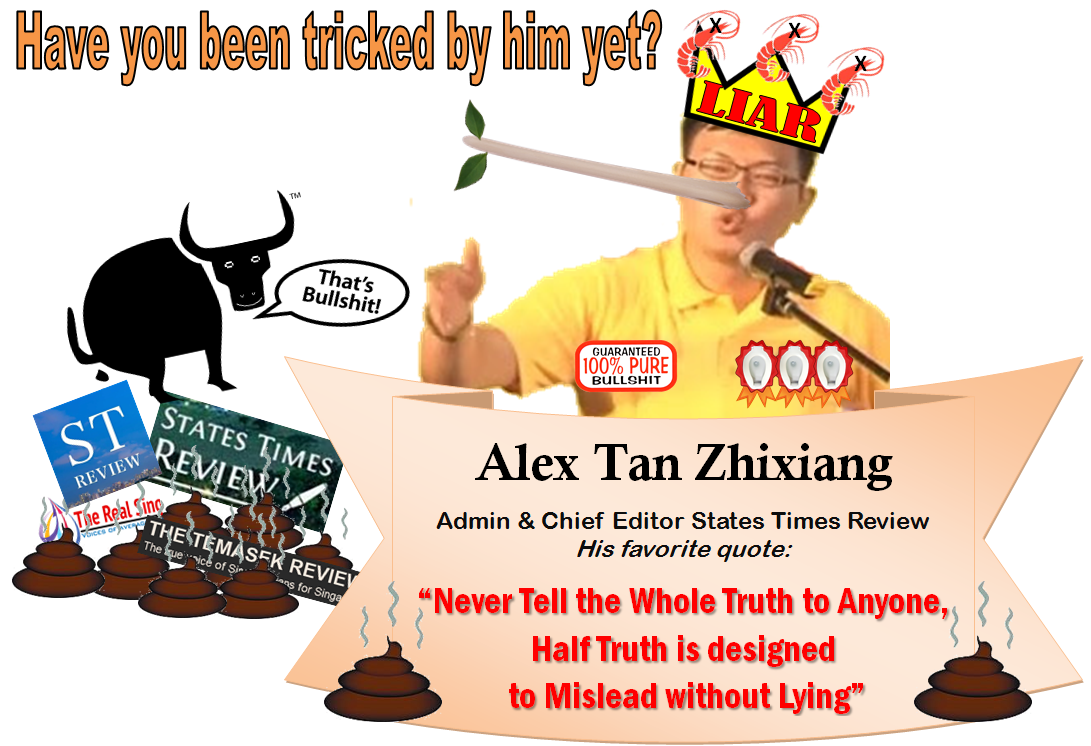
Fake expert Alex Tan Zhixiang


Dunno what else to say. What can one say about such retarded mentality?

Alex Tan is swimming in so much of his own bullshit that he's lost touch of reality.

What qualifies him to label these people as fake experts?

Click here to read some of Alex Tan Zhixiang's massive mountain of bullshit.


Wednesday, July 19, 2017

Diplomacy of Little Red Dot: Past and Present


DIPLOMACY OF LITTLE RED DOT: PAST AND PRESENT
The following is the full Transcript of Remarks by Minister for Foreign Affairs Dr Vivian Balakrishnan at the MFA Townhall on 17 July 2017. 


A very good evening to all our colleagues from MFA, and I believe we also have colleagues from SAF as well as from the administrative service and the civil service. I bid you all a very warm welcome. Let me start by saying it is not by coincidence that today we are at peace, we are at peace with all our neighbours, and we have good relations with all the major powers of the world. We owe a debt of gratitude to all our leaders and diplomats, both present and the past, for this happy state of affairs.

But more recently there has been lively debate on Singapore’s foreign policy, and I think this debate is especially on the part by retired officials, academics and commentators. But there is one key difference for all the people in the room here tonight. The key difference is that we are serving members of the MFA, and we in this room have line responsibility for the actual conduct of foreign policy on a daily basis. What this means is that the deliberations today are not a theoretical debate, and this not an academic word spinning exercise on a lecture circuit.

Some questions that have been raised include the following: First, has Singapore overreached? Have we forgotten our permanent status as a small state in the large dangerous world and tough region? Next question, should Singapore adjust our foreign policy posture given the evolving geopolitical situation, or even because of leadership changes in Singapore? And the third question has been, has our insistence on a consistent and principled approach actually limited our flexibility, our ability to adapt to new circumstances?

These are valid questions but I believe we need to go back to first principles. The ultimate objectives for our foreign policy are first, protect our independence and sovereignty, and second, to expand opportunities for our citizens to overcome our geographic limits. These are our ultimate objectives. It’s easy to state them, difficult to achieve. The existential challenge is how do we achieve these ultimate objectives, given our circumstances that we will always be a tiny city state in South East Asia and with a multi-racial population.


We must not harbour any illusions about our place in the world. History is replete with examples of failed small states. Our founding Prime Minister Mr Lee Kuan Yew always reminded us repeatedly that we have to take the world as it is, and not as we wish it to be. But that does not mean that Mr Lee advocated a ‘do nothing, say nothing’ posture, or that Singapore should simply surrender to our fates. As Prime Minister Lee Hsien Loong has recently reminded us, on issues where our national interests are at stake, we must be prepared to ‘stand up and be counted’.

Some people have suggested that Singapore lay low and “suffer what we must” as a small state. On the contrary, it is precisely because we are a small state that we have to stand up and be counted when we need to do so. There is no contradiction between a realistic appreciation of realpolitik and doing whatever it takes to protect our sovereignty, maintain and expand our relevance, and to create political and economic space for ourselves. The founding fathers of our foreign policy – Mr Lee Kuan Yew, Mr S Rajaratnam, and Dr Goh Keng Swee, and their team – understood this acutely and they formulated a few core foreign policy principles. These principles have served us well since independence but are still worth reviewing again.

Core principles

What are these principles? First, Singapore needs to be a successful and vibrant economy. We need to have stable politics and we need a united society. If you think about it, if we were not successful, if we were not united and if we were not stable, we would be completely irrelevant. All of us in this room have witnessed how delegations of less successful small states are ignored at international meetings. And I am always mindful that foreigners do not speak to us because of the eloquence of our presentations or because we have the highest EQ in the room. We only merit attention because everyone knows that we come from Singapore and Singapore has made a success of itself despite our size, and that we are represented by smart, honest, serious and constructive diplomats.

Second principle- we must not become a vassal state. What this means is that we cannot be bought nor can we be bullied. And it means we must be prepared to defend our territory, our assets and our way of life. This is why we just celebrated 50 years of National Service, and we maintain at great effort an SAF that everybody takes seriously. This does not just depend on the military technology that the SAF possesses, but on the courage and resolve of our soldiers, particularly NS men, to defend what we have and to fight for what we hold dear.

Third, we aim to be a friend to all, but an enemy of none. This is especially so for our immediate neighbourhood where peace and stability in Southeast Asia are absolutely essential. Consequently, Singapore was a founding member of ASEAN and we remain a strong advocate of ASEAN unity and centrality. With the superpowers and other regional powers, our aim is to expand our relationships, both politically and economically, so that we will be relevant to them and they will find our success in their own interest. This delicate balancing act is easier in good and peaceful times, but obviously more difficult when superpowers and regional powers contend with one another. Nevertheless, our basic reflex must be and should be to aim for balance and to promote an inclusive architecture. And we must avoid taking sides, siding with one side against another. While we spare no effort to develop a wide network of relations, these relations must be based on mutual respect for each other’s sovereignty and the equality of nation states, regardless of size. Diplomacy is not just about having “friendly” relations at all costs. It is about promoting friendly relations as a way to protect and advance our own important interests. We don’t compromise our national interests in order to have good relations. The order matters. So when others make unreasonable demands that hurt or compromise our national interests, we need to state our position and stand our ground in a firm and principled manner.

Fourth, we must promote a global world order governed by the rule of law and international norms. In a system where “might is right” or the laws of the jungle prevail, small states like us have very little chance of survival. Instead, a more promising system for small states, and frankly even a better system overall for the comity of nations, is one that upholds the rights and sovereignty of all states and the rule of law. Bigger powers will still have more influence and say, but bigger powers do not get a free pass to do as they please. In exchange, they benefit from an orderly global environment, and do not have to resort to force or arms in order to get their way.

This is why Singapore has always participated actively at the United Nations, and in the formulation of international regimes and norms. We were a key player in the negotiations for the Law of the Sea Treaty (UNCLOS) in 1982. Professor Tommy Koh still remains with us. And I’m sure that is one of your proudest achievements of your diplomatic career. We play an outsized role at the WTO, and in negotiating a web of free trade agreements at a bilateral and multilateral level. As a country where trade is 3.5 times our GDP, we must stand up for the multilateral, global trading system. And as a port at the narrow straits that ultimately connect the Pacific Ocean to the Indian Ocean, freedom of navigation according to UNCLOS is absolutely critical to us.

More recently, we participated actively in the negotiations for the Global Agreement on Climate Change. I spent five years, several of them as a Ministerial facilitator, for what ultimately resulted in the Paris Agreement. And we did so because we are especially susceptible to climate change as a low-lying island city state. So Singapore must support a rules-based global community, promote the rule of international law and the peaceful resolution of disputes. These are fundamental priorities. They reflect our vital interests, and they affect our position in the world. We must stand up on these issues, and speak with conviction, so that people know our position. And we must actively counter the tactics of other powers who may try to influence our domestic constituencies in order to make our foreign policy better suit their interests.

Ultimately, we must be clear-minded about Singapore’s long-term interests, and have the gumption to make our foreign policy decisions accordingly. During the Peloponnesian War, the Athenians were warned of the consequences they would suffer were they to give in to initial Spartan demands. Greek statesman Pericles told his fellow Athenians that if they were frightened into obedience by the initial demands of the Spartans in order to avoid war, then they would instantly have to meet a greater demand. Actually, contained in the Spartans’ demand was actually a test of the Athenians’ resolve. And if they give in once, they would have to give in again, and ultimately they would be enslaved. On the other hand, a firm refusal would make the Spartans clearly understand that they must treat the Athenians more as equals.

Now I know we live in a very different era and different geopolitical situation, but this lesson, this warning against appeasement remains instructive for Singapore. Whether we are dealing with a key security and economic partner or a large neighbour, Singapore has always stood firm when it comes to our own vital national interests, particularly where it impacts on sovereignty, security and the rule of law.


When the US teenager Michael Fay was sentenced to caning for vandalism, back in 1994, we upheld our court’s decision, even under great pressure from the US. In 1968, to take an example further back in our history, we proceeded to hang two Indonesian marines for the bombing of MacDonald House during Konfrontasi. I want all of you to bear in mind the political and strategic circumstances in 1968. We had just been kicked out of Malaysia. The British had just announced their intention to withdraw their forces from Singapore. We were still fighting a communist insurgency. Can you imagine the guts it took for the leaders in 1968, facing such circumstances, to stand up and do the right thing?

These episodes, painful though they may be, established clear red-lines and boundaries. The message was clear: Singapore may be small, but upholding our laws and safeguarding our independence, our citizens’ safety and security was of overriding importance. So we cannot afford to ever be intimidated into acquiescence. And the fact that we have consistently demonstrated this in action, put our relationships with neighbours near and far, other states big and large, on a more solid and actually stable footing.

And this is why we speak up whenever basic principles are challenged. When Russian troops took control of Crimea, Singapore strongly objected to the invasion. We expressed our view that the sovereignty and territorial integrity of the Ukraine, and international law, had to be respected. 

Which brings me to my fifth principle – that we must be a credible and consistent partner. Our views are taken seriously because countries know that we always take a long term constructive view of the issues. The bigger countries engage Singapore because we do not just tell them what they want to hear. In fact, they try harder to make Singapore take their side precisely because they know that our words mean something. We are honest brokers. We deal fairly and openly with all parties. And there is a sense of strategic predictability, which has enabled Singapore to build up trust and goodwill with our partners over the decades.

And because we are credible, Singapore has been able to play a constructive role in international affairs, at ASEAN and at the UN. We have helped to create platforms for countries with similar interests. For example, in 1992, Singapore helped establish the Forum of Small States. As a group, we’ve been able to foster common positions and to have a bigger voice at the United Nations. And today, the Forum of Small States has grown to 107 countries, more than half the membership of the UN.

We play a constructive role in the Alliance of Small Island States (AOSIS). We also launched the Global Governance Group (3G), to ensure that the voices of small states are heard, and to serve as a bridge between the G20 and the larger UN membership.  Our credibility has won us a seat at the table, even when our relevance is not immediately obvious. We are not the the 20th largest economy in the world, but yet we’ve just come back from the G20, where we got invited.

You want to take another example even further afield? When we first expressed interest in the Arctic Council, there were many who wondered what role a small equatorial country would play on Arctic matters.   But rising sea levels and possibility of new shipping routes impact or potentially impact our position as a transhipment hub, and so it is useful for us to be on the Arctic Council.  We have gained observer status in the Arctic Council since May 2013.  And we participate actively and contribute our expertise on maritime affairs. And if anyone wants deeper insights into this, speak to MOS Sam Tan who has represented us resolutely and repeatedly on the Arctic Council.  

Looking Beyond

Now let’s look beyond these five principles. Let me make a few observations. Small states are inconsequential unless we are able to offer a value proposition and make ourselves relevant. Singapore’s economic success, our political stability and our social harmony and unity has attracted attention from others to do business with us, and to examine our developmental model. And this is why our diplomats, both those of you in this room as well as the other half of our family overseas, work so hard all over the world to find common ground and to make common cause with other states. And we search for win-win outcomes based on the principles of interdependence. For example, we have participated in major cooperation projects in Suzhou, Tianjin and Chongqing in China, Amaravati in India, Iskandar Malaysia in Johor, the Kendal Industrial Park in Semarang, Indonesia, and the multiple Vietnam-Singapore Industrial Parks.  When we embarked on these projects, we contribute novel ideas and we implement our plans on a whole of government basis. And what this means is not just MFA, but our colleagues in all the other Ministries who also contribute whole heartedly into these projects.


Singapore’s position today is far more secure than it was at our birth in 1965. But the challenges of small states will be perennial. They cannot be ignored, or wished away. A strong and credible SAF is an important deterrence and foreign policy begins at home. Our diplomacy is only credible, if we are able to maintain a domestic consensus on Singapore’s core interests and our foreign policy priorities. And if our politics does not become fractious, or our society divided. We have safeguarded our international position by building a successful economy and a cohesive society; making clear that we always act in Singapore’s interests, and not at the behest or the bidding of other states.  We have been expanding our relationships with as many countries as possible, on the basis of mutual respect for all states regardless of size and on a win-win interdependence. Upholding international law has been a matter of fundamental principle for us; and being a credible and consistent partner with a long term view has given us a role to play and relevance on the international stage.

Colleagues, geopolitics will become more uncertain and unpredictable.  But we need to ensure that our foreign policy positions reflect the changing strategic realities whilst we maintain our freedom, our right to be an independent nation, with our own foreign policy. We must anticipate frictions and difficulties from time to time. But our task is to maintain this whilst keeping in mind the broader relationships. Our approach as a state with independent foreign policy cannot be like that of a private company. Our state interests go far beyond the short term losses or gains of a private company.  So, we have to stay nimble, be alert to dangers but seize opportunities. 

But we need to also remember that some aspects remain consistent.  We need to advance and protect our own interests.  We must be prepared to make difficult decisions, weather the storms, if they come. We must be prepared to speak up, and if necessary, disagree with others, without being gratuitously disagreeable. We may always be a small state, but all the more reason we need the courage of our convictions and the resolution to secure the long term interests of all our citizens. 

Thank you very much.

Transcript of Remarks by Minister for Foreign Affairs Dr Vivian Balakrishnan at the MFA Townhall on 17 July 2017. Source: MFA

=============================================
Other Pics & Videos inserted by DTCL.