Tuesday, February 27, 2018

[Defending the Lion City] Strengthening SG's response capabilities towards Terror threats

Image source: MHA


The Ministry of Home Affairs has introduced new laws to improve how the SPF can respond to terror threats and incidents.

======================================

Ministry of Home Affairs Press Release
27 Feb 2018 : Public Order and Safety (Special Powers) Bill 2018


         The Public Order and Safety (Special Powers) Bill was introduced for First Reading in Parliament today. The Bill is part of the Ministry of Home Affairs' (MHA) ongoing efforts to combat the threat of terrorism.

Updating of Existing Special Powers Legislation to Enable Police to Respond Effectively to Serious Incidents such as Terrorist Attacks

2.            Singapore continues to face a clear and present security threat, posed by home-grown radicalised individuals and foreign terrorists who view Singapore as a prized target. Attacks around the world have shown that the terrorists are continuously evolving their methods to inflict maximum casualties and deaths. It is therefore important to equip the Police with powers to be able to respond swiftly and effectively to attacks of any scale and of varying tactics.

3.            Over the last two years, MHA has significantly enhanced our ability to respond to the terrorism threat. The Public Order Act was amended and the Infrastructure Protection Act was enacted to enhance the security of large events and critical buildings respectively. The Police have also developed new capabilities for rapid and effective response to terrorist incidents.

 
4.            As part of these continuing efforts to combat terrorism, MHA is introducing the Public Order and Safety (Special Powers) Bill, to provide the Police with the powers necessary to deal with serious public order and safety incidents, including terrorist attacks. The Bill updates the existing Public Order (Preservation) Act (POPA), which was enacted in 1958 to provide special powers to deal with large-scale communal riots. As part of the Bill, POPA will be repealed.

Key Provisions of the Public Order and Safety (Special Powers) Bill

5.            The Public Order and Safety (Special Powers) Bill will:
  1. Enable the use of special powers for serious incidents affecting public safety;
  2. Enable the Police to protect the secrecy of tactical operations; and
  3. Enable the Police to respond to serious incidents more effectively.

Enable the use of special powers for serious incidents affecting public safety

6.            The special powers in the Bill are not available to the Police for routine operations. The Minister for Home Affairs must first issue an order to authorise the use of the powers in the Bill. To do so, the Minister must be of the opinion that (i) a serious incident has occurred or is occurring in Singapore, or there is a threat of such a serious incident occurring, and (ii) that the special powers are necessary to prevent the occurrence of the incident, reduce its impact, or control, restore or maintain public order.

 
7.            The existing POPA provides special powers to deal with large-scale public disorder, such as communal riots. However, they cannot be used in situations which seriously threaten public safety but there is no large-scale public disorder. For example, in the immediate aftermath of a terrorist attack when the pursuit of the terrorists is underway, but there is no large-scale public disorder. The Bill provides for special powers to be used in such serious incidents where public safety is threatened, and also where there is serious violence affecting the public.

Enable Police to protect the secrecy of tactical operations

8.            Denying the terrorists access to information on Police's ongoing tactical operations to neutralise the attack, is critical for the success of the operations. Leakage of such information to the terrorists could endanger the lives of security officers and members of the public who are caught in the attack.

 
9.            During the Mumbai attacks in 2008, live media broadcast of security forces preparing to storm the Taj Mahal Palace Hotel allowed the gunmen within to anticipate the actions of the security forces. In the January 2015 attack on the Hyper Cacher Deli in Paris, the terrorist who was holding several hostages in the deli was able to watch live television broadcasts showing Police officers outside preparing to storm the deli. In both incidents, there is no doubt that the information available to the terrorists made the Police operation more difficult, reduced the chances of a successful operation, and put the safety of the officers and hostages at greater risk.

10.          The Bill therefore proposes that after the Minister has issued an order to authorise the use of the powers in the Bill, the Commissioner of Police be empowered to make a communications stop order to require all persons in the incident area to stop making or communicating films or pictures of the incident area, and stop communicating text or audio messages about the ongoing security operations in the incident area. This is a special power which would only be used when the security situation calls for it.

11.          The Bill also provides the Police with powers to take down or disable any unmanned aircraft and autonomous vehicles and vessels in and around the incident area, regardless of their intention and activity.  Such unmanned aircraft and autonomous vehicles and vessels can be used for surveillance by the terrorists or even as weapons. Currently, the Police only has powers to take down unmanned aircraft and autonomous vehicles and vessels which are clearly posing a threat to public safety and security.

Enable Police to respond to serious incidents more effectively

12.          The Bill will incorporate and update several special powers already available in POPA. In addition, the Bill introduces new provisions needed for today's operational context.

13.          The Bill will enable the Police to direct owners of buildings within the incident area to take certain actions, such as closing their premises, restricting entry and exit, or to provide the Police with information about their buildings like floor plans. These directions will help the Police to manage the safety of the public in the incident area, and facilitate security operations.

 
14.          The Bill will also provide the Police with enhanced powers to stop and question individuals within the incident area in order to obtain information. Such powers are needed, for example, when the Police is conducting a manhunt. When these special powers are exercised, it is an offence for individuals to refuse to provide information to the Police. 


Source: Ministry of Home Affairs

Read more here:
Straits Times: Parliament: 3 proposals in Bill to give police special powers to deal with terror attacks

Channel NewsAsia: MHA tables Bill to expand Singapore police powers to better deal with terror attacks

Monday, February 26, 2018

[Defending the Lion City] Total Defence Day 2018 message

#NeverAgain


This year’s Total Defence Day message by the Defence Minister touches on the newer and less apparent forms of threats that Singapore faces - terrorism, the spread of fake news and cyberattacks – and how each one of us has an important role to play to help Singapore overcome these challenges.

The video message was released on Defence Minister Dr Ng Eng Hen’s Facebook page (https://www.facebook.com/ngenghen/) at 6pm on 14 February 2018. 

The 3-min message was recorded at Reflections at Bukit Chandu, where one of the most intense fighting took place on 14 February 1942 during the Battle for Singapore in WWII. 

As this year’s Total Defence Day (15 February 2018) falls on Chinese New Year eve, the backdrop of the fall of Singapore on Chinese New Year Day in 1942 reminds us that we must never take our peace for granted.

Together We Keep Singapore Strong

For more information on Total Defence, please visit our website: www.totaldefence.sg and Facebook: www.facebook.com/WeAreTotalDefence.


Source: TotalDefenceSG YouTube Channel


The peace and prosperity that we enjoy today, are only possible because of the sacrifices of the past.

Friday, February 23, 2018

[Defending the Lion City] Defence vs Healthcare - which is more important?


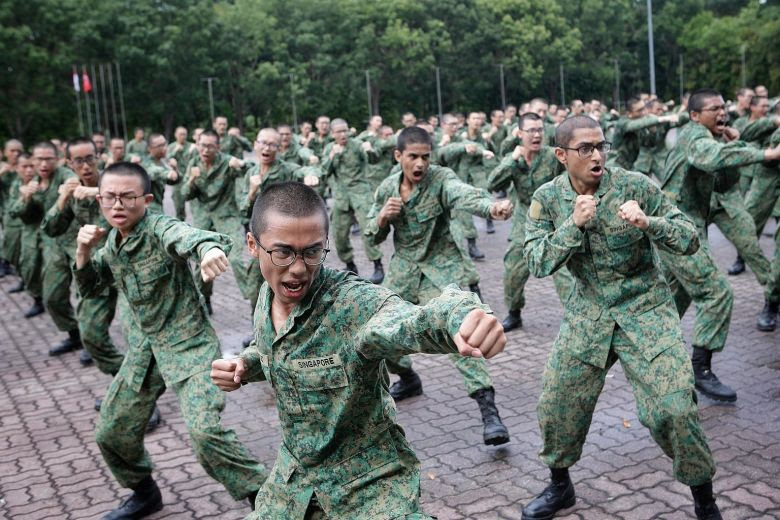
Recruits undergoing Basic Close Combat Training at an SAF unit at the Basic Military Training Centre (BMTC) at Pulau Tekong on Jan 23, 2018. ST PHOTO: KEVIN LIM


Health, defence spending not a zero-sum game

Dr Yik Keng Yeong suggests in his letter that the Government is spending too much on defence compared with healthcare (Rethink of our health, defence costs needed; Feb 22).

As a national serviceman on my third cycle as a Reservist on Voluntary Extended Reserve Service, I feel it is necessary for us to move away from the narrative that social needs and defence are in competition.

The proportion of our annual budget spent on security has dropped by 10 per cent over the last decade.


"Instead, it would be more relevant to see defence as a form of insurance - one we would never want to draw on, but which is there when we need it."


Conversely, spending on social needs now takes up the lion's share of the budget.

In Budget 2017, Defence Minister Ng Eng Hen said that future defence budgets will aim to keep pace with inflation through a trajectory of 3 to 4 per cent annual growth.

His ministry would reprioritise programmes to meet new challenges, while addressing overall budgetary pressures of an ageing society and slowing economic growth, he said.

This year's defence budget of $14.8 billion is in line with this trajectory, growing about 4 per cent from last year.


"Defence capabilities cannot be ramped up instantly when danger emerges, but require long-term planning, equipping and training."


A continued focus on defence versus healthcare spending as a zero-sum game is an incorrect approach.

Instead, it would be more relevant to see defence as a form of insurance - one we would never want to draw on, but which is there when we need it.

Defence capabilities cannot be ramped up instantly when danger emerges, but require long-term planning, equipping and training.


"And Singaporeans can build lives, grow businesses and care for their families under the umbrella of defence that is provided by the Singapore Armed Forces."


Built up over the past 52 years, the stable and secure environment we enjoy and often take for granted has enhanced our economic vibrancy.

Tourists and international companies come to Singapore because it is safe, stable and secure.

And Singaporeans can build lives, grow businesses and care for their families under the umbrella of defence that is provided by the Singapore Armed Forces.

The global security environment is increasingly uncertain, and we cannot take our peace and security for granted.

Investment in defence and the need for everyone to play their part remain paramount.

Without defence, we will not have the safety and security on which to build a successful healthcare system and other hallmarks of a strong nation.

Nicholas Fang


A version of this article appeared in the print edition of The Straits Times on February 23, 2018, with the headline 'Health, defence spending not a zero-sum game'.

Source: The Straits Times, 23 Feb 2018


=====================================================


Rethink of our health, defence costs needed


While our health budget at $10.2 billion, constituting 2.2 per cent of gross domestic product (GDP), seems like a lot of money, other countries spend far more on health care, with the United States topping the list withan expenditure of 17 per cent of GDP.

We all know why our healthcare costs are ballooning: ageing population, newfangled, exorbitant investigations and treatment regimes, reimbursements to doctors for procedures done rather than outcome efficiencies, all-in insurance without co-payments which encourage gouging by doctors, just to name the major ones.

Perhaps, because our health budget still seems far away from the levels of the US, there seems to be insufficient political will to manage health costs more strictly.

Allowing Medisave to be used for procedures in Malaysia (where, anecdotally, costs can be up to 10 times lower), mandatory use of generics where available (already enforced by some health insurances) and a more dedicated use of telemedicine will lower costs.

Our military budget has also ballooned over the last decade.

At $14.8 billion, it exceeds the combined budgets for trade and industry, national development, social and family development together with environment and water resources, which add up to about $13.7 billion.

Defence is paramount to our survival, but whereas we have not had a war for more than 50 years (granted that it may be because of our preparedness, as reflected by the oversized defence budget), we have need of trade, water, infrastructure and family support every single day - so, perhaps a rethink is needed?

Are there too many officers and generals who are paid too handsomely? Do we need the latest military planes when drones with smart bombs may suffice? Does the latest weaponry and the touting of a "4G army" really make us a better fighting force?

Yik Keng Yeong (Dr)


A version of this article appeared in the print edition of The Straits Times on February 22, 2018, with the headline 'Rethink of our health, defence costs needed'.

Source: The Straits Times, 22 Feb 2018

=====================================================


Defense vs Healthcare

How do we determine how much to spend on them?

But in my opinion, here’s the bottom line.

Without Defense, there can be no Country.

Without a country, there can be no Home.


And when Singapore falls*, we won’t even have a home, let alone worry about healthcare or anything else.


* ... and Singapore doesn't even need to fall like we did in WW2. Our enemies simply have to destabilize us enough that our daily lives are disrupted, and international confidence in Singapore falters. That would already be enough to break our ricebowls. 


Thursday, February 15, 2018

PM Lee's 2018 CNY Message


PM Lee handing out hongbaos to Teck Ghee residents. (MCI Photo by Kenji Soon) Source: PMO


In his 2018 Chinese New Year Message, PM Lee Hsien Loong spoke about the need to create a brighter future for our children, and to help Singaporeans lead active and meaningful lives in their silver years. 

PM Lee Hsien Loong | 15 February 2018

Chinese New Year is about family. The many Chinese New Year traditions passed down from generation to generation are steeped in family values. Families gather on Chinese New Year’s eve for reunion dinners (团圆饭). Even those who are abroad will make an effort to connect with their families back home, and celebrate this special occasion together. We stay up through the night to see the year in (守岁) for our parents’ longevity, and give our children red packets (压岁钱) for good fortune. These customs reflect the enduring hopes of every generation, that our aging parents live well in their silver years, and our children grow up happy and successful, in a peaceful and prosperous world.

Honouring our seniors and nurturing the young are not just limited to individual families; they are values and attitudes which hold our society together. As a people too, we should look after the elderly as we are the beneficiaries of their labours, and care for the young who carry our hopes for the future.


Our population is aging. We are working to enable Singaporeans to lead active and meaningful lives in their silver years. This means creating strong social support and community networks, keeping elders socially engaged, and building up healthcare systems and services. It is not just younger generations taking care of their elderly parents, but today’s generation looking ahead and providing for our older selves of tomorrow.

At the same time, we strive to give our children the best chances in life. We are fortunate to live in Asia – a dynamic and fast growing region. We should prepare ourselves to seize the many economic opportunities around us. We should make full use of new technologies, to progress with our partners and neighbours. We will help our young to uncover their diverse talents, and invest heavily in them through education and training, so that when they grow up they can strike out on their own, build their own families and careers, and fulfil their aspirations and dreams. We will invest in Singapore, to build our city and infrastructure, and upgrade our living environment and economy, so that the next generation can continue to create new possibilities, prosper and flourish.  We should uphold our time-tested Asian values of thrift, self-reliance, and leaving something more for our children, instead of burdening them with their parents’ debts.  We must always think beyond the immediate and beyond ourselves, to look and plan over the horizon on behalf of future generations.

I hope you will reflect on these issues in quieter moments over the festive season, in between celebrating with friends and family. The Government too will not stop thinking about what it needs to do, to ready our society for these challenges. Minister Heng Swee Keat will deliver his Budget speech on Monday, immediately after the holiday weekend. These issues guide the thinking behind the Budget. Let us build our shared future together, so that generations of Singaporeans can look forward to more prosperous and joyous Chinese New Years.

As we usher in the year of the Dog, let us be dogged in our efforts to create a better Singapore and a brighter future for our children. Let us also cherish the blessings of kinship, thank our elders for what they have done for us, shower our children with love, and create more shared happy memories with our families.


Happy Chinese New Year! 祝大家狗年兴旺,万事如意!


=====================


2018年总理新春献词

农历新年交织着阖家团圆的温馨和喜悦,对华族家庭来说是一个重要的节日。许多新年的传统习俗,都包含了尊老爱幼等核心家庭价值观。大年除夕,全家老少欢聚一堂、共享团圆饭。即使远在他乡的游子,也尽量赶回家,或通过其它方式同家人联系,一起欢度佳节。除夕夜,我们彻夜不眠,为家中长辈守岁、祈福,也给家中幼儿派发压岁钱,祝愿他们岁岁平安。这些传统习俗世代相传,承载着每一代人不变的期许,希望世界和平、国泰民安,年迈的父母能安享晚年,子女也能健康、快乐地成长,事业有成。

然而,尊重长辈和培育我们的下一代,不该只是自家的事,我们应该把这些美德推广到更大的社会空间,以凝聚社会。所谓“老吾老,以及人之老;幼吾幼,以及人之幼”,作为社会的一份子,我们应该发挥“博爱”精神、推己及人。除了照顾曾为社会做出贡献的年长国人,我们也必须好好栽培年轻的一代,因为他们肩负着我们的希望和未来。

随着我国人口老龄化,我们需要确保国人在步入黄金岁月后,仍过着活跃、有意义的生活。因此,我们必须打造完善的社会援助体系和社区网络,为年长国人提供支援,也确保他们不与社会脱节。我们也有必要提升医疗保健体系和服务,让国人获得良好的照顾。在鼓励年轻国人照顾年迈父母的同时,我们也寄望他们未雨绸缪,为自己的晚年生活做好充分的准备。
所谓前人种树,后人乘凉;我们也应该竭尽所能,把最好的留给下一代。我们很幸运,身处在一个充满活力又快速发展的区域,机遇处处。只要我们把握时机,善用新科技,并同伙伴国和邻国合作,就能实现共同繁荣。因此,我们会帮助年轻一代,发掘他们多方的才能,同时大量投资在教育和培训上,让孩子们长大后能抓紧机遇,施展才华,实现远大的理想和抱负,并且建立自己的家庭和事业。为了打造更美好的家园,我们会投资在城市和基础设施的建设上,改善国人的居住环境,并提升经济,让下一代能够继续创造新的机遇,大有作为,过着富足的生活。我们也应该秉持传统的亚洲精神,克勤克俭、自力更生。我们需要高瞻远瞩,为我们的子子孙孙谋划将来,让他们拥有美好的未来,而不是债留子孙。

俗话说:一年之计在于春。在这新春佳节,我希望国人能找个机会让情绪沉淀下来,静静地思考上述的课题。无论是照顾好年长的国人,或是帮助下一代迈向美好未来,大家不妨想一想自己能为新加坡这个大家庭做些什么?政府也会努力不懈,想方设法,带领国家应对未来的挑战,让国人过更好的生活。财政部长王瑞杰将在农历新年后的第一个星期一,发表今年的财政预算案声明。我们希望通过今年的预算案,鼓励国人同心协力,携手打造我们共同的未来,让世世代代的新加坡人,都能快乐地迎接一年又一年的农历新年。

在我们准备欢迎狗年到来的当儿,我也希望国人能效仿狗儿爱护家庭、不畏艰难、不屈不挠的精神,为我们的孩子打造一个更美好的家园和更灿烂的未来。让我们怀抱感恩的心,珍惜亲情的可贵,感谢长辈为我们做的一切,疼爱我们的子女,和家人共同创造更多美好、开心的回忆。


最后,祝大家新年快乐、狗年兴旺、万事如意!


Source: Prime Minister's Office


[Defending the Lion City] Never Again


https://www.facebook.com/WeAreTotalDefence/

#WeareTotalDefence #totaldefence


Source: Speaker of Parliament, Tan Chuan-Jin's Facebook page


Wednesday, January 10, 2018

Singapore’s vote on recent UN resolution on the Status of Jerusalem

A view of the Al-Aqsa compound (Temple Mount) in Jerusalem's Old City. PHOTO: EPA-EFE


Minister for Foreign Affairs Dr Vivian Balakrishnan responding to Member of Parliament Mr Vikram Nair's Parliamentary Question on Singapore's vote in the recent United Nations General Assembly resolution of the 10th Emergency Special Session (ESS) on the Status of Jerusalem. He was speaking in Parliament on 9 January 2018. (Source: Gov.SG Youtube Channel)


MFA Press Release: Transcript of Minister for Foreign Affairs Dr Vivian Balakrishnan’s reply to the Parliamentary Question and Supplementary Questions, 9 January 2018

Source: Ministry of Foreign Affairs, Singapore


January 09, 2018 MFA Press Release: Transcript of Minister for Foreign Affairs Dr Vivian Balakrishnan’s reply to the Parliamentary Question and Supplementary Questions, 9 January 2018

QUESTION:
Mr Vikram Nair: To ask the Minister for Foreign Affairs whether he can explain Singapore’s vote in favour of the recent United Nations General Assembly resolution of the 10th Emergency Special Session (ESS) on 21 December 2017 on the Status of Jerusalem which indirectly criticised the US’ decision to recognise Jerusalem as the capital of Israel.

REPLY:
1             Mr Deputy Speaker Sir, Singapore voted in favour of the recent United Nations General Assembly resolution at the 10th Emergency Special Session on the Status of Jerusalem. Our vote in favour of this resolution is consistent with our longstanding position on the unfortunately long-running Israeli-Palestinian conflict.  Our position over the years has been based on the principle of seeking peaceful resolution of conflicts by upholding international law and abiding fully with United Nations Security Council resolutions.

2             Jerusalem is a unique city. It has profound religious significance for Muslims, Jews and Christians. The status of Jerusalem is a very complex and sensitive issue with a very long history, fraught with political and religious dimensions, and the special circumstances of Jerusalem have been addressed by numerous United Nations resolutions, with the most recent instance being the resolution that was voted upon on 21 December 2017. In fact, an almost identical resolution was considered by the UN Security Council a week earlier on 18 December 2017. At that UN Security Council session, fourteen of the fifteen members of the Security Council voted in favour of the resolution, and the US was the sole member to vote against and ultimately to cast a veto against the resolution. And that is why the resolution then came to the General Assembly.

3             The resolution in the General Assembly reaffirms previous UN resolutions and in particular rejected any decisions or actions which purport to alter the character and the status of Jerusalem, and the same resolution calls on all States to comply with the existing UN Security Council resolutions on Jerusalem.

4             Singapore’s position on this has been consistent.  We do not take sides in the Israeli-Palestinian conflict.  Our objective has always been to support a peaceful resolution to this conflict. We have been a steadfast advocate of a negotiated two-state solution, with Israel and Palestine living side-by-side in peace and security.  Accordingly, the future status of Jerusalem should be determined through direct negotiations between both sides and any unilateral and premature action that might alter the status of Jerusalem would only serve to further destabilise the region. It would impede progress towards a just and durable solution to the Israeli-Palestinian conflict.

5             Our vote on the recent resolution is therefore consistent with this policy position. It has at its foundation, a key principle of Singapore’s foreign policy, which is the promotion of a rules-based global community governed by the rule of international law, and always seeking peaceful resolution of disputes.  It is also in this context that Singapore has always strictly abided by all UN Security Council resolutions.  Indeed the UN Security Council Resolution 478 (1980) specifically calls on all UN Member States not to take any action that purport to alter the character and status of Jerusalem.

6             Singapore’s position on this issue is well known and our vote at the various UN resolutions related to the Israeli-Palestinian conflict have been guided by this same principle, regardless of the positions of others.  Although other states, including bigger powers, may occasionally differ or disagree with certain positions that we take, we maintain the consistent application of this principle. This ability to maintain consistency over the long term has enabled us to be taken seriously and to be regarded as a reliable partner who can play a constructive role in international affairs.  Indeed, Singapore remains a steadfast partner of the US, of Israel and of the Palestinian people.  Our longstanding bilateral relations with all countries are strong and multifaceted, and our shared interests far exceed the differences.  At the same time, this gives us access and a strong relationship based on trust with the Palestinians and indeed with the Middle East as a whole.

7             Mr Speaker Sir, Singapore’s vote in favour of the United Nations General Assembly resolution on the 21 December 2017 was actually a vote for peace and stability.  As a small country with a multi-racial and multi-religious population, Singapore, of all countries, fully appreciates that tolerance and the peaceful resolution of disputes are vital for social harmony, for our success as a nation, and indeed for world peace.  We therefore hope that the parties involved will work towards a resumption of direct peace negotiations. This can only be achieved when both sides approach these longstanding sensitive issues in a spirit of good faith and appreciation of each other’s beliefs, values, aspirations, hopes and anxieties.
 .    .    .    .    .


TRANSCRIPT OF MINISTER FOR FOREIGN AFFAIRS DR VIVIAN BALAKRISHNAN’S ORAL REPLIES TO SUPPLEMENTARY QUESTIONS, 9 JANUARY 2018


QUESTION:
Mr Vikram Nair: Thank you Mr Deputy Speaker. Just two supplementary questions. First, was there a reason Singapore chose to vote in favour of the resolution rather than, say, abstain, because that is clearly taking a position on the matter? And second, Singapore has always advocated a two-state solution and a change in the status of Jerusalem, I believe the Minister is implying, would make that more difficult. What steps has Singapore taken to facilitate the two-state solution given its strong relationships with both sides?


REPLY:
1             Thank you for those two questions. I think, on your first question, when you are faced with a resolution there is always a choice. You can vote in favour, you can abstain, or you could vote against. In fact, there is a fourth choice, which is to be absent, but I think members of this House will know that that is not Singapore’s style. When we are confronted with a question, we face it head-on and we make what we believe is an appropriate choice that is consistent with our position, our policies and our values. So we looked very carefully at this resolution, and as I explained earlier, the real problem or the catalyst for this current resolution – and I am going to say so without naming names, and without identifying countries – but what really precipitated this was an announcement. An announcement which could be construed as changing the status quo and hence, in our view, would be a unilateral and premature pronouncement, which instead of helping peace, would actually impede the peace process. So that is why after very careful consideration and consultation, we decided to stand by our principles and say we do not think this is a good idea and therefore we are voting in favour of the resolution. It is a principled position because we are actually not taking sides. We are not saying one party or the other, or its supporters are right or wrong.


2             This relates to your second question. Singapore is not a superpower. We are not a regional power and we are not a key player in the Middle East. Our approach – I would look at it at two levels. First, we do want to be friends with everyone, but we want to be not just fair weather friends; we want to be long-term, reliable, principled friends. Now, for that kind of relationship to occur, and you have two parties who have been fighting for thousands of years, you can imagine that it is a very difficult role to play.  Nevertheless, because both the Israelis as well as the Palestinians, and the Arab and all the other countries in the Middle East know that Singapore does not take sides, they know that we do not bend for the sake of pressure or inducements, and that we genuinely stand for peace and for development.


3             So that gives us special access. I felt this special access when in April 2016, Prime Minister Lee made the first visit as the incumbent Prime Minister of Singapore to both Jordan and Israel. And amongst various parts of the trip, I think the most significant was when we had a chance to go up to Temple Mount or in the Arabic, Al-Haram Al-Sharif, where the Dome of the Rock is, where the Al-Aqsa Mosque is. And at the risk of being long-winded, let me tell you my sentiments as the Prime Minister and our delegation including Masagos and – I think Rahayu went along with us. Intan, was it? Yes, Intan. I remember, the first sense I felt was a sense of awe. Whether or not you are religious, when you visit Jerusalem and you go to those sites, you cannot help but feel that this is a special place, a sacred place:  a place where Heaven and Earth seem to come to a confluence. That's the first sense.


4             My second sense was gratitude for being a Singaporean. Because here we were, accompanied by security from both the Israelis and the Jordanians, and they gave us full access. Minister Masagos even had a chance to pray in the cave beneath the Dome of the Rock. They gave us full access to the Al-Aqsa Mosque, and we are non-Muslims. But everyone knew, we were from Singapore, and this was a multi-religious, multi-racial group. We were welcomed and protected by both parties.  That sense of gratitude, that sense of special access – you know people talk about the Singapore passport being very powerful. It is not really about the passport, but the fact that the world welcomes and trusts us.


5             The third sentiment I felt during that trip was sadness as I thought about the thousands of lives that had been lost, and the blood that had been shed on that hill in the name of race, language and religion. It made me more determined than before to appreciate what we have in Singapore; that when we say we believe in peaceful resolution and we believe in direct, honest negotiations, and that we believe in living side-by-side even to the point where we need an ethnic integration policy. We are not just prescribing to the world, we are a living, real example of multi-racial, multi-religious peace. When we say to live side-by-side in peace and security, we are a working vision, a working example of that future.


6             So that, in a sense, in an anecdotal way, what informs our attitude to this issue. So on any particular resolution, and there have been lots of UN resolutions on this, I will not be able to tell you a priori whether we are going to abstain or vote against, or for. But I am sharing with you the principles behind which we will interpret the resolution, and then we will vote accordingly. From time to time we will have to take a different position from friends and supporters, but I am confident that they know Singapore and Singaporeans well. They know that we do not grandstand, we do not take political postures for the sake of posturing. But we do so in all sincerity as a reflection of who we are. As a multi-religious society and our long-standing friendship, support, and advocacy for peace in the Middle East. That in a nutshell is about all that we can do. We are not a superpower. Thank you.


QUESTION:

Assistant Professor Mahdev Mohan: Mr Deputy Speaker, I thank the Minister for his very detailed and heartfelt response to Mr Nair’s questions. The vote by Singapore was not only an enlightened one, it was fully in accordance with international law and the rule of international law. My only question is, at the time when the vote was cast, were there efforts for ASEAN to speak with one voice at that vote? I ask this question because I noticed that both Myanmar and Philippines abstained from the vote.

REPLY:

1             The short answer is that no, there was no time and no opportunity to cobble together a consolidated ASEAN position. But having said that, I am not even sure that that would have been ideal. As I said, this was a very sensitive and delicate situation, and I think every country had to take a position based on its own analysis of its own national interests. So this was not an occasion to try to corral or to put pressure on the individual members of ASEAN. And there will be, and I say this in full cognisance that there will be I am sure, future situations and future resolutions, where it may be even harder for us to get together and to settle on a common position, so I would not, a priori, aim to do that and I don’t view that, therefore, as a setback – that a couple of ASEAN Member States abstained, and that all the rest of us voted in favour.
.    .    .    .    .
MINISTRY OF FOREIGN AFFAIRS
SINGAPORE
9 JANUARY 2018

Monday, January 8, 2018

M’sia’s PM: M’sia has less debts than Singapore!


If you follow M’sian politics, you will know that M’sia politicians, be it the ruling BN govt or their opposition, like to use Singapore for comparisons, if not as a convenient scapegoating target.

And this behavior is more evident when M’sian is gearing up for their general elections.

A recent example which had most S’poreans, and not a small number of M’sians too, rolling their eyes in disbelief, was the claim from the M’sian Deputy Education Minister that Malaysians' command of English was better than Singapore’s. (See here, here and here)

The latest salvo in the SG vs MY debate was fired by none other than the M’sian PM himself.

In a recent blog post, the M’sian PM said that:

 “… Not only that, (the M’sian) Government debt to GDP ratio is better than developed countries like Singapore at 112 percent, United Kingdom at 89.3 percent, Canada at 92.3 percent and many other examples. …”


Najib must have a taken a leaf from the SG opposition’s playbook of half-truths. Time and time again, the SG opposition wannabes will throw out this misleading statistic to scare and try to stir resentment in the SG electorate.

“Look! The PAP Govt is so corrupt! Not only are they refusing to return your CPF money but they are racking up so much debts! It is true! Look at the World Bank reports!”

Sounds scary, isn’t it. The SG Govt has external debts that are equivalent to 112% of its GDP, or about US$1.766 trillion depending on which article/source you are reading. (See here, here and here.)

But here’s the problem.

While the statistics quoted is quite correct, the interpretation of that statistic is wrong.

I’m not going to attempt to explain why Najib’s interpretation is wrong. It’s a hard topic to explain ‘cos my English is not that powderful as Najib’s (according to his education minister).

Plus this external debt question has been explained to death so many times by tons of better writers than me who can, and have clearly explain the facts. Here are some of them:

Mothership: Najib claims that S’pore government debt higher than our GDP, but here’s why you shouldn’t panic (6 Jan 2018)

Straits Times: askST: Why does Singapore have an external debt of US$1.766 trillion? (20 Nov 2016)

The Middle Ground: Why Singapore’s high external debt is nothing to worry about (19 Sept 2016)

The Scarlet Ibis: Singapore Government Debt – A Cause for Alarm or a Misunderstanding? (12 Sep 2011)

Quora: Why does Singapore have such high public debt?

And here’s what the SG Govt has publicly stated about its debt levels and national reserves.

SG Factually: Is it fiscally sustainable for Singapore to have such a high level of debt?

SG Ministry of Finance: FAQs about Singapore’s Reserves

Bottomline: Don’t just read the headlines, or take other’s words at face value. Read up, see what the facts are and decide for yourself.


Oh, and Najib, it would be great if you and your colleagues can stop dragging S’pore into M’sian politics. It’s rather tiresome and doesn’t do any good for our bilateral relations.