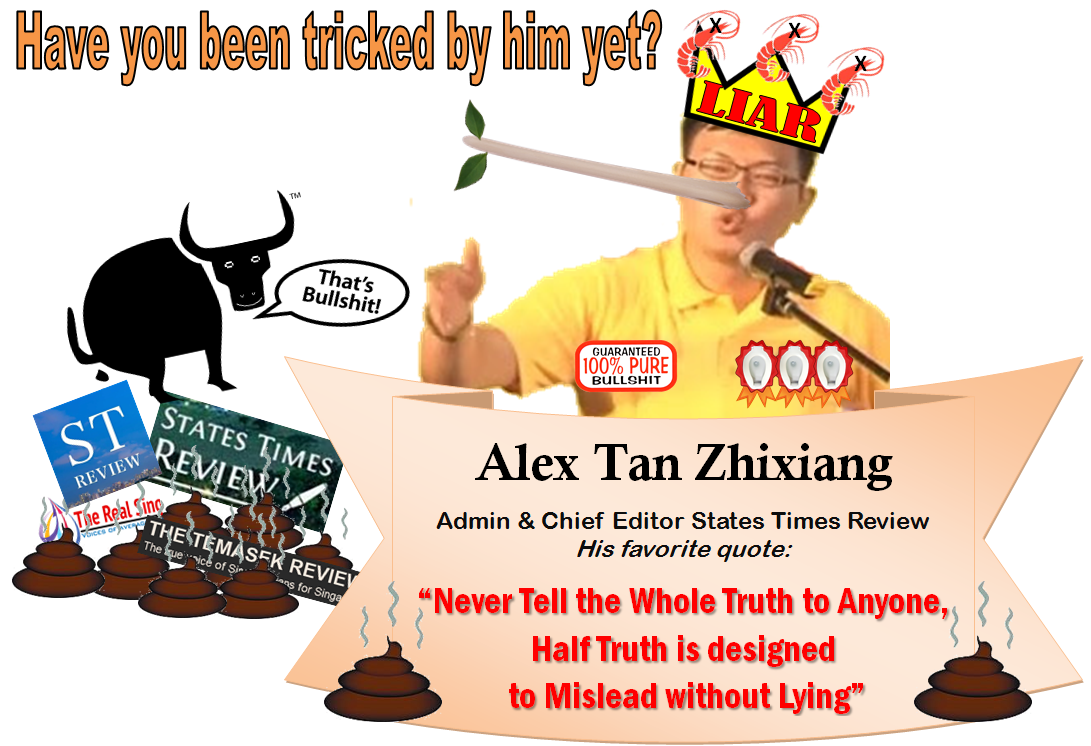
While no one expects the WP MPs to just copulate to the AHTC lawsuit that has been brought against them by AHTC's Independent Panel, the reasons excuses given in their press statement is just too lame.
SO WHATif you didn't profit from your own incompetence in managing AHTC?
Does that absolve you from any and all responsibility? You make the mistake(s), you pay the price (according to the full extend of the law).
Don't try to pretend it's ok simply because you didn't get any money out from it. Do you know what fiduciary duty means or not?
At your election rallies, you boldly claim that voters can trust you; that WP has more than 20 years of experience in running the Town Councils. And yet, year after year since then, your own appointed Auditors keeps on giving your Financial Statements a "Qualified Opinion". Do you even realize how cockup your accounts must be to be labelled as "qualified"??
If you can't even get running a local town council right, how can you even dare to think that you are qualified to be the "co-driver" and "check & balance" for the PAP, let alone aspire to be the SG government someday? As it is, the NMPs are already doing a far superior job of checking and balancing the PAP govt than you are. You didn't even bother to participate in the Public Consultation sessions for the amendments to the Elected Presidency. So why do the voters need you for?
And don't try to feign innocence by saying that your actions were in the best interests of your residents.
Even using the broadest definition of "Best interests of the residents", this can hardly include shoddy account practices and being unable to account clearly for how the public funds and resident monies have been used.
Is it "acting in good faith" when you continually playing the victim card; to deny the auditors access to documents; to go to Court to challenge the MND/HDB orders for you to open your books; to apply for Court gag orders to prevent pertinent information from being released into the public domain? Instead of wasting everyone's time by playing petty politics, why didn't you bother to fix the problems?
You even had the stupid balls to challenge the Parliament's authority to question you over the AHPETC accounts. Instead of giving straight answers, you said that you would only answer to your residents rather than answer/explain/account for your actions to the highest authority in Singapore. What happen to WP's manifesto of transparency and accountability? Is that all just bullshit to win votes?
You were given a golden opportunity in GE2011 to show Singapore that WP could be a honest, competent opposition party who would help to safeguard the interests of Singaporeans. Chee Soon Juan would have sold his soul for what the voters gave you in GE2011.
Yet, instead of building on that, you chose to squander away that opportunity to prove your worth.
Instead of working to improve the lives of your residents, you deliberately engaged in petty politics, blaming everyone else for your own failures instead of taking responsibility and fixing the problems.
Do you even realise that to date, you have not even apologize to your residents for this mother-of-all cockups?
So don't try to pretend that you are innocent and give all sorts of talkcock bullshit reasons.
It has been a long time coming that you should faced all of the consequences of your own actions and choices.
For disappointing your own voters and showing such gross incompetence and indifference, I really hope that you will be lose the lawsuit and subsequently lose your parliamentary seats.
Singapore does not need rotten duds like you to be our representatives in Parliament.
Despite the Worker's Party leadership's best efforts to deflect, delay, obstruct and remain unaccountable for the mess that is the AHPTEC/AHTC Accounts, the day of reckoning has arrived.
Here's a brief recap to how things have reached this stage.
Will the implicated WP MPs do the honorable thing and resign? Thereby triggering off a By-Election?
Will there be criminal charges brought against those involved? And when that happens, will
there be a By-Election since the person(s) may be disqualified as an MP upon
conviction. (See Disqualifications
for membership of Parliament).
Is this the beginning of the end for the Worker's Party? Will this end the Worker's Party dominance as Singapore's premier Opposition Party?
Will Chee Soon Juan jump in at this golden opportunity to sink WP to further his own (hopeless) ambition to be elected as an MP?
Or will the WP MPs simply deny, deflect, play the victim card and continue to disavow any responsibility for the mess that THEY created THEMSELVES?
The following is the full Transcript of Remarks by Minister for Foreign Affairs Dr Vivian Balakrishnan at the MFA Townhall on 17 July 2017.
A very good evening to all our colleagues from MFA, and I believe we also have colleagues from SAF as well as from the administrative service and the civil service. I bid you all a very warm welcome. Let me start by saying it is not by coincidence that today we are at peace, we are at peace with all our neighbours, and we have good relations with all the major powers of the world. We owe a debt of gratitude to all our leaders and diplomats, both present and the past, for this happy state of affairs.
But more recently there has been lively debate on Singapore’s foreign policy, and I think this debate is especially on the part by retired officials, academics and commentators. But there is one key difference for all the people in the room here tonight. The key difference is that we are serving members of the MFA, and we in this room have line responsibility for the actual conduct of foreign policy on a daily basis. What this means is that the deliberations today are not a theoretical debate, and this not an academic word spinning exercise on a lecture circuit.
Some questions that have been raised include the following: First, has Singapore overreached? Have we forgotten our permanent status as a small state in the large dangerous world and tough region? Next question, should Singapore adjust our foreign policy posture given the evolving geopolitical situation, or even because of leadership changes in Singapore? And the third question has been, has our insistence on a consistent and principled approach actually limited our flexibility, our ability to adapt to new circumstances?
These are valid questions but I believe we need to go back to first principles. The ultimate objectives for our foreign policy are first, protect our independence and sovereignty, and second, to expand opportunities for our citizens to overcome our geographic limits. These are our ultimate objectives. It’s easy to state them, difficult to achieve. The existential challenge is how do we achieve these ultimate objectives, given our circumstances that we will always be a tiny city state in South East Asia and with a multi-racial population.
We must not harbour any illusions about our place in the world. History is replete with examples of failed small states. Our founding Prime Minister Mr Lee Kuan Yew always reminded us repeatedly that we have to take the world as it is, and not as we wish it to be. But that does not mean that Mr Lee advocated a ‘do nothing, say nothing’ posture, or that Singapore should simply surrender to our fates. As Prime Minister Lee Hsien Loong has recently reminded us, on issues where our national interests are at stake, we must be prepared to ‘stand up and be counted’.
Some people have suggested that Singapore lay low and “suffer what we must” as a small state. On the contrary, it is precisely because we are a small state that we have to stand up and be counted when we need to do so. There is no contradiction between a realistic appreciation of realpolitik and doing whatever it takes to protect our sovereignty, maintain and expand our relevance, and to create political and economic space for ourselves. The founding fathers of our foreign policy – Mr Lee Kuan Yew, Mr S Rajaratnam, and Dr Goh Keng Swee, and their team – understood this acutely and they formulated a few core foreign policy principles. These principles have served us well since independence but are still worth reviewing again.
Core principles
What are these principles? First, Singapore needs to be a successful and vibrant economy. We need to have stable politics and we need a united society. If you think about it, if we were not successful, if we were not united and if we were not stable, we would be completely irrelevant. All of us in this room have witnessed how delegations of less successful small states are ignored at international meetings. And I am always mindful that foreigners do not speak to us because of the eloquence of our presentations or because we have the highest EQ in the room. We only merit attention because everyone knows that we come from Singapore and Singapore has made a success of itself despite our size, and that we are represented by smart, honest, serious and constructive diplomats.
Second principle- we must not become a vassal state. What this means is that we cannot be bought nor can we be bullied. And it means we must be prepared to defend our territory, our assets and our way of life. This is why we just celebrated 50 years of National Service, and we maintain at great effort an SAF that everybody takes seriously. This does not just depend on the military technology that the SAF possesses, but on the courage and resolve of our soldiers, particularly NS men, to defend what we have and to fight for what we hold dear.
Third, we aim to be a friend to all, but an enemy of none. This is especially so for our immediate neighbourhood where peace and stability in Southeast Asia are absolutely essential. Consequently, Singapore was a founding member of ASEAN and we remain a strong advocate of ASEAN unity and centrality. With the superpowers and other regional powers, our aim is to expand our relationships, both politically and economically, so that we will be relevant to them and they will find our success in their own interest. This delicate balancing act is easier in good and peaceful times, but obviously more difficult when superpowers and regional powers contend with one another. Nevertheless, our basic reflex must be and should be to aim for balance and to promote an inclusive architecture. And we must avoid taking sides, siding with one side against another. While we spare no effort to develop a wide network of relations, these relations must be based on mutual respect for each other’s sovereignty and the equality of nation states, regardless of size. Diplomacy is not just about having “friendly” relations at all costs. It is about promoting friendly relations as a way to protect and advance our own important interests. We don’t compromise our national interests in order to have good relations. The order matters. So when others make unreasonable demands that hurt or compromise our national interests, we need to state our position and stand our ground in a firm and principled manner.
Fourth, we must promote a global world order governed by the rule of law and international norms. In a system where “might is right” or the laws of the jungle prevail, small states like us have very little chance of survival. Instead, a more promising system for small states, and frankly even a better system overall for the comity of nations, is one that upholds the rights and sovereignty of all states and the rule of law. Bigger powers will still have more influence and say, but bigger powers do not get a free pass to do as they please. In exchange, they benefit from an orderly global environment, and do not have to resort to force or arms in order to get their way.
This is why Singapore has always participated actively at the United Nations, and in the formulation of international regimes and norms. We were a key player in the negotiations for the Law of the Sea Treaty (UNCLOS) in 1982. Professor Tommy Koh still remains with us. And I’m sure that is one of your proudest achievements of your diplomatic career. We play an outsized role at the WTO, and in negotiating a web of free trade agreements at a bilateral and multilateral level. As a country where trade is 3.5 times our GDP, we must stand up for the multilateral, global trading system. And as a port at the narrow straits that ultimately connect the Pacific Ocean to the Indian Ocean, freedom of navigation according to UNCLOS is absolutely critical to us.
More recently, we participated actively in the negotiations for the Global Agreement on Climate Change. I spent five years, several of them as a Ministerial facilitator, for what ultimately resulted in the Paris Agreement. And we did so because we are especially susceptible to climate change as a low-lying island city state. So Singapore must support a rules-based global community, promote the rule of international law and the peaceful resolution of disputes. These are fundamental priorities. They reflect our vital interests, and they affect our position in the world. We must stand up on these issues, and speak with conviction, so that people know our position. And we must actively counter the tactics of other powers who may try to influence our domestic constituencies in order to make our foreign policy better suit their interests.
Ultimately, we must be clear-minded about Singapore’s long-term interests, and have the gumption to make our foreign policy decisions accordingly. During the Peloponnesian War, the Athenians were warned of the consequences they would suffer were they to give in to initial Spartan demands. Greek statesman Pericles told his fellow Athenians that if they were frightened into obedience by the initial demands of the Spartans in order to avoid war, then they would instantly have to meet a greater demand. Actually, contained in the Spartans’ demand was actually a test of the Athenians’ resolve. And if they give in once, they would have to give in again, and ultimately they would be enslaved. On the other hand, a firm refusal would make the Spartans clearly understand that they must treat the Athenians more as equals.
Now I know we live in a very different era and different geopolitical situation, but this lesson, this warning against appeasement remains instructive for Singapore. Whether we are dealing with a key security and economic partner or a large neighbour, Singapore has always stood firm when it comes to our own vital national interests, particularly where it impacts on sovereignty, security and the rule of law.
When the US teenager Michael Fay was sentenced to caning for vandalism, back in 1994, we upheld our court’s decision, even under great pressure from the US. In 1968, to take an example further back in our history, we proceeded to hang two Indonesian marines for the bombing of MacDonald House during Konfrontasi. I want all of you to bear in mind the political and strategic circumstances in 1968. We had just been kicked out of Malaysia. The British had just announced their intention to withdraw their forces from Singapore. We were still fighting a communist insurgency. Can you imagine the guts it took for the leaders in 1968, facing such circumstances, to stand up and do the right thing?
These episodes, painful though they may be, established clear red-lines and boundaries. The message was clear: Singapore may be small, but upholding our laws and safeguarding our independence, our citizens’ safety and security was of overriding importance. So we cannot afford to ever be intimidated into acquiescence. And the fact that we have consistently demonstrated this in action, put our relationships with neighbours near and far, other states big and large, on a more solid and actually stable footing.
And this is why we speak up whenever basic principles are challenged. When Russian troops took control of Crimea, Singapore strongly objected to the invasion. We expressed our view that the sovereignty and territorial integrity of the Ukraine, and international law, had to be respected.
Which brings me to my fifth principle – that we must be a credible and consistent partner. Our views are taken seriously because countries know that we always take a long term constructive view of the issues. The bigger countries engage Singapore because we do not just tell them what they want to hear. In fact, they try harder to make Singapore take their side precisely because they know that our words mean something. We are honest brokers. We deal fairly and openly with all parties. And there is a sense of strategic predictability, which has enabled Singapore to build up trust and goodwill with our partners over the decades.
And because we are credible, Singapore has been able to play a constructive role in international affairs, at ASEAN and at the UN. We have helped to create platforms for countries with similar interests. For example, in 1992, Singapore helped establish the Forum of Small States. As a group, we’ve been able to foster common positions and to have a bigger voice at the United Nations. And today, the Forum of Small States has grown to 107 countries, more than half the membership of the UN.
We play a constructive role in the Alliance of Small Island States (AOSIS). We also launched the Global Governance Group (3G), to ensure that the voices of small states are heard, and to serve as a bridge between the G20 and the larger UN membership. Our credibility has won us a seat at the table, even when our relevance is not immediately obvious. We are not the the 20th largest economy in the world, but yet we’ve just come back from the G20, where we got invited.
You want to take another example even further afield? When we first expressed interest in the Arctic Council, there were many who wondered what role a small equatorial country would play on Arctic matters. But rising sea levels and possibility of new shipping routes impact or potentially impact our position as a transhipment hub, and so it is useful for us to be on the Arctic Council. We have gained observer status in the Arctic Council since May 2013. And we participate actively and contribute our expertise on maritime affairs. And if anyone wants deeper insights into this, speak to MOS Sam Tan who has represented us resolutely and repeatedly on the Arctic Council.
Looking Beyond
Now let’s look beyond these five principles. Let me make a few observations. Small states are inconsequential unless we are able to offer a value proposition and make ourselves relevant. Singapore’s economic success, our political stability and our social harmony and unity has attracted attention from others to do business with us, and to examine our developmental model. And this is why our diplomats, both those of you in this room as well as the other half of our family overseas, work so hard all over the world to find common ground and to make common cause with other states. And we search for win-win outcomes based on the principles of interdependence. For example, we have participated in major cooperation projects in Suzhou, Tianjin and Chongqing in China, Amaravati in India, Iskandar Malaysia in Johor, the Kendal Industrial Park in Semarang, Indonesia, and the multiple Vietnam-Singapore Industrial Parks. When we embarked on these projects, we contribute novel ideas and we implement our plans on a whole of government basis. And what this means is not just MFA, but our colleagues in all the other Ministries who also contribute whole heartedly into these projects.
Singapore’s position today is far more secure than it was at our birth in 1965. But the challenges of small states will be perennial. They cannot be ignored, or wished away. A strong and credible SAF is an important deterrence and foreign policy begins at home. Our diplomacy is only credible, if we are able to maintain a domestic consensus on Singapore’s core interests and our foreign policy priorities. And if our politics does not become fractious, or our society divided. We have safeguarded our international position by building a successful economy and a cohesive society; making clear that we always act in Singapore’s interests, and not at the behest or the bidding of other states. We have been expanding our relationships with as many countries as possible, on the basis of mutual respect for all states regardless of size and on a win-win interdependence. Upholding international law has been a matter of fundamental principle for us; and being a credible and consistent partner with a long term view has given us a role to play and relevance on the international stage.
Colleagues, geopolitics will become more uncertain and unpredictable. But we need to ensure that our foreign policy positions reflect the changing strategic realities whilst we maintain our freedom, our right to be an independent nation, with our own foreign policy. We must anticipate frictions and difficulties from time to time. But our task is to maintain this whilst keeping in mind the broader relationships. Our approach as a state with independent foreign policy cannot be like that of a private company. Our state interests go far beyond the short term losses or gains of a private company. So, we have to stay nimble, be alert to dangers but seize opportunities.
But we need to also remember that some aspects remain consistent. We need to advance and protect our own interests. We must be prepared to make difficult decisions, weather the storms, if they come. We must be prepared to speak up, and if necessary, disagree with others, without being gratuitously disagreeable. We may always be a small state, but all the more reason we need the courage of our convictions and the resolution to secure the long term interests of all our citizens.
Thank you very much.
Transcript of Remarks by Minister for Foreign Affairs Dr Vivian Balakrishnan at the MFA Townhall on 17 July 2017. Source: MFA
So this arrogant Lee/Li thinks he can make snide remarks about Singapore's judiciary and get away with it?
Who
does Li Sheng Wu thinks he is? Just because he is LKY's grandson, he
thinks he is above the law? Expect ACG not to investigate for him
insulting the very judiciary system his grandpa built?
Anyway, the best retort that I've read so far, is written by "I Tahan You Very Long Already"
Here are some of my fav quotes.
On the irony that while claiming that the S'pore Judiciary is "pliant", he is then "surprised" that "govt" is so "petty", and that the AGC is now investigating his FB post.
"Perhaps, they have been used to that sort of powers and privileges that
their grandfather’s and father’s positions accorded them all these
years? That they should feel they are different from the rest of us?
That they are above the law and must be treated special?"
On directly attacking the very system that his grandfather, Mr Lee Kuan Yew, created.
And to add further insults, he just about attacks his own grandfather by
encouraging everyone to read a (now refuted) New York Times piece which
slammed Singapore. In short, he is slamming his own grandfather, the
founding Prime Minister of Singapore. Ironically, the late Lee Kuan Yew
mind you, was particularly protective of Singapore’s reputation.
On how LWL and LSW are conveniently pretending not to understand how Singapore's Contempt laws work.
Despite all the top notched education, these two – Shengwu and Wei Ling –
appear to have little understanding of the laws and the workings of the
social media. (Amazingly, one is a President’s scholar and the other is
a fellow in Harvard and a world class debater.) You make baseless
allegations, well knowing it will viral, and then now cry foul when the
comments have taken effect , made their impact and drew a response?
On why LSW should be treated just like everyone else under the law.
Now, here‘s the question I have for everyone. Can anyone give me a good
reason why Shengwu should be treated differently from Alex Au and Alan
Shadrake if our courts and judges are indeed independent? He being the
grandson of Lee Kuan Yew? He being the nephew of the Prime Minister?
Certainly, our founding PM would not have it. He left a system where he
himself is not above the law, let alone the grandson.
It should be noted that the NYT published an edited version the Ambassador's rebuttal, which had left out this sentence from the full text as released by the MFA.
"I am surprised that NYT did not seek any comments from Prime Minister Lee Hsien Loong or the Singapore government before writing the piece."
Interesting huh.. I thought that NYT is a champion of free speech and doesn't believe in censorship.
Commentary: Small state doesn’t mean a weak state By Wang Gungwu 12 Jul 2017 10:46PM (Updated: 13 Jul 2017 07:59AM)
Source: Channel NewsAsia
Size doesn’t matter; it’s a question of leadership, resources, unity of purpose, knowing what you need to do, and relating to other states, says Wang Gungwu.
In an interview with the Channel NewsAsia Programme Insight (to be telecast July 13, 9.30pm SG/HK), Professor Wang Gungwu – eminent historian and chairman of the East Asian Institute – talks about how small states can navigate today’s world. Here are excerpts of his views.
Smallness in itself doesn’t mean weak. There are some small states that are very strong.
And some very large states are very weak, because they are divided, or their people come from different origins and can’t agree on anything; and their leaders are weak, or simply incompetent or corrupt, or otherwise incapable of providing unified leadership.
A small state that is united, very clear in its purpose, focused in finding good sets of relationships, can be very powerful and exert a lot of influence. So, smallness by itself doesn’t seem, to me, to mean very much.
Today, we have an international world order based on the United Nations (UN), in which smallness is not an important factor because the UN recognises all states as being equal.
‘Rule of law’ is a very modern phrase. It’s a very important ideal, something that a small state would value as helping to protect itself. But, there is no guarantee in the end. If everybody accepts the rules, then there should be no problems for a small state, but that’s too idealistic a picture. It is never quite like that.
And so, the question of how a small state relates to bigger states - and the biggest states - needs a lot of careful, alert leadership, watching out for all opportunities, possibilities, and taking full advantage of any system they face, to maximise their security.
In that context, size doesn’t matter; it’s a question of leadership, resources, unity of purpose, knowing exactly what you want and what you need to do.
SMALL STATES THAT HAVE DONE BIG THINGS
I’m very struck by how, in history, many very small groups of people have succeeded in doing fantastic things. Famous stories like the Athenians in the Mediterranean, who built a small city state, built up an empire, and eventually defeated the vast Persian empire.
Rome eventually became a vast empire, but actually it began as a very small state.
And take those that were city states more recently. A small place like Switzerland, located far away up in the mountains. It already has a kind of security on its own, but maximises its position and resources, human resources in particular. It arms itself very carefully, but carefully relating to all its neighbours in such a way that it has now survived for over 700 years. And it is still flourishing.
Does it matter whether it’s small, or what the population is like? What matters is how it was organised, how united they were, how forcefully they projected themselves as a unit that people must respect and admire.
I was always struck by one very small state, Portugal. The Portuguese, probably less than a million people at the time, were able to reach out by being very venturesome, extremely courageous and visionary, and they eventually created a maritime empire that stretched around the globe.
So, smallness was not in itself an issue. Portugal’s location was a great advantage. Their timing was very good because nobody else at the time thought of what they were doing, so they were innovative, they saw an opportunity, and they created something unique to themselves.
There were the vast land empires that were built up by the Mongols. Genghis Khan’s tribe was a very small tribe. Was there such a thing as a Mongol nation? Very hard to say. But he was able to create a sense of Mongol centrality, sense of unity and purpose, and they set out to conquer the world. And they nearly did.
Manchu is another example. A small nomadic group, about a million of them. But they were so united in purpose, so well-organised and militarily capable of exerting so much force, that they were able in the end to conquer the whole of China - which at that time, probably had up to 300 million people.
And so, a small group of people, with a tremendous sense of unity and purpose, can make a big difference. In today’s world, I think this principle still basically applies.
If a country is united, and the people are all clear about what they believe to be the important things for their country to survive, if they can really work together to do that, I don’t think anybody can touch them.
You arm yourself accordingly, you train yourself, you discipline yourself, you make all sorts of arrangements with your neighbours and with people far away; you relate yourself to all the powers, the international institutions like the UN, to make sure that you have maximum space to move in.
And you’re constantly looking out for opportunities, alert to possibilities, very nimble, quick-footed, quick to respond. If you can do all this, you can get a lot done, and be very powerful and influential.
SINGAPORE’S EXCEPTIONALISM
Singapore is a very exceptional country. As everybody knows, it wasn’t a country until 1965, and nobody expected it to be an independent country. The exceptional achievements of Singapore are why everybody looks at it with great interest and admiration - how did it do that?
But there is a certain fragility underlying Singapore’s history, because of the shortness of its history, and the different kinds of challenges that the people faced.
Therefore it has to be extra sensitive, extra alert, and extra everything. It’s got to be that much smarter, that much quicker, that much more responsive and sensitive.
ON HAVING TO CHOOSE BETWEEN ONE OR THE OTHER
The world will never, in my mind, to go back to the Cold War era of two major powers like the US and Soviet Union fighting for dominance. I don’t believe that people in China or the US want that to happen again.
So I think for us to project a world in which we have to make a choice between the US and China is a false premise.
I think we should not encourage that Cold War situation. It is possible for all the other states to organise themselves in such a way to prevent that from happening. The more multilateral the arrangement is, the better the chances of ensuring you don’t have a small state forced to make a choice between two big powers.
I think what would happen would be a multilateral set of relations involving more and more people, including other powers which are equally relevant: India and Japan for example, and Europe.
Some people are not happy with the idea of multi-polarity. But I think a kind of multi-polarity is inevitable. It’s already happening, the number of multilateral groups that are being formed, whether it’s G7, G20, or the ones that ASEAN itself has sponsored like ASEAN Plus 3 and the East Asian Summit - they’re all criss-crossed.
And the criss-crossing, to my mind, is a good sign. It never exposes you to having to choose between one or the other.
Catch Prof Wang Gungwu, Ambassador-at-large Tommy Koh, and Professor Kishore Mahbubani on Insight on Channel NewsAsia, July 13, 9.30pm SG/HK. Source: CNA/yv Read more at http://www.channelnewsasia.com/news/cnainsider/commentary-small-state-doesn-t-mean-a-weak-state-9026514
SINGAPORE: Temasek Holdings announced on Tuesday (Jul 11) a record net portfolio value of S$275 billion (US$197 billion) as at end-March 2017, up from S$242 billion (US$180 billion) a year ago.
The Singapore-based investment company posted a one-year Total Shareholder Return of 13.4 per cent for the year, reversing from the 9 per cent decline the year before.
In a statement, Temasek said it continued to reshape its portfolio during the year, while adopting a measured and disciplined investment pace.
As and when opportunities arise, Temasek said it “capitalises on rich market valuations to exit some of (its) holdings”, while maintaining the flexibility to “re-enter when valuations are corrected”.
Over a longer term 10-year period, annualised Total Shareholder Return was 4 per cent.
During the financial year, Temasek invested S$16 billion and divested S$18 billion of its portfolio, resulting in a net divestment position for the first time since the March 2009 year.
Speaking at a media briefing, Temasek president and joint head of investment proup, portfolio management group, and Singapore, Chia Song Hwee, said: “Given the market environment, and high valuation, we see less investment opportunity because we find that, generally speaking, the market pricing is a bit too high."
"But on the flip side, it allowed us to exit some of our positions or sell part of our stake given the valuation may be close to our intrinsic value."
Executive director and CEO of Temasek International, Lee Theng Kiat, said it continues to focus on “longer term opportunities such as technology, life sciences, agribusiness, non-bank financial services, consumer, and energy & resources”.
Investments in these new focus areas made up 24 per cent of its portfolio last year, up from 8 per cent six years ago, and delivered better returns than its average return from the overall portfolio.
The main sectors for its investments during the year were telecommunications, media & technology, transportation & industrials, and life sciences & agribusiness.
Temasek said the US accounted for the largest share of investments during the year. Meanwhile, it continued to make investments in Asia, with Singapore accounting for the largest share of these investments.
Key investments in Singapore during the year included an increased stake in Singtel, and acquisition of all minority shares of SMRT.
Main divestments included positions in Synchrony Financial, Bharti Airtel, Lafarge Holcim and Evonik Industries. It also exited some holdings via acquisitions by third parties, including divestments of its stakes in Neptune Orient Lines and B/E Aerospace.
Looking ahead, Temasek said it had a “constructive outlook” on the global economy, but cautioned of political risks and stretched public market valuations in the medium term.
Temasek’s head of strategy and senior managing director of portfolio strategy & risk group, Michael Buchanan, said the investment firm was “cautiously confident that various key economies will weather their medium term challenges”, despite some geopolitical risks on the horizon.
Since its inception in 1974, Temasek’s compounded annualised Total Shareholder Return is 15 per cent in Singapore dollar terms.
Some people ask: how do we benefit from our Sovereign Wealth Funds?
Their investment returns provide resources for government spending to benefit Singaporeans.
2017 Net Investment Returns Contribution (NIRC) to the national budget is estimated at $14.7 billion.
This is 20% of the national budget. It means $1 out of every $5 that
the government has for budget spending comes from the income derived
from investing our reserves.